
A 3-part set of posts on Birthright Citizenship and the case before the U.S. Supreme Court - PART I - Legal and Historical Reasons to Have It
I wasn't sure I wanted to do a series on this topic because it is so politicized, but reading articles the past couple of days leading up to today's Supreme Court hearing made me realize how little objective information (as opposed to one-sided presentations) are out there. Plus, I find it interesting to compare most media takes ("there is only one possible answer") versus scholarly and legal analysts (who still have opinions, but cite legal arguments for both sides). That, to me, makes it a topic to provide arguments and evidence for both sides and let the students decide (which is what we always "say" we are doing in civics) . . .
Jay LeBlanc
4/1/20269 min read
So here is my plan for the next 3 days of posts:
Part I - civic and historical reasons why we have birthright citizenship and should keep it;
Part II, civic and cultural reasons why we should not have birthright citizenship in its present form; and
Part III, classroom resources and lessons related to the topic.
Again, my intention is not to get into the politics of birthright citizenship arguments (though I'm sure I will repeat or link some of their points today and tomorrow). As I noted in the introduction, we say that part of our job as social studies teachers is to help students understand the facts and the arguments of both sides, and then make their own decision. It is difficult to do that, however, if only one side is available to present (and if you don't believe that, just Google search "birthright citizenship" and click the "News" tab). So part of MY job is to make sure you have some ideas and resources how to present both sides - up to YOU what you do with it . . .
First, Are We All Talking About the Same Thing?
Let's start by being clear what the current situation is, in two different contexts:
#1 - Status Quo Situation in the World
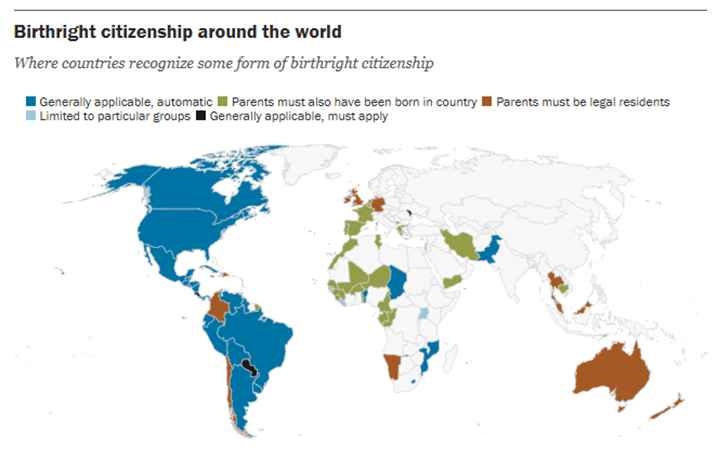
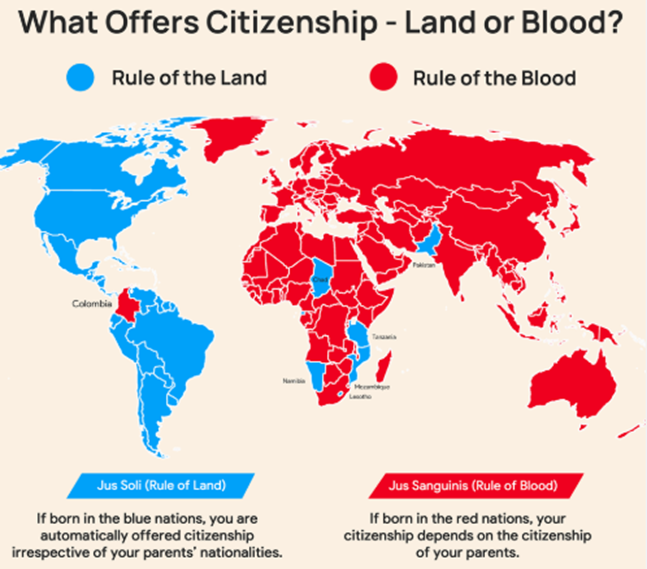
Here are two similar (but slightly different, based on interpretations of local limitations) maps of the world showing where countries recognize some form of "birthright citizenship":
The infographic maps above just give you an approximate visual, but in both cases are up to date as of 2026. Specifically, the first one from the Pew Research Center is based on a dataset of national citizenship laws compiled by the Global Citizenship Observatory, a research project at the European University Institute’s Robert Schuman Centre for Advanced Studies. I have linked that below so you can look up any nation in the world to see their rules for citizenship. Overall, though, countries generally fit into 1 of 3 categories:
33 countries (including the U.S.) automatically offer citizenship no matter where parents come from
26 countries offer citizenship IF parents meet criteria (legal residents, belong to specific groups, etc..)
156 countries offer citizenship only if one or both parents are citizens.
#2 - Legal Precedent in the United States
This is going to be a very short summary of the legal precedents leading up to today's Trump v. Barbara Supreme Court hearing. I will probably get into more details about each side's interpretations of those precedents later in this session (in the arguments in favor) and again tomorrow (for the arguments against):
Before the adoption of the Fourteenth Amendment, the antebellum United States generally embraced the common-law doctrine of citizenship by birth within the country. Justice Joseph Story described the rule in Inglis v. Trustees of Sailor's Snug Harbor:
"The rule commonly laid down in the books is, that every person who is born within the ligeance of a sovereign is a subject; and, e converso, that every person born without such allegiance is an alien. . . . Two things usually concur to create citizenship; first, birth locally within the dominions of the sovereign; and secondly, birth within the protection and obedience, or in other words, within the ligeance of the sovereign."
The exceptions to this primarily impacted two groups. First, the rule applied only to the people born of "free persons," thus excluding the children of slaves. That had been clearly spelled out by the Supreme Court as part of the Dred Scott v. Sanford (1857) decision, where the court had declared that African Americans were not and could not become citizens of the United States. The rule also excluded the children of Native Americans living in tribes, on the reasoning that they were born under the dominion of their tribes, and not within the purview of the law of the United States.
The Fourteenth Amendment to the U.S. Constitution, adopted in Jul 1868 (in the wake of the Civil War), included the following passage:
"All persons born or naturalized in the United States, and subject to the jurisdiction thereof, are citizens of the United States and of the State wherein they reside."
There are extensive arguments about the "original intent" of Congressmen writing the 14th Amendment - some historians believe it was intended to simply address the former slaves (the original version, for example, still included Native Americans as non-citizens because they are not subject to the jurisdiction of the United States) while others believe it covered everyone except clear exceptions (like children of ambassadors).
Ultimately a subsequent Supreme Court case (and a later law of Congress) were needed to clarify the precedent. In United States v. Wong Kim Ark (1898), the Supreme Court held that, under the Fourteenth Amendment to the U.S. Constitution, any child born in the United States is a US citizen from birth, with the sole exception of children born to a parent or parents with diplomatic immunity, since such parent is not a "subject to the US law". The court thus ruled that Wong's U.S. citizenship had been acquired by birth and had not been lost or taken away by anything happening since his birth. That has been the standing precedent for the subsequent 128 years. Finally, all non-citizen Native Americans (members of tribes not paying taxes to the U.S.) were made U.S. Citizens under the Indian Citizenship Act of 1924.
Part I - Arguments Why Birthright Citizenship Should Remain In Place:
I'm going to focus on the 5 most common arguments in favor of leaving birthright citizenship as it now stands (or in a couple of cases, arguments why President Trump does not have standing or authority to change a precedent of the Supreme Court). I know each of these are topics that could easily be expanded - my goal is to give you a quick overview and/or data backing it up, then links to explore more for yourself:
Argument #1 - A ruling of the Supreme Court is the law of the land until (or unless) a later ruling overturns it. Nothing has changed to make the valid precedent - United States v. Wong Kim Ark (1898) - not the law of the land, and therefore the executive branch has no right to use an executive order to change that precedent.
A president’s authority to issue an executive order typically comes, either explicitly or implicitly, from a congressional statute, but on occasion presidents have justified orders on the basis of their constitutional power to execute the nation’s laws. Whether the Constitution empowers the president only to execute policies devised by Congress or additionally vests the president with substantive policymaking powers has long been a matter of dispute. As a result, orders based on inherent presidential powers not authorized by Congress are more likely to raise separation-of-powers concerns. In these cases, courts must determine whether the president has exercised legislative power belonging only to Congress.
Courts may strike down executive orders not only on the grounds that the president lacked authority to issue them but also in cases where the order is found to be unconstitutional in substance. In some cases, it is not an executive order itself that is challenged in court, but instead a regulation promulgated pursuant to an order or the manner in which executive branch officials have interpreted an order. While many executive orders have been challenged on specific statutory and constitutional grounds, others have been subjected to “reasonableness review.” This legal concept permits courts to review both statutes and executive actions limiting the rights to life, liberty, or property to ensure that they are reasonable.
Argument #2 - Lack of confusion about the text of the 14th Amendment: For almost 160 years, there has been a clear common understanding of the meaning of the citizenship clause of the 14th Amendment, and agreement on its' implementation on a bipartisan basis.
The core textual question is the meaning of “subject to the jurisdiction.” Specifically, the question is whether US-born children of lawful temporary visitors and persons not lawfully present are “subject to the jurisdiction” of the United States. There is no sense in which lawful permanent residents are subject to US jurisdiction but temporary visitors or persons lacking lawful status are not. Therefore, the clause’s text, history, and subsequent application show that U.S.-born children are "subject to the jurisdiction".
The Citizenship Clause is explicitly about the place of birth rather than (as was traditional in other societies) the parentage of birth. Indeed, the Clause’s very words will sometimes operate to distinguish sharply parent from child: A mother unlawfully present may be removed from the country or otherwise punished even though her newborn enjoys the benefits of citizenship.
Argument #3 - Social and Civic Integration: Birthright citizenship guarantees that children born in the country are fully integrated, preventing them from being born into a foreign citizenship status simply due to their parents' status. This prevents the creation of a permanent "caste" of disenfranchised individuals who are effectively strangers in their place of birth.
The idea that the U.S.-born children, grandchildren, great-grandchildren, etc. of people born in the United States would themselves inherit their forefathers’ lack of legal status would have deep implications for social cohesion and the strength of the democracy itself. It would be contrary to the American sense of fair play that has rejected visiting the sins of the parents on the children, thereby perpetuating the kind of hereditary disadvantage as practiced in many countries in Europe.
Without birthright citizenship, the parents of every baby born in the U.S. would need to establish their citizenship status to have access to common medical support. It would mean a break in the continuity of care that currently exists, according to an amicus brief in the case. "If you say, 'Well, we don't know if the baby is a citizen,' it is highly questionable whether babies will then have Medicaid, SNAP, WIC [food benefits], any access to these critical programs at the most vulnerable time in any of our lives."
Argument #4 - Improper Process to Override a Constitutional Amendment: If the proponents of jus sanguinus citizenship believe the legal process established by the 14th Amendment is incorrect, they should follow the process established by the Constitution - gain the approval of 38 of the 50 states for a new amendment repealing (or replacing) the old one, rather than attempting to use executive fiat to override the Constitution.
According to the ACLU, the president cannot repeal part of the Constitution by executive order. And Congress cannot repeal it by simply passing a new bill. Amending the Constitution would require a two-thirds vote in both the House and Senate, and also ratification by three-quarters of the states. The effort to erase the citizenship guarantee will never clear those hurdles — for very good reasons.
The Supreme Court has the power to end birthright citizenship by overruling its longstanding interpretation of the 14th Amendment, although it seems unlikely that it would do so.
Argument #5 - Ethical and Democratic Values: Birthright citizenship is seen as aligning with democratic ideals, recognizing that a child's legal status should not be defined by the actions or status of their parents.
Birthright citizenship promotes a shared sense of belonging. When people are recognized as full members of society, they are more likely to invest in their communities, pursue education and careers, and participate in civic life. This inclusion strengthens democracy and brings communities together. Creating a permanent subclass of people who grow up in the U.S. but are denied full membership undermines national unity and weakens the social fabric.
Attacks on marginalized communities threaten the entire 14th Amendment, including the Equal Protection and Due Process Clauses that underpin victories against segregation, discrimination, voter suppression, and unchecked government power. If the government can redefine citizenship, unequal treatment under the law becomes easier to justify. Civil rights become conditional. Equal protection becomes negotiable. State power expands while accountability shrinks.
Links for Part I - Arguments Why Birthright Citizenship Should Remain In Place
I'm not going to get into classroom resources until Part III - these are just links to back up where the information came from for the arguments listed above. This is just a starting point - I would say 95% of the articles I read the past 2-3 days advocated for this side of the argument - so there is plenty more where these came from. The documentation for the other side of this argument (and particularly data not provided by the current executive branch) will be a little more of a research challenge - but that also means (hopefully) I will have done the work for you.
Sources for the Graphics Above:
"Country Profiles from the Global Citizenship Observatory" (allowing specific country searches of citizenship laws/regulations), The European University Institute’s Robert Schuman Centre for Advanced Studies, Mar 2026, https://globalcit.eu/country-profiles/
"U.S.-style birthright citizenship is uncommon around the world", Pew Research Center, Mar 2026, https://www.pewresearch.org/short-reads/2026/03/31/us-style-birthright-citizenship-is-uncommon-around-the-world/
"Which countries, other than the US, offer birthright citizenship?", Al-Jazeera, Feb 2025, https://www.aljazeera.com/news/2025/2/6/which-countries-other-than-the-us-offer-birthright-citizenship
Sources for the Arguments and Legal Precedents Above:
"Babies are an afterthought in the birthright citizenship case, advocates say", National Public Radio's Morning Edition, Mar 2026, https://www.npr.org/2026/03/31/nx-s1-5761354/birthright-citizenship-child-health-medicaid-social-security
"Citizenship Clause", Wikipedia, Apr 2026, https://en.wikipedia.org/wiki/Citizenship_Clause
"A history of birthright citizenship at the Supreme Court", SCOTUS Blog, Feb 2025, https://www.scotusblog.com/2025/02/a-history-of-birthright-citizenship-at-the-supreme-court/
"Judicial Review of Executive Orders", Federal Judicial Center, 2024, https://www.fjc.gov/history/administration/judicial-review-executive-orders
"No, Mr. President. You Can’t Change the Constitution by Executive Order", American Civil Liberties Union (ACLU), Oct 2018, https://www.aclu.org/news/immigrants-rights/no-mr-president-you-cant-change-constitution-executive-order
"The Originalist Basis of Birthright Citizenship", Law and Liberty, Feb 2025, https://lawliberty.org/the-originalist-basis-of-birthright-citizenship/
"Repealing Birthright Citizenship: The Unintended Consequences", Migration Policy Institute, Aug 2015, https://www.migrationpolicy.org/news/repealing-birthright-citizenship-unintended-consequences
ECON and More
Curating articles for K-12 education.
CONTACT
© 2025. All rights reserved.