
A 3-part set of posts on the Minimum Wage - PART II - Economic Reasons NOT to Increase It
I've been wanting to get to this topic since the start of the year (with several cities increasing their local minimum wages) but already had a lot of stuff scheduled and wanted to do three days in a row on the topic to be fair to it (rather than start and then not finish the "rest of the story"). NOTE my emphasis on "economic" - I don't want this to become either a politicized opinion piece or an empathy battle on "why don't you care?".
Jay LeBlanc
2/5/20269 min read
So here is my plan for the 3 days of posts:
Part I - economic reasons why it is good to increase the minimum wage;
Part II, economic reasons why it is a bad idea to increase the minimum wage; and
Part III, classroom resources and lessons related to the topic.
Again, my intention is not to get into the politics of minimum wage arguments (though I'm sure I will repeat or link some of their points today and tomorrow). We have LOTS of things that government provides . . . and we have LOTS of debt trying to figure out how to pay for those things. So part of our job as social studies teachers is to help students understand the facts and the arguments of both sides, and then make their own decision. And part of MY job is also to make sure you have some ideas of how to do that . . .
First, Are We All Talking About the Same Thing?
This time I'm going to focus on three different graphics (the middle one is a pair showing the same data):
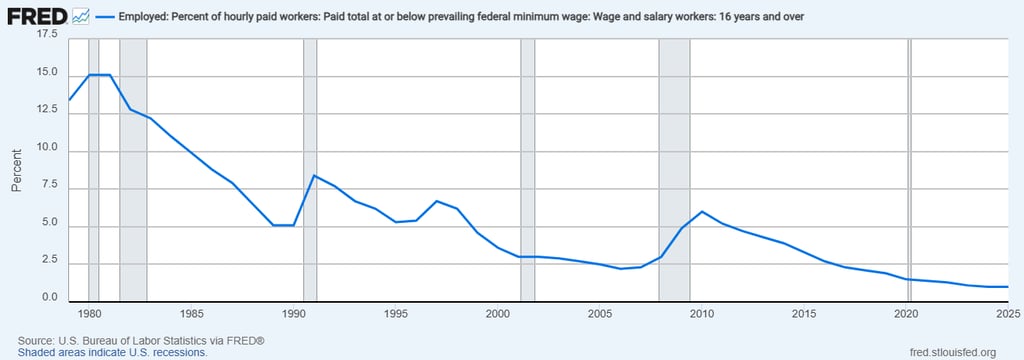
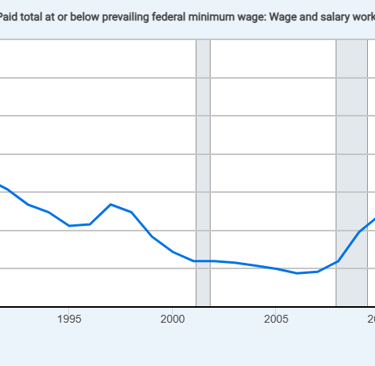
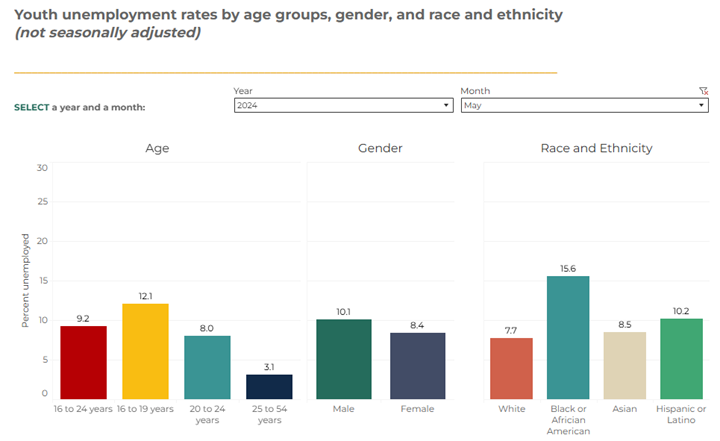
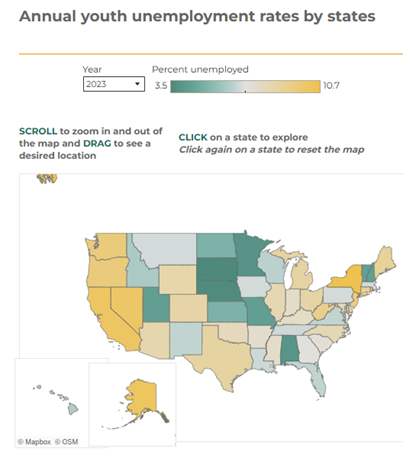
The FRED graph at the top shows the percentage of workers in the U.S. over the past 25 years who are being paid at (or below) the federal minimum wage level of $7.25/hour - two generations ago that was 15% of the workforce, but today it is 1% of workers. The pair in the middle shows data for an argument to be made below - in increasing the minimum wage for the benefit of one group of workers, a different group (age 16-24) is increasingly being priced out of the market and not given opportunities to gain resume experience (even if they would be willing to work for less than the minimum wage in their state or locality). The left shows the "big picture", while the right shows the correlation between states with significantly higher minimum wage levels and the level of teen unemployment in those same states.
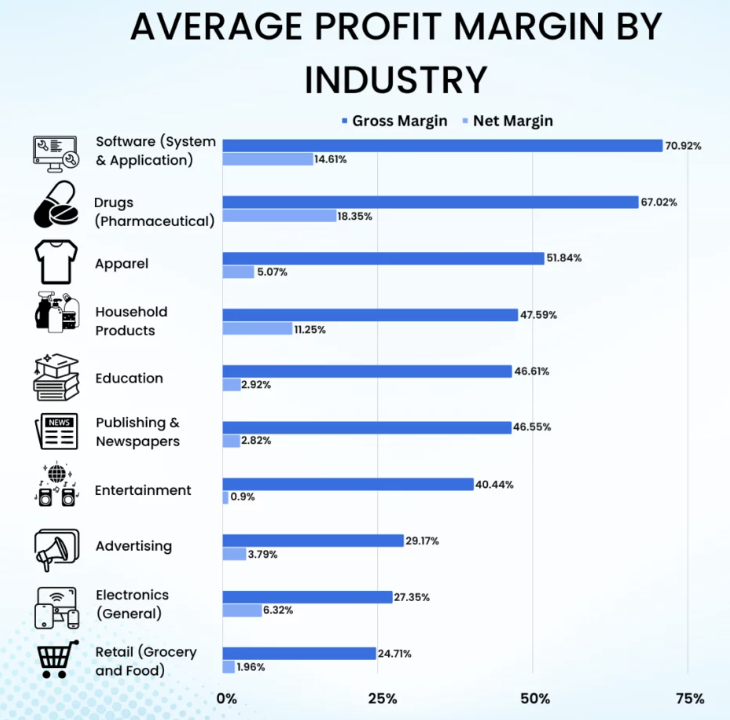
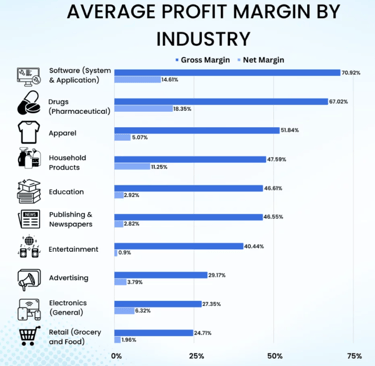
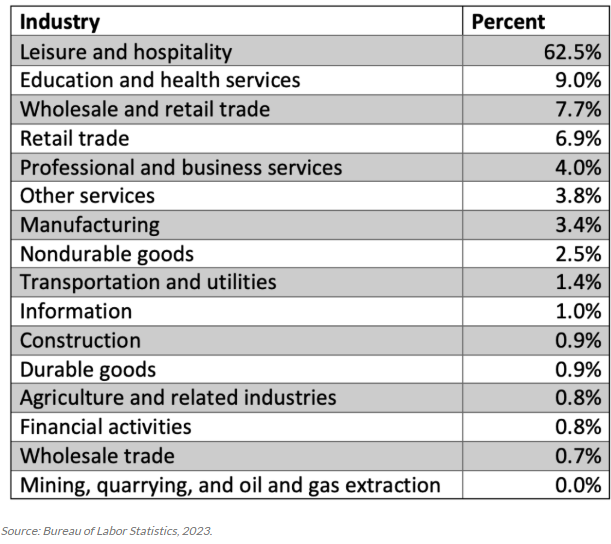
Finally, the bottom left graph shows both the gross profit margin (dark blue) AND net profit margin (light blue) in a selection of U.S. industries. In yesterday's post the advocates of minimum wage increases typically responded to concerns about business owners by saying "They can afford it - they will just take it out of their huge profits" or something similar. Opponents below will respond by noting that few conglomerates on the S&P 500 are paying anything close to $7.25/hr - the companies paying those kind of wages are the same ones (restaurants, small retail, entertainment) with very small net profit margins above. On the right is a chart from the Bureau of Labor Statistics listing exactly what industries had minimum wage workers (as of 2023).
So a lot of what we are looking at in today's post (reversing yesterday's argument) is - why have 40% of states have chosen to keep their minimum wage rate the same as the federal minimum, and how have the 60% of states who increased their minimum wage rate beyond the federal minimum done (good and bad)?
Part II - Economic Arguments Why We Should NOT Increase the Minimum Wage:
Like yesterday, I'm going to focus on the 5 most common economic arguments in opposition to increasing the minimum wage - in some cases they will be the exact opposite of arguments made in yesterday's post, while other arguments will be different economic issues or concerns brought up to keep the status quo. Also like yesterday I know each of these are topics that could easily be expanded - my goal is to give you an overview and/or data backing it up, then links to explore more for yourself:
Argument #1 - Job Loss and Reduced Employment: A higher wage floor can make it too costly for employers to maintain staff, leading to layoffs or hiring freezes. Higher wage requirements can also accelerate the adoption of technology and automation, replacing low-skilled workers with machines.
The Congressional Budget Office (referring to the Raise the Wage Act proposal of 2023) says raising the minimum wage would increase the cost of employing low-wage workers. As a result, some employers would employ fewer workers than they would have employed under a lower minimum wage. However, for certain workers or in some circumstances, employment could increase. Changes in employment would be seen in the number of jobless—not just unemployed—workers. Jobless workers include those who have dropped out of the labor force (because they believe no jobs are available for them) as well as unemployed workers (those who are searching for work).
The Federal Reserve Bank of St. Louis notes a firm will consider substituting capital for labor for a given task when the marginal cost of producing goods with capital is less expensive than the marginal cost of producing goods with labor. Increasing the minimum wage provides economic incentives for firms to adopt new technologies that replace workers: That is, a higher minimum wage raises the cost of labor and increases the range of tasks that are susceptible to displacement by automation—especially the tasks of minimum wage jobs, which tend to be labor intensive and composed of low-skill tasks. For example, consider the self-checkout lanes at grocery stores and digital kiosks at a fast-rood restaurant that substitute for employees, or the robot arms in an assembly line that complete simple tasks that human hands once did.
Argument #2 - Reduced Hours and Benefits: To mitigate higher payroll costs, employers may reduce employee work hours, cut benefits like health insurance, or decrease training opportunities.
The Harvard Business Review notes that a previous increase of just $1 caused the percentage of employees working more than 20 hours per week to decrease by 23%. (Working 20 hours per week is the threshold for employees to be eligible for retirement benefits.) Meanwhile, the percentage of workers with more than 30 hours per week—making them eligible for health care benefits—decreased by 14.9%. And total wage compensation decreased by 13.6%! Under these circumstances, it becomes more challenging to juggle multiple jobs to earn enough money to pay the bills.
AIER says employers often adjust their workforce strategy by hiring fewer employees and increasing the workload of those who remain. This means existing workers may face greater job demands, longer shifts, and increased pressure to be more productive. While some employees may appreciate the extra hours, others may experience burnout, stress, and reduced job satisfaction. Additionally, businesses may shift toward employing fewer full-time workers and instead rely on part-time or temporary staff to reduce costs. This can make it more difficult for employees to secure stable, long-term employment with non-wage benefits such as health insurance and retirement contributions.
Argument #3 - Disproportionate Impact on Vulnerable Workers: As a subgroup of the population impacted by job loss or reduction of hours, minimum wage hikes can more severely hurt young workers and minorities by reducing entry-level positions that provide necessary initial job experience.
In a report published by the National Bureau of Economic Research, economists who examined every study on the minimum wage in the U.S. over the past three decades concluded that there was a “clear preponderance” of employment losses as the minimum wage rose, with teens, young adults, and less-educated workers experiencing the greatest losses. In other words, increases in the minimum wage often hurt the very people they’re meant to help.
The Wall Street Journal in Aug 2025 noted that most economic research shows high minimum wages increase teen unemployment, though there are no doubt other contributors. In a tight labor market, wage mandates may have less of an effect on hiring. But when the economy cools and competition for labor weakens, higher minimums make it more costly to hire teens. The upshot is that teens lose chances to learn critical life skills, such as showing up on time, following orders and juggling tasks.
Argument #4 - Increased Consumer Prices (Inflation): Businesses, particularly small businesses, may pass the increased labor costs on to consumers through higher prices for goods and services. In states with automated minimum wage increases based on CPI, this can lead to a vicious cycle of even higher inflation as wages try to catch expenses.
A survey of labor economists found that a majority believe minimum wage hikes actually worsen the cost of living. Research shows that higher minimum wage hikes have historically contributed to rising prices faced by consumers. One survey of decades of economic studies finds that every $1 wage hike could cause as much as a 4.5% increase in prices.
Lending Tree advises business owners that they can pass on increased labor costs to the consumer by raising prices. Be careful, though — raise prices too high and too quickly, and you risk turning away customers. If this happens, increased labor costs plus lost customers can further strain a business’s bottom line. It may be helpful to observe your competitors — if prices are increasing across the board within your industry, customers may be more open to higher prices. They also suggest that hiring independent contractors on an as-needed basis can be more cost-effective than paying a regular employee’s salary plus benefits.
Argument #5 - Impact on Small Businesses and Low-Margin Sectors: Industries like retail, food service, and hospitality operate on thin margins, making them vulnerable to mandated wage increases, which may lead to reduced hours, lower profits, or business closures.
A recent report by Axios Denver described the state of Colorado’s restaurant scene as “death by a thousand cuts” – saying the state’s restaurant industry had been “battered” by operating cost increases. As a result, over 200 restaurants closed statewide – and 82% of closures were in Denver itself. In fact, the Denver Post found the city has lost nearly a quarter of all of its restaurants in the last three years. As a result, this has taken a toll on jobs in Colorado restaurants. A look at recent data reveals that annual wage hikes that go into effect in January of each year are having worse and worse impacts on seasonal fluctuations. Denver's minimum wage once again rose last month to $19.29/hour.
A working paper from the Harvard Business School found that the impact of the minimum wage depends on whether a restaurant is already close to the margin of exit. Restaurants with lower ratings are disproportionately driven out of business by increases to the minimum wage. Our estimates suggest that a one dollar increase in the minimum wage leads to a 14 percent increase in the likelihood of exit for a 3.5-star restaurant (which is the median rating on Yelp) but little or no impact on 5-star restaurants.
Links for Part II - Why NOT Increase the Minimum Wage?
I'm not going to get into classroom resources until Part III - this is just links to back up where the information came from for the arguments listed above. Two related things I will mention based on the research I did to write this post: 1) You will note that a lot of the articles below are much more recent - to be fair, they are building much of their "evidence" off of results of minimum wage increases during the past 10 years. But as I said yesterday, surprised the other side isn't apparently doing the same (instead of appealing to empathetic arguments to make their case). And 2) I will use some additional graphics in Part III that (I think) go with both sets of arguments - for example, information on how the CPI data is gathered that both sides use for their own purposes. I also had a couple of articles that I didn't use here because I knew I would include them in the classroom resources in Part III as well. And finally, I could not share links to a couple of the reports listed above - most of the Harvard Business School content, for example, is behind a paywall (but accessible to me to review through a local university).
Sources for the Graphics Above:
"Average Profit Margin", Vibetrace, Jan 2023, https://vibetrace.com/average-profit-margin/
"Employed: Percent of Hourly Paid Workers: Paid total at or below prevailing federal minimum wage: Wage and salary workers: 16 years and over", U.S. Bureau of Labor Statistics via FRED (from the Federal Reserve Bank of St. Louis, Feb 2026
"Characteristics of minimum wage workers, 2023" (a BLS Report), Bureau of Labor Statistics, May 2024, https://www.bls.gov/opub/reports/minimum-wage/2023/
"Youth Unemployment Tracker", Mathematica, 2024, https://www.mathematica.org/dataviz/youth-unemployment-tracker
Sources for the Arguments Above:
"Automation and the Minimum Wage", Federal Reserve Bank of St. Louis, Nov 2021, https://www.stlouisfed.org/publications/page-one-economics/2021/11/01/automation-and-the-minimum-wage
"The Economics of the Minimum Wage: Myths, Facts, and Consequences", American Institute of Economic Research (AIER), Apr 2025, https://aier.org/article/the-economics-of-the-minimum-wage-myths-facts-and-consequences/
"Increasing the Minimum Wage Comes at Too High a Price for Workers", Thomas A Roe Institute for Economic Policy Studies, Jul 2024, https://www.heritage.org/jobs-and-labor/commentary/increasing-the-minimum-wage-comes-too-high-price-workers
"The Minimum Wage Makes the Affordability Crisis Worse", Wall Street Journal, Dec 2025, https://www.wsj.com/opinion/the-minimum-wage-makes-the-affordability-crisis-worse-6c92dad2
"Myth or Measurement: What Does the New Minimum Wage Research Say About Minimum Wages and Job Loss in the United States?", National Bureau of Economic Research (NBER), revised Mar 2022, https://www.nber.org/system/files/working_papers/w28388/w28388.pdf
"The Pros and Cons of Raising the Minimum Wage", Lending Tree, Feb 2025, https://www.lendingtree.com/business/minimum-wage-increase-effects/
"Raising the Minimum Wage: Winners and Losers", When Free to Choose by Northwood University, Sep 2024, https://www.northwood.edu/news/raising-the-minimum-wage-winners-and-losers/
"Rising Labor Costs Put Pressure on Small Businesses", Ascentium Capital, Jun 2022, https://ascentiumcapital.com/blog/rising-labor-costs-puts-pressure-on-small-businesses
"The Wages of Teen Unemployment: Teen jobless rates are higher in states with higher minimum wages", Wall Street Journal, Aug 2025, https://www.wsj.com/opinion/teen-unemployment-minimum-wage-states-8b32de44?st=A71HG7
"What Is the Minimum Wage?", Minimum Wage Facts and Analysis, Jan 2026, https://minimumwage.com/what-is-the-minimum-wage/