A 3-part set of posts on the Minimum Wage - PART III - Connections to the Classroom (and a few takeaways from me)
I've been wanting to get to this topic since the start of the year (with several cities increasing their local minimum wages) but already had a lot of stuff scheduled and wanted to do three days in a row on the topic to be fair to it (rather than start and then not finish the "rest of the story"). NOTE my emphasis on "economic" - I don't want this to become either a politicized opinion piece or an empathy battle on "why don't you care?".
Jay LeBlanc
2/6/20268 min read
So here is my plan for the 3 days of posts:
Part I - economic reasons why it is good to increase the minimum wage;
Part II, economic reasons why it is a bad idea to increase the minimum wage; and
Part III, classroom resources and lessons related to the topic.
Again, my intention is not to get into the politics of minimum wage arguments (though I'm sure I will repeat or link some of their points today and tomorrow). We have LOTS of things that government provides . . . and we have LOTS of debt trying to figure out how to pay for those things. So part of our job as social studies teachers is to help students understand the facts and the arguments of both sides, and then make their own decision. And part of MY job is also to make sure you have some ideas of how to do that . . .
First, Are We All Talking About the Same Thing?
For Part III, a couple of interesting infographics I came across that didn't fit into "FOR" or "AGAINST":
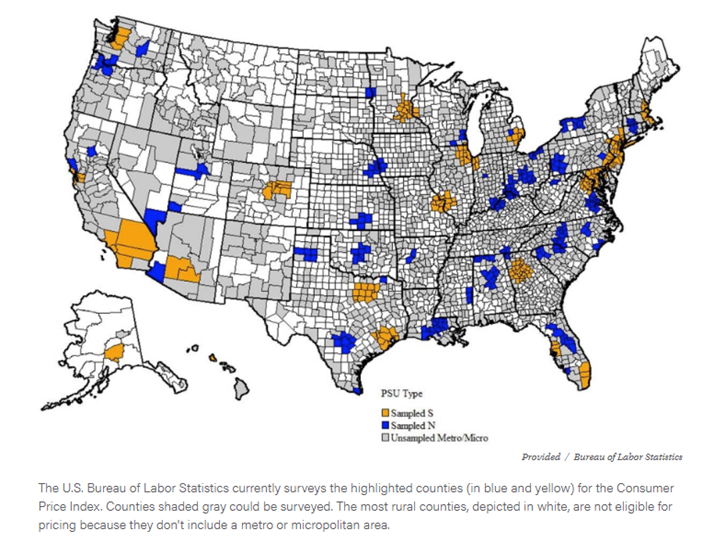
So depending on which side of the argument you are on, you could argue that the CPI (our main way of calculating consumer inflation and tying it back to automatic minimum wage hikes) is doing a good job of measuring inflation in the big cities and states that are setting higher wage rates, OR you could argue that huge sections of the country outside of the large urban areas (many of them in states using the $7.25/hr federal rate) are not having their cost of living measured very well.
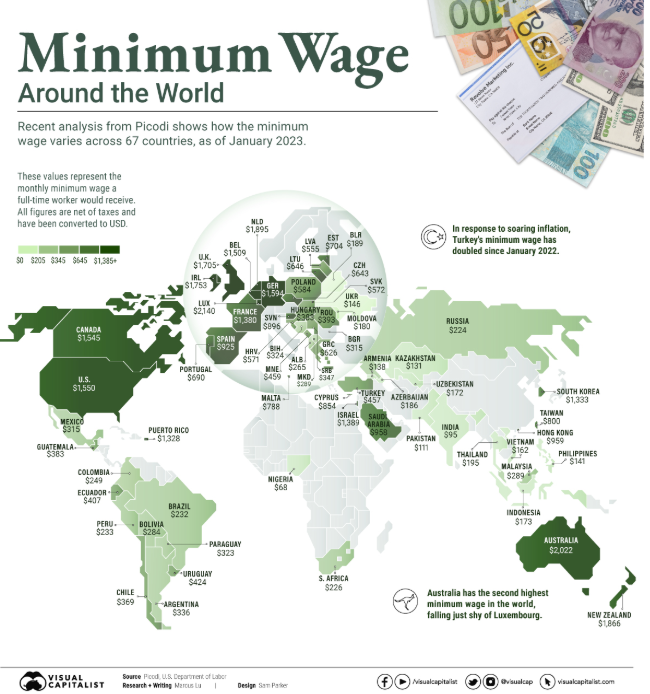
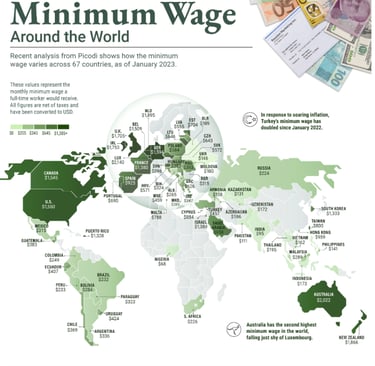
This map gives you an interesting comparison with the countries of the world who have a minimum wage in place (note some of the countries that do not - China, most of Africa, and all the Scandinavian countries). In this case, the story that goes with this infographic notes that the figure for the United States is determined per capita averaging the states with the federal minimum and the states who have set higher minimums, then converting it to a monthly figure. Maybe more importantly for comparison purposes, it is a NET figure after taxes are taken out (to equalize the figures with European countries that have high minimum wages and also have high taxes to pay).
Part III - Connections to the Classroom:
I'm going to feature a few lessons and informative articles on minimum wage topics, then provide my usual set of links at the bottom. If you were hoping I would have a "this side is right, this side is wrong" segment - nope! But I will mention near the end some of the trade-offs built into each side, and unintended consequences you might want to point out to your students in any kind of classroom discussion or debate.
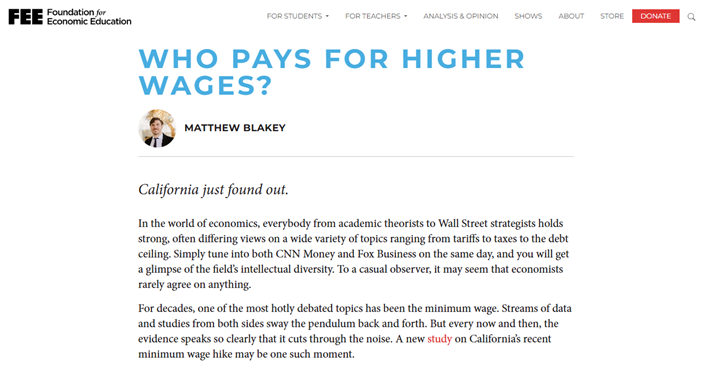
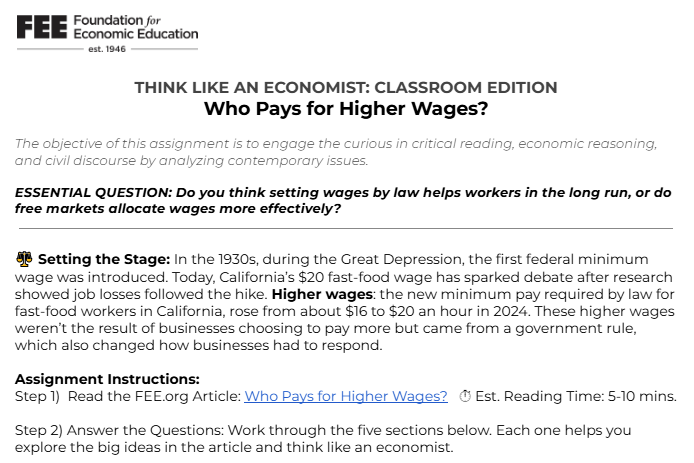
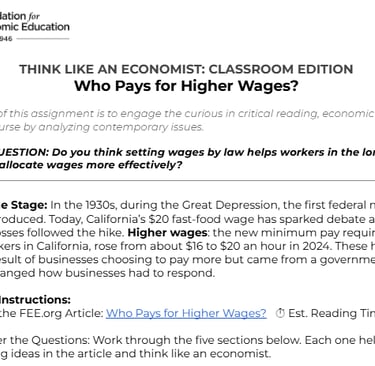
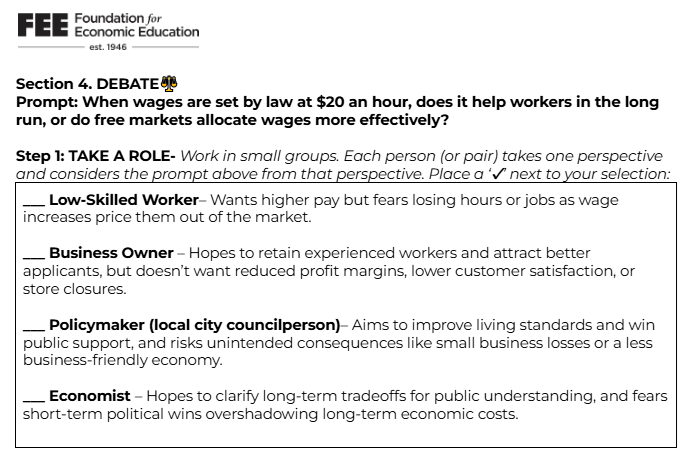
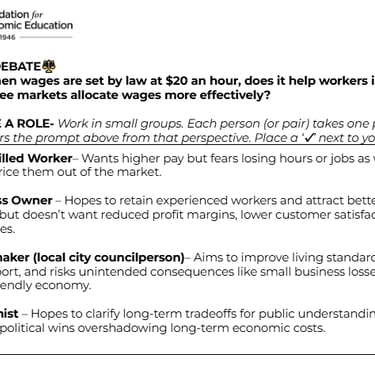
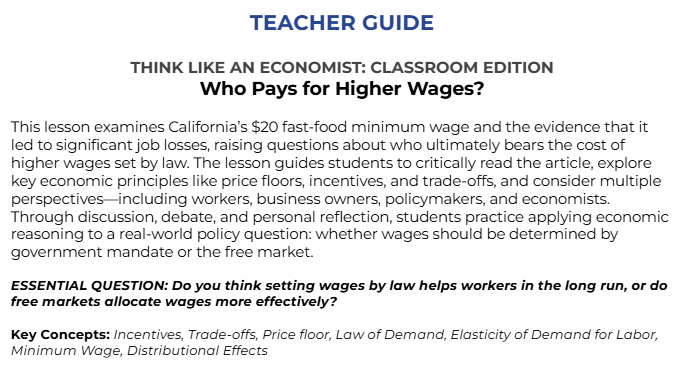
Lesson Plan - Foundation for Economic Education (FEE), "Think Like An Economist: Who Pays for Higher Wages?"
This is a FEE lesson plan with activities, based on an article originally written by one of their economists. While the article is interesting and timely on its' own (based on California's raising of their minimum wage for fast food chains), the activities and checks for understanding in the resources are the real prize here, making it much easier to use with a classroom of high school students (again, you need a free teacher account to access). I have included several screenshots to give you a sampling of the material, but there are 13 pages of resources in the lesson.
Video from an AP Curriculum - Marginal Revolution University, "Price Floors: The Minimum Wage"
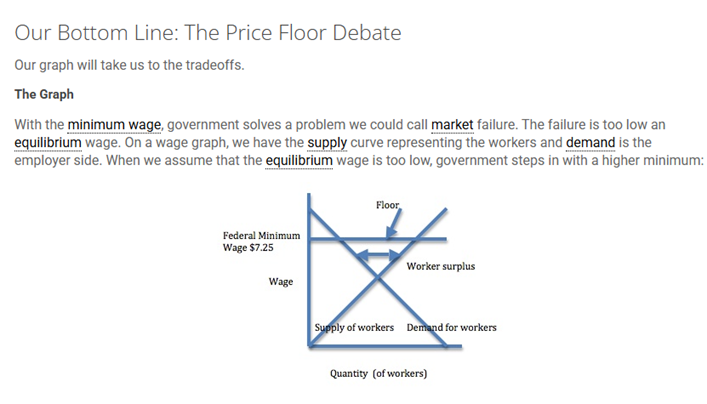
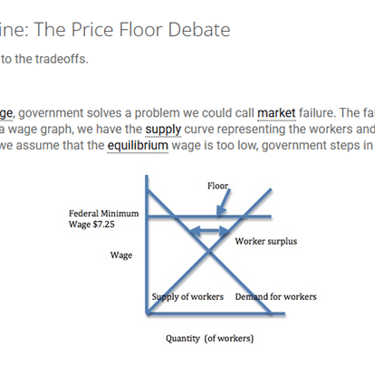
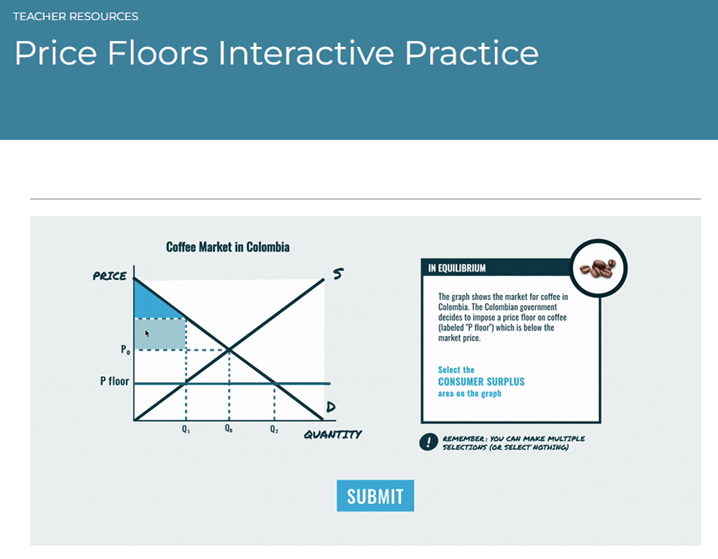
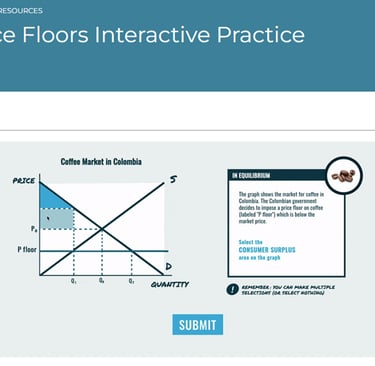
This one is definitely at a higher difficulty level, but two things about that. One, the video does a good job of explaining the supply and demand graph movements, and WHY minimum wage increases have unintended consequences - not necessarily bad, but choices that society should be aware of. MRU does have some limited support resources for the video, but primarily would point teachers toward their curriculum on price floors and their interactive activity (which I am also including a screenshot of here).
Lesson Plan with Resources - Izzit.com, "Raise the Wage"
This is an older lesson that has been updated (and upgraded) with new resources to support the video and activities. It includes PowerPoint slides, a couple of activities, and various checks for understanding. Worth a reminder - like many of these types of providers, Izzit does require a free registration to confirm you are a teacher (and not just a student looking for the answer key!). But first and foremost (like most Izzit materials) it starts with a video:
Two blog articles from economists on Minimum Wage - Monday Morning Economist, "The guac isn't the only thing that costs extra" AND Econlife.com, "The Surprising Cost of a Minimum Wage Hike"
These are simply links to two good articles from professional economists (both of whom write their blogs toward an audience of educators and students) on implications of minimum wage increases. The Monday Morning Economist article is a little older (2021) but relates to fast food prices (which I think students could easily relate to), while the Econlife article is brand new from last week.

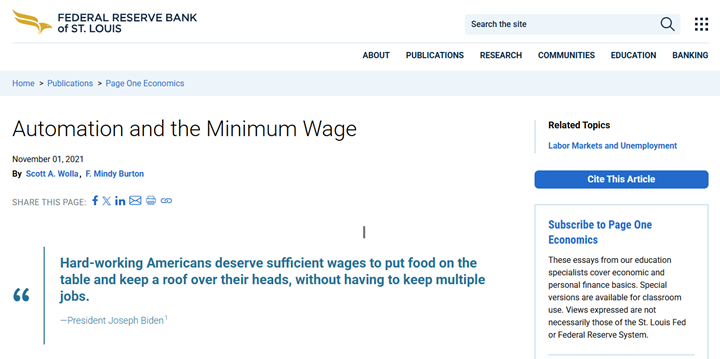
Reading - Federal Reserve Bank of St. Louis, "Page One Economics: Automation and the Minimum Wage"
Starting with this article mostly because Scott Wolla's information on automation was one of the references I used in Part II of these posts. As with most of the Page One Economics series, this article is pointed specifically at a high school audience - several of the references probably would fit better in an AP class than regular economics. But it does a great job of explaining one of the trade-offs with higher minimum wages - the risk that workers can be replaced not with other workers, but with no worker at all.
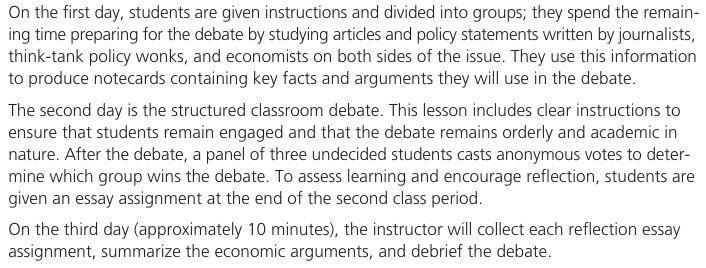
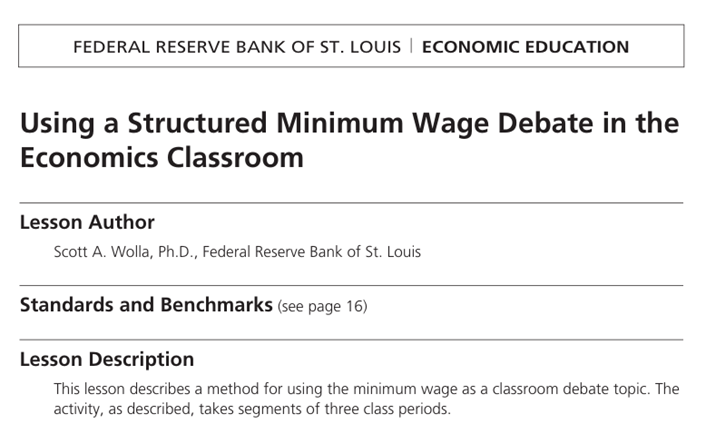
Lesson Plan - Federal Reserve Bank of St. Louis, "Using a Structured Minimum Wage Debate in the Economics Classroom"
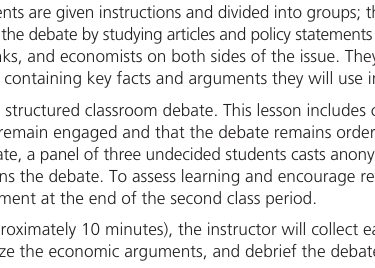
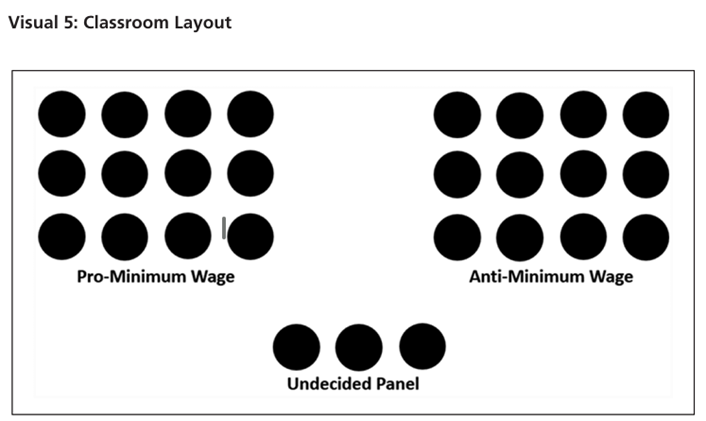
While I am on Scott Wolla resources at the St. Louis Fed, here is a lesson he wrote a few years ago about setting up a debate in an economics classroom on this topic. A little detailed, but if you want an interactive activity where the students are doing the work (rather than "sage on the stage") it is a good one to work with. Including a couple of screenshots, but this is definitely a traditional lesson plan without a lot of graphics (other than supply-demand charts).

Links for Part III - Why Increase the Minimum Wage?
I want to at least share a few insights that percolated through my brain while doing all this research:
First and probably most importantly - a minimum wage is hopefully something that only a small group of workers in the U.S. (1% based on BLS data) need to use. And many of those workers are impacted more by rules on tipping (like setting a lower hourly wage but getting to keep tips to bring the total above the minimum wage).
We have minimum wage laws historically for a reason, but now they primarily impact very specific industries and worker groups. So more attention needs to be paid to "unintended consequences" - when a state like California has 30%+ unemployment for teenagers, it seems to suggest that one group of workers is being picked as "winners" by government at the expense of someone else.
It has never made sense to me that many economists see no connection between wage increases and inflation rates. Most of the affordability issues Americans currently complain about - with the exception of housing - are in labor-intensive industries. Fast food; restaurants; medical services; day care - those are all industries that require a LOT of people (getting paid a higher wage) to get products to the consumer. And like the issue of tariffs, maybe some of the costs can be absorbed by the employer . . . but not all.
Finally a reminder - the U.S. is one of the very few countries in the world that allows states and cities to set their own HIGHER minimum wage rates (they can set one lower, but it then defaults to the national standard). In most countries, the national government sets a rule and everyone (for better or for worse) follows it. So we have a lot of room to experiment in the U.S. . . . as long as those states and cities are willing to accept the possible negative externalities of their choices. Cause it is really hard to go back to a lower minimum wage if an area later decides the costs outweigh the benefits.
Sources for the Graphics Above:
"The federal government isn't actually measuring how inflation is hurting rural America" (map of CPI sampling sites is within the article), KCUR (Kansas City affiliate of NPR), Mar 2023, https://www.kcur.org/2023-03-01/the-federal-government-isnt-actually-measuring-how-inflation-is-hurting-rural-america
"Mapped: Minimum Wage Around the World", Visual Capitalist, Mar 2023, https://www.visualcapitalist.com/minimum-wage-around-the-world/
Classroom Resources Listed Above (in the order presented):
"Page One Economics: Automation and the Minimum Wage" (article), Federal Reserve Bank of St. Louis, Nov 2021, https://www.stlouisfed.org/publications/page-one-economics/2021/11/01/automation-and-the-minimum-wage
"Using a Structured Minimum Wage Debate in the Economics Classroom" (lesson plan), Federal Reserve Bank of St. Louis, 2019, https://www.federalreserveeducation.org/teaching-resources/economics/markets/using-a-minimum-wage-debate-in-an-economics-class (full version) OR https://www.federalreserveeducation.org/resources/lessons/lesson--structured-minimum-wage-debate.pdf (just the lesson plan PDF)
"Raise the Wage" (video), IzzitEDU, 2016, https://www.youtube.com/watch?v=z8d1aHhfhrY
"Raise the Wage Lesson Resources", Izzit.com, 2025, https://www.izzit.org/lessons/lesson.php?lesson=raise_the_wage
"The guac isn't the only thing that costs extra" (blog article), Monday Morning Economist, Jun 2021, https://www.mondayeconomist.com/p/chipotle
"The Surprising Cost of a Minimum Wage Hike" (blog article), Econlife.com, Jan 2026, https://econlife.com/2026/01/minimum-wage-hikes/
"Who Pays for Higher Wages?" (article), Foundation for Economic Education, Aug 2025, https://fee.org/articles/who-pays-for-higher-wages/
"Think Like An Economist (Classroom Edition) - Who Pays for Higher Wages?" (lesson), FEE's Learning Center, Aug 2025, https://docs.google.com/document/d/1Ytva2qm7G5GXuYpQiC-Hy2tYQiC4_1rIdKcwzvnx038/edit?tab=t.0
"Price Floors: The Minimum Wage" (video w/resources), Marginal Revolution University, https://mru.org/courses/principles-economics-microeconomics/price-floor-example-minimum-wage (full version) OR https://www.youtube.com/watch?v=65kfAswiHLk (just the video)
"Price Floors Interactive Practice", Marginal Revolution University (MRU), https://mru.org/teacher-resources/active-learning/price-floors-interactive-practice
A Few Final Articles that Didn't "Fit" on One Side of the Debate or the Other:
"The Economic Divide Between Big and Small Companies Is Growing (Economic fortunes of low- and high-income Americans are diverging—same pattern happening with companies)", Wall Street Journal, Dec 2025, https://www.wsj.com/business/the-economic-divide-between-big-and-small-companies-is-growing-f3bcf222
"The Era of Big Raises for Low-Paid Workers Is Over", Wall Street Journal, Aug 2025, https://www.wsj.com/economy/jobs/low-wage-employees-pay-growth-cdf3cd36
"Mamdani and the Minimum Wage Law", Foundation for Economic Education, Nov 2025, https://fee.org/articles/mamdani-and-the-minimum-wage-law/
"Want to watch economists fight? Bring up the minimum wage", PBS Newshour, Jan 2025, https://www.pbs.org/newshour/politics/dont-know-anything-minimum-wage
"What Difference Does a Minimum Wage Make?", Federal Reserve Bank of Richmond, Oct 2021, https://www.richmondfed.org/publications/research/econ_focus/2021/q2-3/district_digest