
Countries of the World (Africa) - Sudan
Ninth country from Africa in my new geography series. As I mentioned in my last African posting, since I focused a lot on recent history with South Sudan, in this one I will focus a little more on ancient history (while still covering more recent developments since the split into two countries).
Section I - Basic Info on Sudan
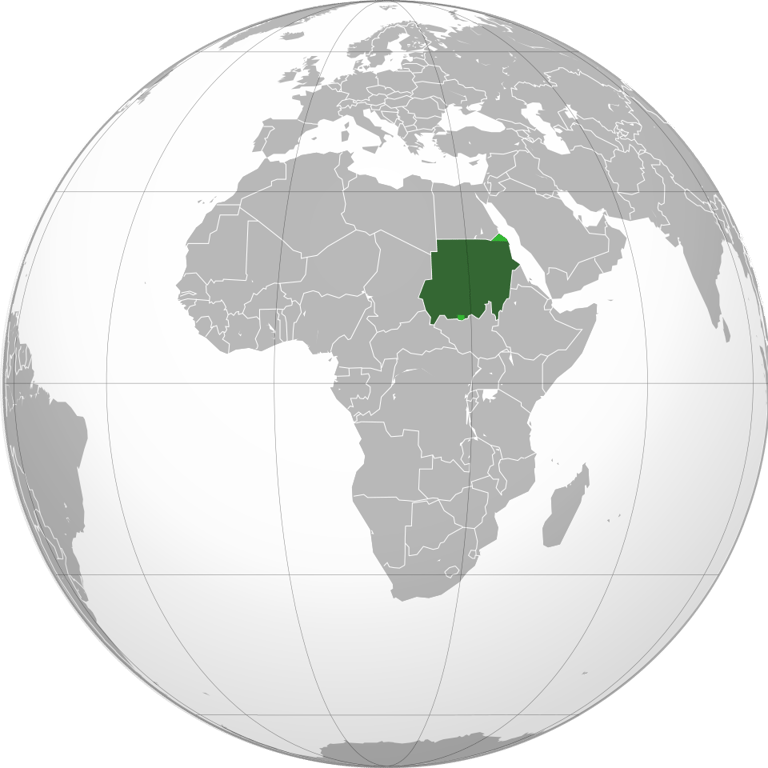
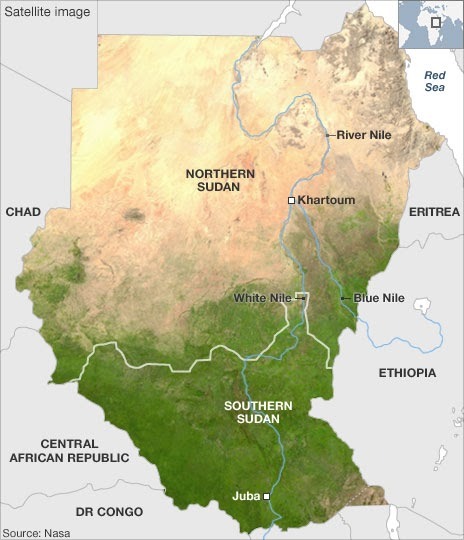
Official Name: Republic of the Sudan
Population: 51,767,437 (28th largest in the world, 8th largest in Africa)
Area/Size: 718,723 square miles (about the size of Alabama and Alaska combined)
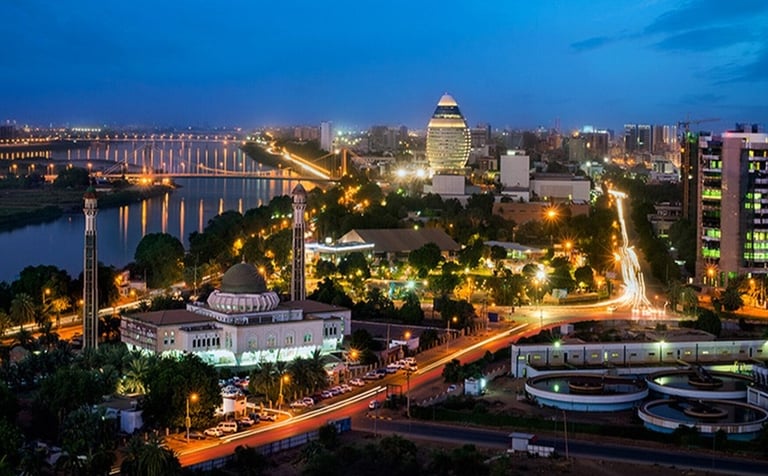
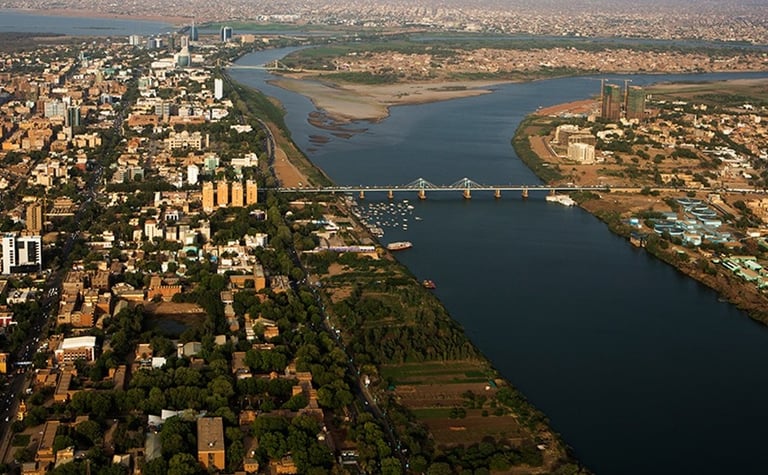
Capital: Khartoum (6.8 million - sister city of St. Petersburg, Russia)
Spoken Languages: Arabic and English (both official), Nubian, Ta Bedawie, Fur
Religions: Sunni Muslim (92%), Christian (4%), ethnic religions (3%)
Life Expectancy: 68.2 years Internet Access Rate: 26.4%
Per Capita Income: $2,127 Unemployment: 7.5%
What do they Export?: Crude oil, sheep and goats, sesame seeds, gold, ground nuts
Export Partners: UAE (21%), China (17%), Saudi Arabia (16%), Malaysia (9%)
Import Partners: China (21%), India (19%), Egypt (16%), UAE (14%), Saudi Arabia (7%)
Government Type: Presidential republic (military coups in 2019 and 2021 after 30 years of military dictatorship - no elections in past 40 years)
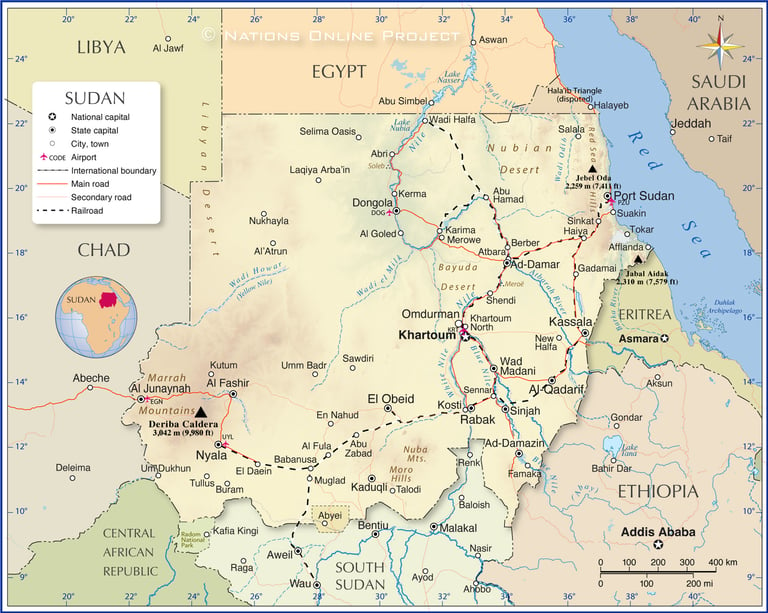
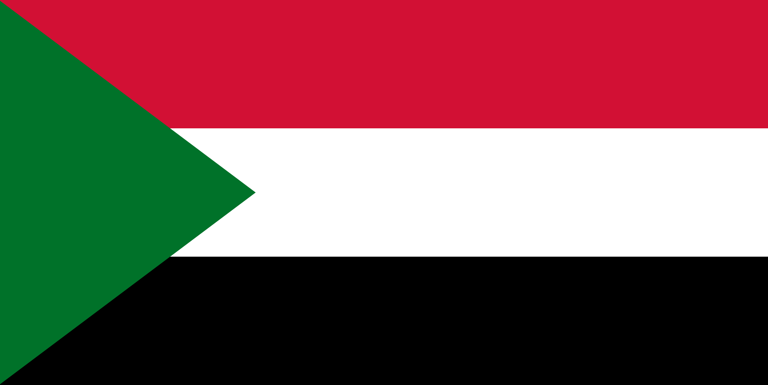
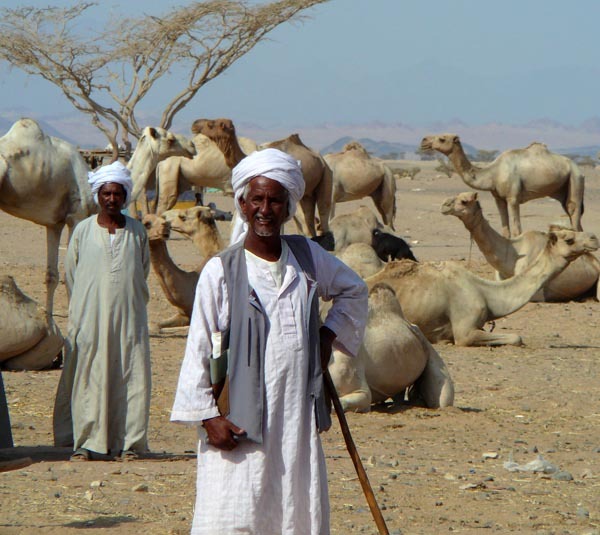
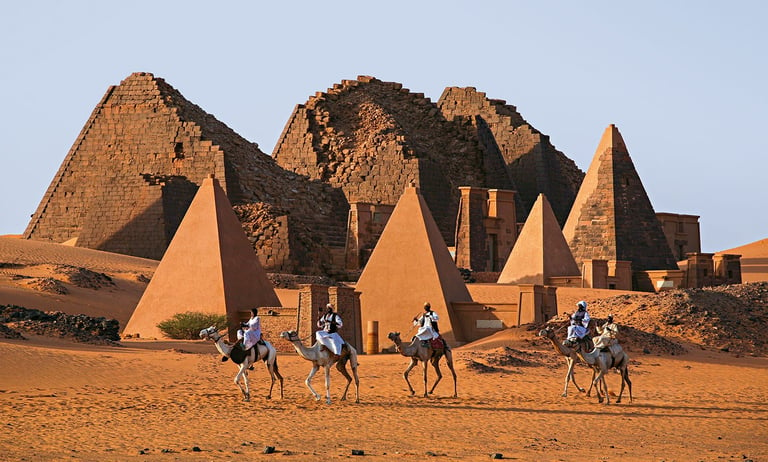
Section II - Images of Sudan
7 Key Dates/Periods in Sudan's History
As I mentioned above, I will primarily try to focus on ancient history in this segment and larger segments about the history of Sudan (as a single country) in the 19th and 20th centuries. For the last portions I will look at some of the issues of Sudan since the break, primarily focusing on Darfur and the civil war issues they still deal with today.
3000 BC - 650 BC - During the fifth millennium BC, migrations from the drying Sahara brought neolithic people into the Nile Valley along with agriculture. The population that resulted from this cultural and genetic mixing developed a social hierarchy over the next centuries which became the Kerma culture, flourishing from around 2500 BC to 1500 BC in "Upper Nubia" (parts of present-day northern and central Sudan). In its last 200 years they became a sizable, populous empire rivaling Egypt, until the Egyptian King Thutmose I destroyed Kerma and annexed Nubia into the New Kingdom of Egypt. After the conquest, Kerma culture was increasingly Egyptianized, yet rebellions continued for 220 years. Following Egypt's disintegration amid the Late Bronze Age collapse, the Kushites reestablished a kingdom through much of modern-day Sudan and in the 8th century BC, King Kashta ("the Kushite") peacefully became king of Upper Egypt. His successor Piye then invaded Lower Egypt, establishing the Kushite-ruled Twenty-fifth Dynasty which ruled Egypt for over a century until the Assyrian conquest in the mid-7th century BC.
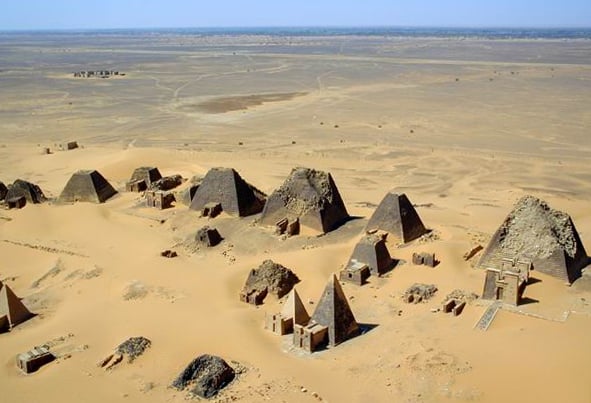
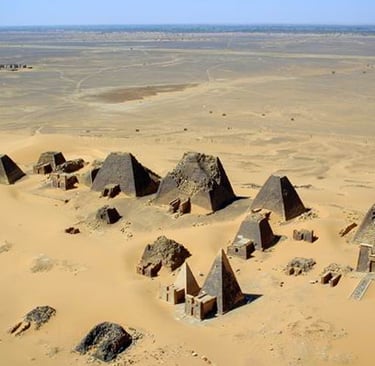
650 BC - 350 AD - After the defeat by the Assyrians, it appears the Kush leaders chose to move further south and center their kingdom around the ancient city of Meroë, approximately 200 km north-east of Khartoum. The Kushite rulers possibly chose Meroë because it was on the fringe of the summer rainfall belt, and the area was rich in iron ore and hardwood for iron working. The location also afforded access to trade routes to the Red Sea. The site of the city of Meroë is marked by more than two hundred burial pyramids in three groups, which have the distinctive size and proportions of Nubian pyramids, and date from around 540 BC to 350 AD. In the fifth century BC, Greek historian Herodotus described it as "a great city...said to be the mother city of the other Ethiopians." Other than relics found in excavated pyramids, little is known about Kush in the historical record other than mention of their conflicts with the Roman Empire in Egypt from around 25 BC to 60 AD. The kingdom of Meroë began to fade as a power by the 1st or 2nd century AD, sapped by the war with Roman Egypt and the decline of its traditional industries.
350 - 1500 - On the turn of the fifth century the Blemmyes established a short-lived state in Upper Egypt and Lower Nubia, but before 450 they were already driven out of the Nile Valley by the Nobatians. The latter eventually founded a kingdom on their own and converted to Christianity. So by the sixth century there were in total three Nubian kingdoms: Nobatia in the north; the central kingdom of Makuria; and Alodia, in the heartland of the old Kushitic kingdom near modern-day Khartoum. Between 639 and 641 the Muslim Arabs of the Rashidun Caliphate conquered Byzantine Egypt - twice they invaded Nubia but were repelled, making the Nubians one of the few who managed to defeat the Arabs during the Islamic expansion. Afterward the Makurian king and the Arabs agreed on a unique non-aggression pact that also included an annual exchange of gifts, thus acknowledging Makuria's independence. From the mid-eighth to mid-eleventh century the political power and cultural development of Christian Nubia peaked. The culture of the medieval Nubians has been described as "Afro-Byzantine", but was also increasingly influenced by Arab culture. Arts flourished in the form of pottery paintings and especially wall paintings. The Nubians developed an alphabet for their language, Old Nobiin, basing it on the Coptic alphabet, while also using Greek, Coptic and Arabic. Eventually in the 14th and 15th centuries Bedouin tribes overran most of Sudan, and the small remaining Nubian kingdoms existed in name only.
1500 - 1880 - In 1504 the Funj are recorded to have founded the Kingdom of Sennar, and Islam began to be preached on the Nile by Sufi holy men who settled there in the 15th and 16th centuries. However, the Funj would retain un-Islamic customs like the divine kingship or the consumption of alcohol until the 18th century. Soon the Funj came in conflict with the Ottomans, but an Ottoman attempt to capture Dongola was repelled by the Funj in 1585 and an uneasy border was established between the two states. During the 17th century the Funj state reached its widest extent, but in the following century it began to decline. A coup in 1718 kicked off a policy of pursuing a more orthodox Islam, and until the 19th century Arabic succeeded in becoming the dominant language of central riverine Sudan. In 1821, the Ottoman ruler of Egypt, Muhammad Ali of Egypt, invaded and conquered northern Sudan. Succeeding efforts to expand further into Sudan and incorporate it into Egypt was met with little or no resistance. The Egyptian authorities made significant improvements to the Sudanese infrastructure (mainly in the north), especially with regard to irrigation and cotton production.
1880 - 1956 - Two events at the start of the 1880s significantly changed the direction of Sudan. First, the British occupied Egypt, while leaving Sudan in the hands of corrupt officials from the former regime. This led to the outbreak of what became the Mahdist War, referring to the rise of a revolt led by Muhammad Ahmad ibn Abd Allah (known as the Mahdi, or Guided One) and his imposition of traditional Sharia Islamic laws. Muhammad Ahmad led a successful military campaign against the Turco-Egyptian government of the Sudan culminating in the conquest of Khartoum, then died six months later. His successors attempted to invade both Egypt and Ethiopia, but the British (fearing that other European powers would take advantage of Sudan's instability) decided to intervene directly and led military campaigns against the Mahdist Sudan from 1896 to 1898. In 1899, Britain and Egypt reached an agreement under which Sudan was run by a governor-general appointed by Egypt with British consent; in reality, Sudan was effectively administered as a Crown colony until 1956. The Egyptian revolution of 1952 finally heralded the beginning of the march towards Sudanese independence. Both Egypt and Britain sensed a great instability fomenting, and thus opted to allow both Sudanese regions, north and south to have a free vote on whether they wished independence or a British withdrawal.
1956 - 2005 - In Dec 1955 the Premier of Sudan, Ismail al-Azhari, announced that Sudan would unilaterally declare independence. However, the Arab-led Khartoum government ignored their promises to southerners to create a federal system, which led to a mutiny by southern army officers that sparked seventeen years of civil war (1955–1972). In 1958, following a period of economic difficulties, General Ibrahim Abboud overthrew the parliamentary government in a bloodless coup d'état. Abboud did not carry out his promises to return Sudan to civilian government, however, and popular resentment against army rule led to a wave of riots and strikes in late October 1964 that forced the military to relinquish power. Between 1966 and 1969, Sudan had a series of governments that proved unable either to agree on a permanent constitution or to cope with problems of factionalism, economic stagnation, and ethnic dissidence, leading to another coup in May 1969.
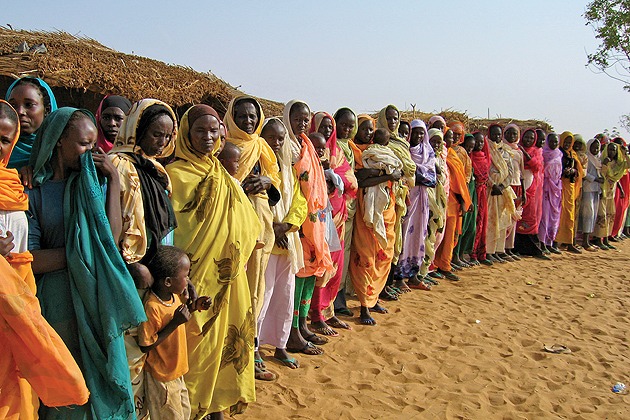
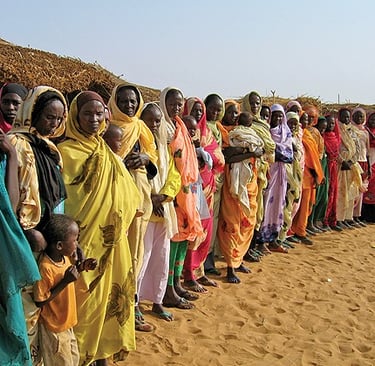
In the 1980s, the civil war in the south was reignited following the government's Islamification policy which would have instituted Islamic law, while several million people were threatened by famine, particularly in western Sudan, after a major drought. In 1989, the government and southern rebels began to negotiate an end to the war, but a coup d'état brought a military junta into power, led by Omar al-Bashir, which was not interested in compromise and the war with the south continued. In early 2003 a new rebellion in the western region of Darfur began, with the rebels accusing the central government of neglecting the Darfur region. Both the government and the rebels have been accused of atrocities in this war, although most of the blame has fallen on Arab militias (Janjaweed) allied with the government. After intervention (politically and to a lesser extent militarily) by the African Union and the nation of Chad, a final peace treaty was signed in Jan 2005 beginning the process of splitting South Sudan into a separate country.
2005 - present - In Aug 2006, the United Nations Security Council approved Resolution 1706 to send a new peacekeeping force of 17,300 to Darfur. Following prolonged and intensive negotiations with the Government of the Sudan and significant international pressure, it finally accepted a joint African Union/United Nations peacekeeping operation in Darfur. In Apr 2019, after several months of sustained street protests Sudan's long-time military leader/president Omar al-Bashir was ousted. However, when a council made up of both military and civilian representatives could not settle on the specifics of a new government (and threatened by the threat of a military conflict with Ethiopia), the Sudanese military, led by General Abdel Fattah al-Burhan, took control of the government in Oct 2021 in another military coup. A war between the Sudanese Armed Forces (SAF) and the paramilitary Rapid Support Forces (RSF), rival factions of the military government of Sudan, began on 15 April 2023, with the fighting concentrated around the capital city of Khartoum and the Darfur region. The two sides were then joined by rebel groups who had previously fought against the two sides, and the conflict continues today.
Other Non-Political Issues
Section III - Issues of Sudan
General Information on Sudan:
"All About Sudan", Africa.com, Jan 2026, https://africa.com/heres-what-you-need-to-know-about-sudan/
"Real Sudan: Discover Authentic Sudan" (unofficial tourism site - none run by government), Real Sudan, 2026, https://www.realsudan.com/
“Sudan Country Case Study" (a collection of links to other stories), United States Holocaust Memorial Museum, 2026, hhttps://www.ushmm.org/genocide-prevention/countries/sudan
“Sudan", Wikipedia, Jun 2026, https://en.wikipedia.org/wiki/Sudan or https://simple.wikipedia.org/wiki/Sudan
“Sudan Country Profile", World Bank Group, Jan 2026, https://data360.worldbank.org/en/economy/SDN
History Links on Sudan:
"Archaeological Sites of the Island of Meroe", UNESCO, 2025, https://whc.unesco.org/en/list/1336
"Civil War in Sudan", Global Conflict Tracker from the Council on Foreign Relations, May 2026, https://www.cfr.org/global-conflict-tracker/conflict/power-struggle-sudan
“In the Land of Kush: A dazzling civilization flourished in Sudan nearly 5,000 years ago. Why was it forgotten?", National Geographic, Sep 2020, https://www.smithsonianmag.com/travel/sudan-land-kush-meroe-ancient-civilization-overlooked-180975498/
"Khartoum: the creation and the destruction of a modern African city", The Conversation, May 2023, https://theconversation.com/khartoum-the-creation-and-the-destruction-of-a-modern-african-city-205705
"A Nubian Kingdom Rises: Excavations at a city on the Nile reveal the origins of an ancient African power", Archaeology Magazine, Sep/Oct 2020, https://archaeology.org/issues/september-october-2020/features/sudan-kerma-nubian-kingdom/
"Sudan A Legacy of Cultural Synthesis and Conflict" (video), Aphi Siri (from Thailand), Jun 2026, https://www.youtube.com/watch?v=5U2raD9RatQ
Current Events Stories on Sudan:
"Armed drones leading cause of civilian death in Sudan war: UN rights chief" AND "Sudan war: Drone attacks damage key aid routes", United Nations News, Jun 2026, https://news.un.org/en/story/2026/05/1167479 AND https://news.un.org/en/story/2026/06/1167688
"‘Some people’s lives matter more than others’: local responders in Sudan feel ignored as the world focuses on other crises", The Conversation, May 2026, https://theconversation.com/some-peoples-lives-matter-more-than-others-local-responders-in-sudan-feel-ignored-as-the-world-focuses-on-other-crises-282716
“Sudan crisis worsens as civil war enters 4th year and Hormuz closure disrupts aid", PBS NewsHour, Jun 2026, https://www.pbs.org/newshour/show/sudan-crisis-worsens-as-civil-war-enters-4th-year-and-hormuz-closure-disrupts-aid
"Sudan has vast oil, gold and agricultural resources. Who controls them?", Al-Jazeera, Nov 2025, https://www.aljazeera.com/news/2025/11/20/sudan-has-vast-oil-gold-and-agricultural-resources-who-controls-them
"What would prolonged war mean for Sudan? Sudan’s war has triggered one of the world’s worst humanitarian crises, with fears a protracted war could worsen it", Al-Jazeera, May 2026, https://www.aljazeera.com/features/2026/5/8/what-would-prolonged-war-mean-for-sudan
Other Interesting Links Related To Sudan:
"Community Food: A Taste of Togetherness in Sudan", Safeguarding Sudan's Living Heritage (a project funded by the British Council Cultural Protection Fund), Jun 2025, https://www.sslh.online/en/posts/community-food-a-taste-of-togetherness-in-sudan
“Satellite imagery reveals how Sudan’s war scorched its ‘breadbasket’: Images from satellites show a collapse in agriculture under Rapid Support Forces control and a fragile recovery following army advances", Al-Jazeera, May 2026, https://www.aljazeera.com/economy/2026/5/4/satellite-imagery-reveals-how-sudans-war-scorched-its-breadbasket
"Sudan Explained in 11 Minutes | History, Geography, Culture" (video), Opentiera, May 2024, https://www.youtube.com/watch?v=iDpzZ6N4AHA
“The Top 10 Most Popular Foods in Sudan", Chef's Pencil, Oct 2022, https://www.chefspencil.com/most-popular-foods-in-sudan/
"What it’s like to scuba dive under pyramids?", National Geographic Magazine, Jun 2022, https://www.nationalgeographic.com/history/article/what-its-like-to-scuba-dive-under-pyramids
Section IV - Resources About Sudan
ECON and More
Curating articles for K-12 education.
CONTACT
© 2025. All rights reserved.