
Countries of the World (Asia) - United Arab Emirates
Second Asian country in my new geography series. One thing you will notice is I will be starting at different points in each list - I DON'T want this to become an overview of all the "A" countries at the same time (like reading the encyclopedia, for those who remember actually using physical encyclopedias!). Again, I'm going to play with the format on these first few and see what I like, then try to be as consistent with my content going forward as I can.
Section I - Basic Info on the United Arab Emirates


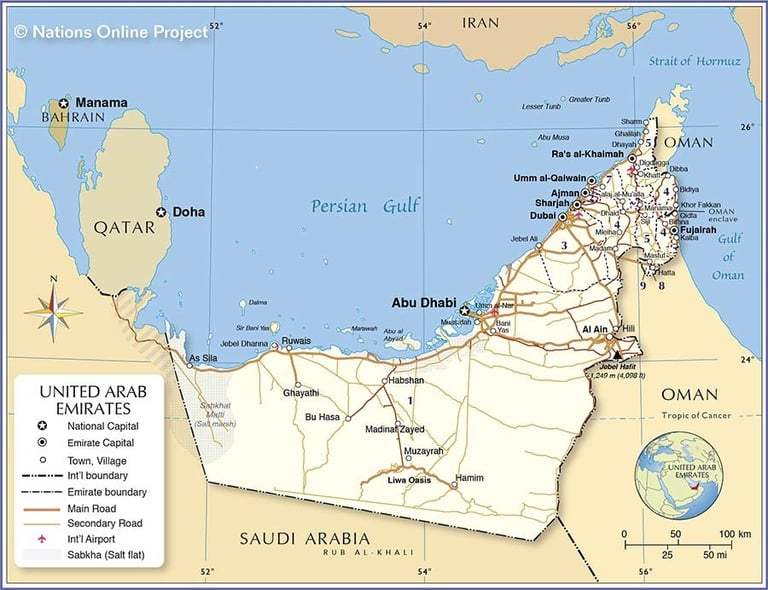
Official Name: United Arab Emirates
Population: 10,093,593 (93rd largest in the world, 28th largest in Asia)
Area/Size: 32,278 square miles (about the size of South Carolina)
Capital: Abu Dhabi (1,600,000 - sister city of Houston, TX)
Other Major Cities: Dubai (3,100,000), Sharjai (1,900,000)
Spoken Languages: Arabic (official), English
Religions: Muslim (75%), Christian (15%), Hindu (6%), Buddhist (3%)
Life Expectancy: 80.1 years Internet Access Rate: 100%
Per Capita Income: $77,959 Unemployment: 2.1%
What do they Export?: Crude and refined petroleum, natural gas, dates, camel milk
Export Partners: China (11%), India (11%), Japan (10%), Iraq (6%)
Import Partners: China (19%), India (7%), United States (6%), Turkey (4%)
Government Type: Federation of monarchies (the 7 emirates each have hereditary rulers chosen by key families - the overall rulers come from Abu Dhabi or Dubai)
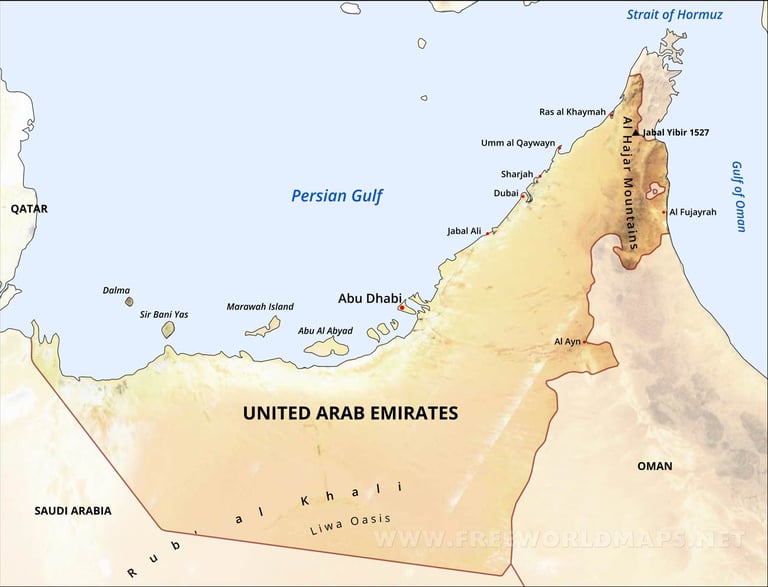
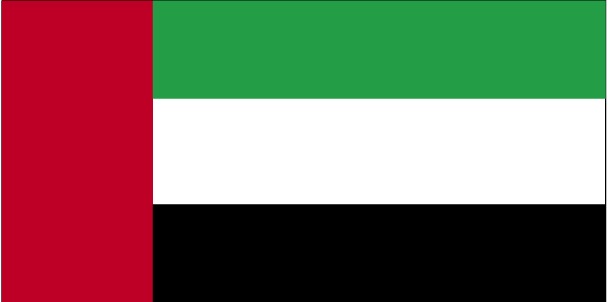
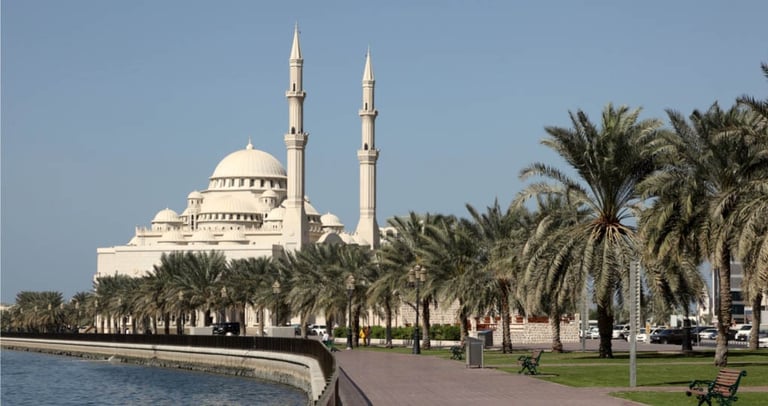
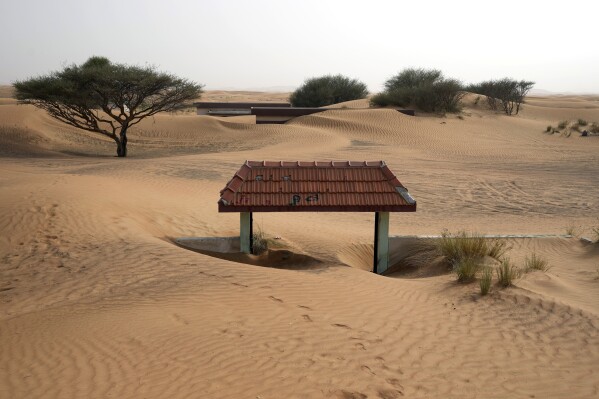
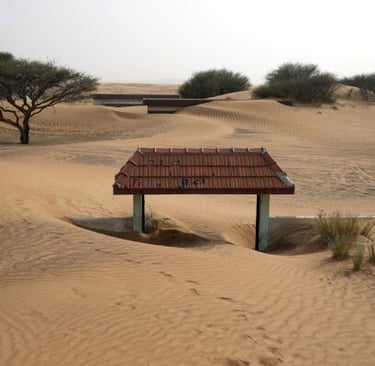
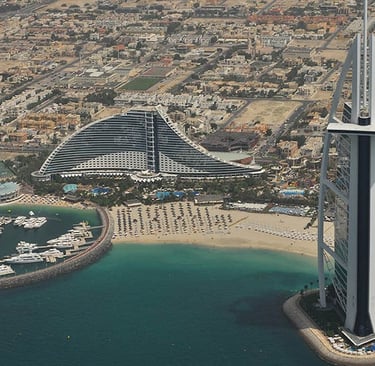
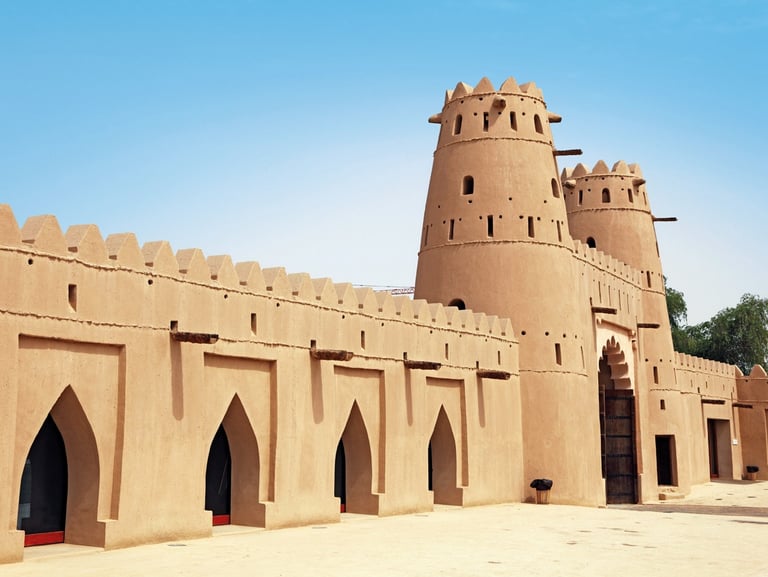
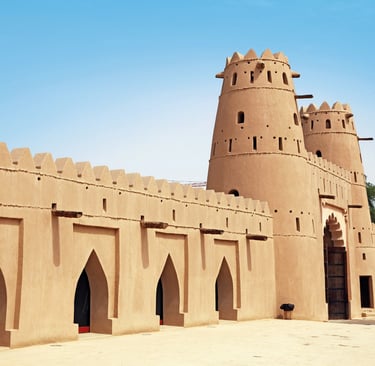
Section II - Images of the United Arab Emirates




5 Key Dates in Emirates History
Probably no surprise to teachers, but most of the time the "key dates" will drive what the present-day issues are in the country. While most focus on "United Arab Emirates" as a relatively-new political creation, the region has been the center of travel and conquest for thousands of years.
c. 6000 - 1300 BC - The area's history can be traced back to 6000 B.C., and the area and surrounding region was simply referred to as the Arabian Peninsula. During most of this period, the Bedouin communities lived on fishing and plant collecting. This era (notably from the Bronze Age and the Iron Age) was characterized by the emergence of pottery, evidence of which was found in the Al Ain world heritage sites (linked below). The end of the period was marked by the emergence of the first use of falaj irrigation systems that enabled the extraction of groundwater for continuous cultivation in the dry climate.
630 - 1258 AD - The spread of Islam to the northeastern tip of the Arabian Peninsula is thought to have followed directly from a letter sent by the Islamic prophet Muhammad to the rulers of Oman in 630 CE. This led to a group of rulers travelling to Medina, converting to Islam, and subsequently driving a successful uprising against the unpopular Sassanids, who dominated the coast at the time. Julfar (in the area of today's Ras Al Khaimah) was an important port that was used as a staging post for the Islamic invasion of the Sasanian Empire, while the area of the Al Ain Oasis was known as Tu'am and was an important trading post for camel routes between the coast and the Arabian interior. Islamic civilisation flourished in the Gulf region until the end of the Abbasid Caliphate around 1258.
1498 - 1968 - a period of European involvement with the coastal ports for trade and conquest. First came the Portuguese with Vasco DaGama's successful voyage to India in 1498 - by the mid 16th century they reached the height of their maritime power and established a semi-monopoly of the pepper and spice trade. Ultimately they were forced out by the rise of the Ya'arubid Dynasty (1624-1742), who established Oman as a major maritime power. The Dutch then controlled trade from the early-17th to mid-18th centuries before losing world power to the British and French. The British finally focused on this area as part of their trade routes to India after the defeat of Napoleon, negotiating treaties with the emirates of the area for peaceful trade and relations in return for British defense of the emirates from foreign aggression. This ends in 1968 with the decision of the British to withdraw from the Middle East militarily.
1935 - 1969 - Marks a period of exploration for oil in the region, mostly unsuccessful until the 1960s. In 1935 the first exploration agreements were signed with leaders of some emirates (particularly Abu Dhabi) but those efforts were largely interrupted by World War II. While some onshore wells were dug (and came up dry) in the 1950s, it was the offshore oil strike off Abu Dhabi in 1958 (and later discoveries of the larger Fateh and Mubarek offshore fields) that seemed to promise future riches. Finally onshore drilling became successful in the 1960s, particularly leading to wealth for the larger emirates of Dubai and Abu Dhabi.
December 2, 1971 - Independence day for the United Arab Emirates, though with only 7 of the 9 emirates included. When Britain made the decision (mentioned above) to withdraw from the Middle East they also announced that they would end their treaty with the "Trucial States" (as they were known) in 3 years. By Mar 1968 discussions had begun on founding a ‘Federation of the Arab Emirates’, and Bahrain and Qatar were invited to join the Federation. However, the negotiations fell apart by late 1969 over voting and representation issues, as Bahrain and Qatar opted to drop out of further talks. With Bahrain and Qatar declaring independence in Aug/Sep 1971, and fearing threats from other Middle Eastern countries, 6 of the other 7 emirates decided to join forces in a union in Dec 1971 (with the last one joining a month later).
Other Non-Political Issues
Section III - Issues of the United Arab Emirates
General Information on the United Arab Emirates:
“United Arab Emirates", One World Nations Online, Jan 2025, https://www.nationsonline.org/oneworld/arab_emirates.htm
“United Arab Emirates", Wikipedia, Dec 2025, https://en.wikipedia.org/wiki/United_Arab_Emirates or https://simple.wikipedia.org/wiki/United_Arab_Emirates
“United Arab Emirates Explained in 14 Minutes (History, Geography, & Culture)” (video), Opentiera, Sep 2025, https://www.youtube.com/watch?v=sWPAIXdhKsA
"United Arab Emirates Travel Guide", National Geographic, 2025, https://www.nationalgeographic.com/travel/destination/united-arab-emirates
“The World Factbook - United Arab Emirates", Central Intelligence Agency, Jan 2026, https://www.cia.gov/the-world-factbook/countries/united-arab-emirates/
History Links on the United Arab Emirates:
“About the UAE - History", The Official Platform of the UAE Government, Sep 2023, https://u.ae/en/about-the-uae/history
“Cultural Sites of Al Ain (Hafit, Hili, Bidaa Bint Saud and Oases Areas)", UNESCO World Heritage Convention, https://whc.unesco.org/en/list/1343
“From rags to riches: The story of Abu Dhabi" (video), BBC World Service, 2024, https://www.youtube.com/watch?v=f9O289mglVk
"Little Sparta: The Origins of the U.S.-UAE Relationship", Real Clear Defense, Apr 2025, https://www.realcleardefense.com/articles/2025/04/02/little_sparta_the_origins_of_the_us-uae_relationship_1101419.html
“Zayed National Museum (The National Museum of the UAE), https://zayednationalmuseum.ae/en/
Current Events Stories on the United Arab Emirates:
“The Economy of the United Arab Emirates", Economics Explained, 2021, https://www.youtube.com/watch?v=QP-eJRMrnBg
“Saudi Arabia bombs Yemen port over weapons shipment from UAE, issues warning to Abu Dhabi”, NBC News, Dec 2025, https://www.nbcnews.com/world/middle-east/saudi-arabia-bombs-yemen-port-weapons-shipment-uae-issues-warning-abu-rcna251477
"UAE used military bases in Red Sea region to aid Israel's war against Hamas, leaks reveal", Jerusalem Post, Jan 2026, https://www.jpost.com/middle-east/article-883261
"United Arab Emirates Joins U.S. and China in Giving Away A.I. Technology", New York Times, Sep 2025, https://www.nytimes.com/2025/09/09/technology/uae-emirates-ai-open-source.html
“Why the U.A.E. Is Building a $5B Casino in the Gambling-Free Gulf" (video - WSJ Breaking Ground), Wall Street Journal, Nov 2025, https://www.youtube.com/watch?v=W2FM1vmXdd8
Other Interesting Links Related To the United Arab Emirates:
"7 Emirates, 7 Thrones: A Look Inside UAE's Ruling Families", The Times of India, Jul 2025, https://timesofindia.indiatimes.com/world/middle-east/7-emirates-7-thrones-a-look-inside-uaes-ruling-families/articleshow/122334060.cms
"Beyond Dubai’s Glitter, Glimpses of Life Before Oil", New York Times, Oct 2025, https://www.nytimes.com/2025/10/28/travel/dubai-uae-oil-wealth.html
"Chasing the rain in the United Arab Emirates", Africa News, Sep 2025, https://www.africanews.com/2025/09/05/chasing-the-rain-in-the-united-arab-emirates/
"Tallest Building in Dubai (video - Superstructures: Engineering Marvels), National Geographic, Apr 2025, https://www.youtube.com/watch?v=mC6EjyvktW4
"UAE Culture", Embassy of the United Arab Emirates in Washington, D.C., Jan 2026, https://www.uae-embassy.org/discover-uae/traveling-in-the-uae/uae-culture
Section IV - Resources About the United Arab Emirates
ECON and More
Curating articles for K-12 education.
CONTACT
© 2025. All rights reserved.