
Countries of the World (Asia) - Uzbekistan
Third Asian country in my new geography series. I've been pretty happy so far with the format on these first few, but please let me know if you are seeing something different!
Section I - Basic Info on Uzbekistan
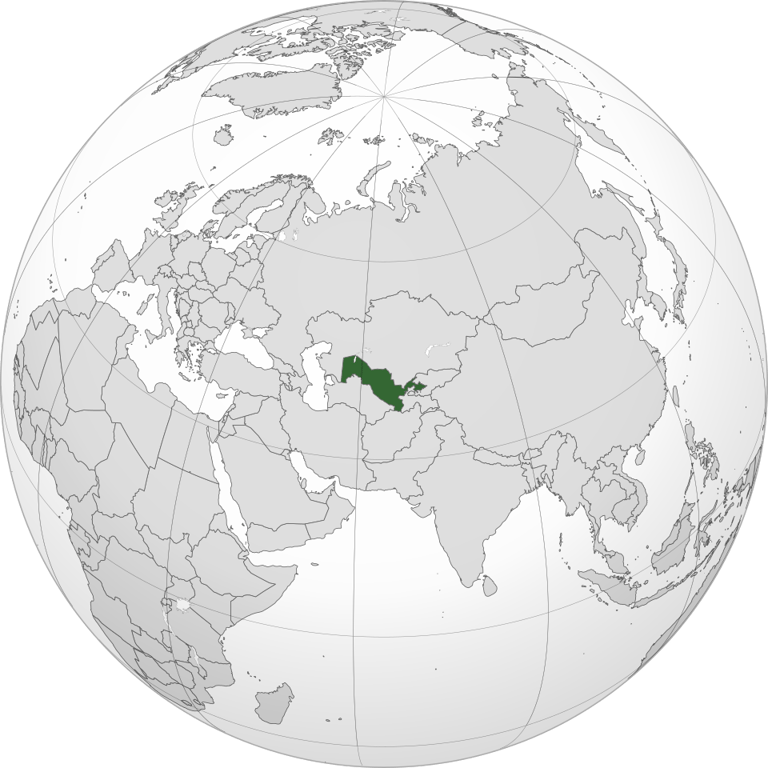
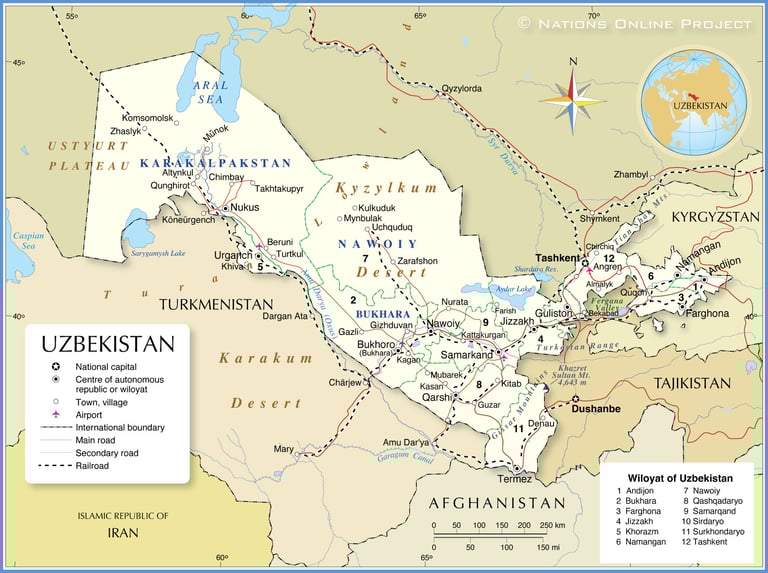
Official Name: Republic of Uzbekistan
Population: 37,015,151 (42nd largest in the world, 18th largest in Asia)
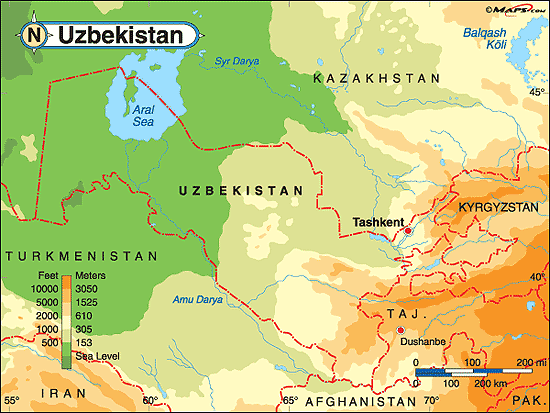
Area/Size: 172,742 square miles (about the size of Washington/Oregon combined)
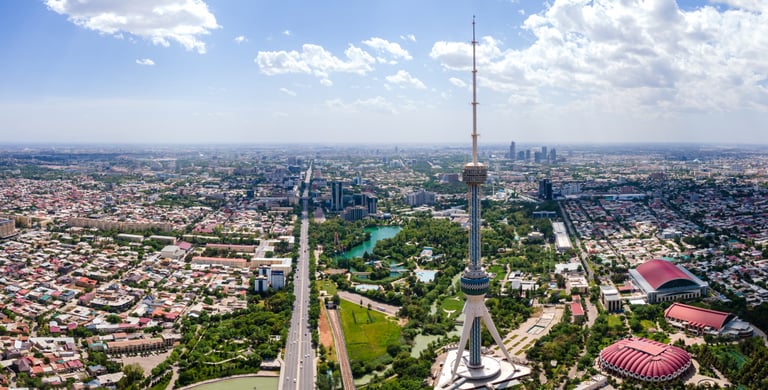
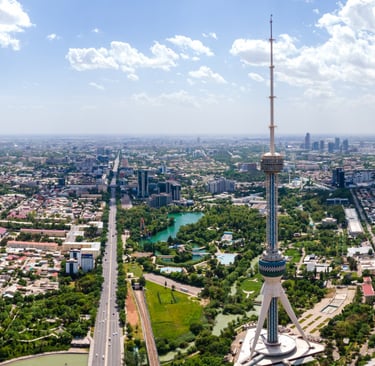
Capital: Tashkent (2.7 million - sister city of Seattle, WA)
Spoken Languages: Uzbek (official - 75%), Russian (14%), Tajik (5%)
Religions: Muslim (88%), Eastern Orthodox (9%), agnostic (3%)
Life Expectancy: 76.7 years Literacy Rate: 89.0%
Per Capita Income: $11,879 Unemployment: 4.5%
What do they Export?: Gold, cotton yarn, clothing, fertilizers, fabric
Export Partners: Switzerland (34%), Russia (12%), U.K. (11%), China (7%)
Import Partners: China (32%), Russia (17%), Kazakhstan (8%), South Korea (6%)
Government Type: Presidential republic (only two leaders since independence - regularly bans opposition candidates from running - very authoritarian)

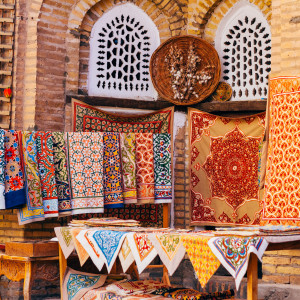
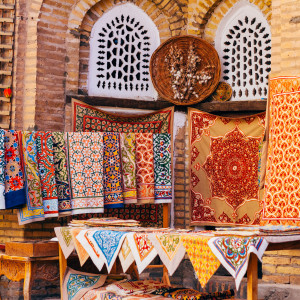
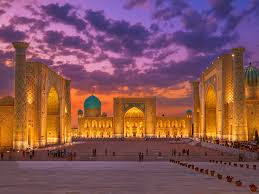
Section II - Images of Uzbekistan
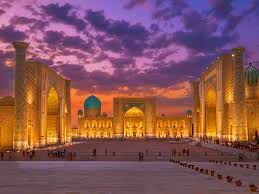


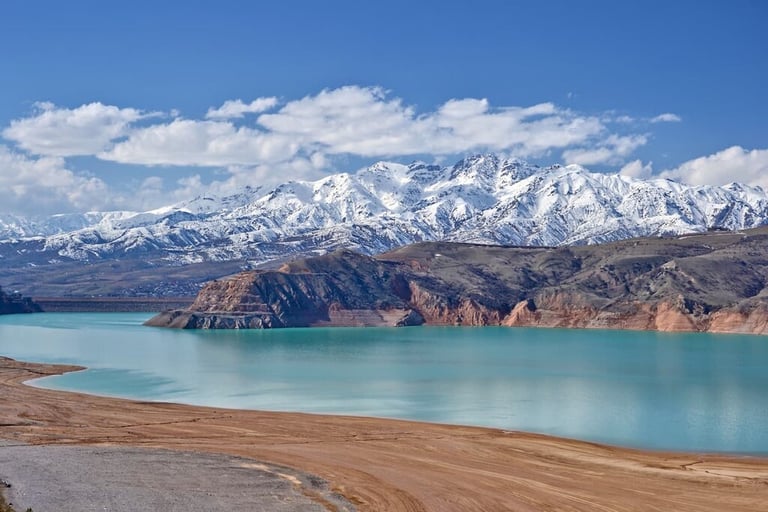
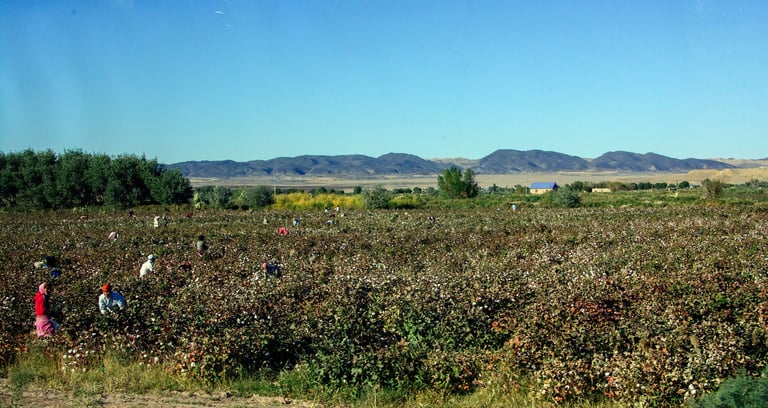
6 Key Dates in Uzbeki History
Probably no surprise to teachers, but most of the time the "key dates" will drive what the present-day issues are in the country. While most focus on "Uzbekistan" as a relatively-new political creation, the region has been the center of travel and conquest for thousands of years.
c. 1000 BC - Central Asia was occupied by the Scythians, Iranian nomads who arrived from the northern grasslands of what is now Kazakhstan. These nomads, who spoke Iranian dialects, settled in Central Asia and began to build extensive irrigation systems along the rivers of Central Asia. They also built cities such as Bukhara and Samarkand, which became centers of government and culture as part of the Iranian province of Transoxiana. Trade on what later became the Silk Route also made this region a constant magnet for invasions from first Alexander the Great, and later the northern steppes and from China. In the same centuries the region also became an early important center of intellectual life and religion.
c. 650 - 1000 AD - The conquest of Central Asia by Muslim Arabs brought to the region a new religion that continues to be dominant. The Arabs first invaded Transoxiana in the middle of the seventh century through sporadic raids during their conquest of Persia, and its status as an Islamic region was solidified by the Arab victory over Chinese armies in 751 at the Battle of Talas. Subsequently, the Abbasid Caliphate, which ruled the Arab world for five centuries beginning in 750, was established thanks in great part to assistance from Central Asian supporters. During the height of the Abbasid Caliphate in the 8th and 9th centuries, Central Asia and Transoxiana experienced a golden age. Bukhara became one of the leading centers of learning, culture, and art in the Muslim world, its magnificence rivaling contemporaneous cultural centers such as Baghdad, Cairo, and Cordoba. Some of the greatest historians, scientists, and geographers in the history of Islamic culture were natives of the region including al-Bukhari, Al-Tirmidhi, al Khwarizmi, al-Biruni, Avicenna and Omar Khayyam.
1219 - 1500 - The Mongol conquest of Central Asia, which took place under Genghis Khan from 1219 to 1225, led to a wholesale change in the ethnic makeup of the region. The Mongol Empire maintained orderly succession for several more generations, but in the early 14th century the empire began to break up into its constituent parts. One tribal chieftain, Timur (Tamerlane), emerged from these struggles in the 1380s and proceeded to conquer all of western Central Asia, Iran, Asia Minor, and the southern steppe region north of the Aral Sea. Timur initiated the last flowering of Islamic culture in the region by gathering in his capital, Samarkand, numerous artisans and scholars from the lands he had conquered. A wide range of religious and palatial construction projects were undertaken in Samarkand and other population centers. Timur also patronized scientists and artists; his grandson Ulugh Beg was one of the world's first great astronomers.
1510 - 1873 - The decline of Timur's empire after his death in 1504 led to the rise of Uzbek khanates. By 1510 the Uzbeks completed their conquest of Central Asia, including the territory of present-day Uzbekistan. The two most important (and longest-lasting) Uzbek states were the Khanate of Bukhara and the Khanate of Khiva. This also led to a growing rivalry with Iran over the rich far-eastern territory of present-day Iran, largely because the Uzbeks were Sunni Muslims, and Iran was Shia. In the 17th and 18th centuries the amount of trade began to decline, contributing to growing weakness in the wealth of the Uzbek khanates. As ocean trade routes were established from Europe to India and China, they circumvented the Silk Route and trading centers such as Bukhara and Samarkand began to steadily decline. The Uzbeks' struggle with Iran also led to the cultural isolation of Central Asia from the rest of the Islamic world.
1873 - 1991 - Russia gradually gained influence in the region through the second half of the 19th century, culminating with the khanates becoming Russian protectorates between 1868 and 1873. The treaties gave Russia control of the foreign relations of these states and gave Russian merchants important concessions in foreign trade; the khanates retained control of their own internal affairs. You also begin to see large numbers of ethnic Russians, attracted by the climate and the available land, emigrating into Central Asia. Eventually after the Russian Revolution, the Communists established the Uzbek Soviet Socialist Republic (Uzbek SSR) which initially included present-day Uzbekistan and Tajikistan. Tajikistan became the separate Tajik Soviet Socialist Republic in 1929.
September 1, 1991 - President of the Uzbek SSR Islam Karimov declared Uzbekistan independent from the USSR on 31 August 1991. The next day was then declared a national holiday, and a day off from work by the government (leading to that day officially becoming Independence Day). Karimov goes on to lead an authoritarian state in Uzbekistan for the next 25 years, until his death in 2016. He was replaced by his long-time Prime Minister, Shavkat Mirziyoyev, on 14 December of the same year and Mirziyoyev continues to rule a very tightly-controlled country to this day.
Other Non-Political Issues
Section III - Issues of Uzbekistan
General Information on Uzbekistan:
“Uzbekistan", One World Nations Online, Jan 2025, https://www.nationsonline.org/oneworld/uzbekistan.htm
“Uzbekistan", Wikipedia, Jan 2026, https://en.wikipedia.org/wiki/Uzbekistan or https://simple.wikipedia.org/wiki/Uzbekistan
“Uzbekistan Explained in 13 minutes (History, Geography, & Culture)” (video), Opentiera, 2024, https://www.youtube.com/watch?v=_VmrtK5fYyI
"Discover New Uzbekistan!" (official travel website), 2025, https://uzbekistan.travel/en/
“The World Factbook - Uzbekistan", Central Intelligence Agency, Jan 2026, https://www.cia.gov/the-world-factbook/countries/uzbekistan/
History Links on Uzbekistan:
"The Ancient Cities Of The Silk Road - Uzbekistan" (video), OffTheMainRoad, 2024, https://www.youtube.com/watch?v=60v8STcoAhk
“Explore Central Asia’s newest UNESCO World Heritage Site, Silk Roads: Zarafshan-Karakum Corridor", Wanderlust, Sep 2023, https://www.wanderlustmagazine.com/inspiration/world-heritage-silk-roads-zarafshan-karakum-corridor/
“Historic Centre of Bukhara", UNESCO World Heritage Convention, https://whc.unesco.org/en/list/602
“In Uzbekistan, Coming to Terms With the Country’s Dazzling History", New York Times, May 2020, https://www.nytimes.com/2020/05/11/t-magazine/uzbekistan-history-silk-road.html
“Lost Silk Road Cities Discovered in Uzbek Mountains", BBC News, Oct 2024, https://www.bbc.com/news/articles/c238kv8ddeyo
“Samarkand – Crossroad of Cultures", UNESCO World Heritage Convention, https://whc.unesco.org/en/list/603
Current Events Stories on Uzbekistan:
"Building a Water-Secure Future in Central Asia", World Bank News, Sep 2024, https://www.worldbank.org/en/news/immersive-story/2024/09/26/building-a-water-secure-future-in-central-asia
“Forced Labor In Central Asian Cotton Fields Disrupts Schools, Hospitals”, Radio Free Europe, Nov 2025, https://www.rferl.org/a/forced-labor-central-asia-cotton-harvest/33578833.html
“Russia will build Central Asia’s first nuclear power plant in an agreement with Uzbekistan”, Associated Press News, May 2024, https://apnews.com/article/russia-nuclear-plant-uzbekistan-putin-6b29cec95b9f5be8d1b408063f1d0065
"Trump says he’s inviting Kazakhstan and Uzbekistan to next year’s G20 summit in Miami", Associated Press News, Dec 2025, https://apnews.com/article/trump-kazakhstan-uzbekistan-g20-0d5787656a4106245b4326726e59154c
“Uzbek president re-elected for seven-year term in snap election", Al-Jazeera, Jul 2023, https://www.aljazeera.com/news/2023/7/10/uzbek-president-re-elected-for-seven-year-term-in-snap-election
Other Interesting Links Related To Uzbekistan:
“7 of the best things to do in Uzbekistan", Wanderlust, Aug 2021, https://www.wanderlustmagazine.com/inspiration/top-things-to-do-in-uzbekistan/
"Don’t Shoot! Photo Ban Looms In Uzbekistan", Radio Free Europe, Oct 2025, https://www.rferl.org/a/uzbekistan-photo-ban-tourism-industry/33555477.html
“From Uzbek disco to Uighur rock: Forgotten sounds of the Silk Road", Al-Jazeera, Oct 2024, https://www.aljazeera.com/features/2024/10/12/from-uzbek-disco-to-uighur-rock-forgotten-sounds-of-the-silk-road
“Uzbek national team is Central Asia’s first to qualify for the World Cup tournament”, Eurasianet, Jun 2025, https://eurasianet.org/uzbek-national-team-is-central-asias-first-to-qualify-for-the-world-cup-tournament
"Why Are Traditional Bread Ovens Being Smashed In Uzbekistan?" (video), Radio Free Europe, Dec 2025, https://www.rferl.org/a/why-are-traditional-bread-ovens-being-smashed-in-uzbekistan/33614463.html OR https://www.facebook.com/watch/?v=1511622499957602
"The World's Two Double Landlocked Countries", World Atlas, Feb 2021, https://www.worldatlas.com/articles/doubly-landlocked-countries.html
Section IV - Resources About Uzbekistan
ECON and More
Curating articles for K-12 education.
CONTACT
© 2025. All rights reserved.