
Countries of the World (The Americas) - Panama
Fourth country from the Western Hemisphere in my new geography series. One small change you might notice I made (and went back to fix on earlier ones) was including "Internet Access Rate" rather than "Literacy Rate" for countries. I forgot I made that change the last 2-3 years in the classroom - felt like students could relate to it easier (and it helped them judge the development status of countries).
Jay LeBlanc
2/23/20267 min read
Section I - Basic Info on Panama
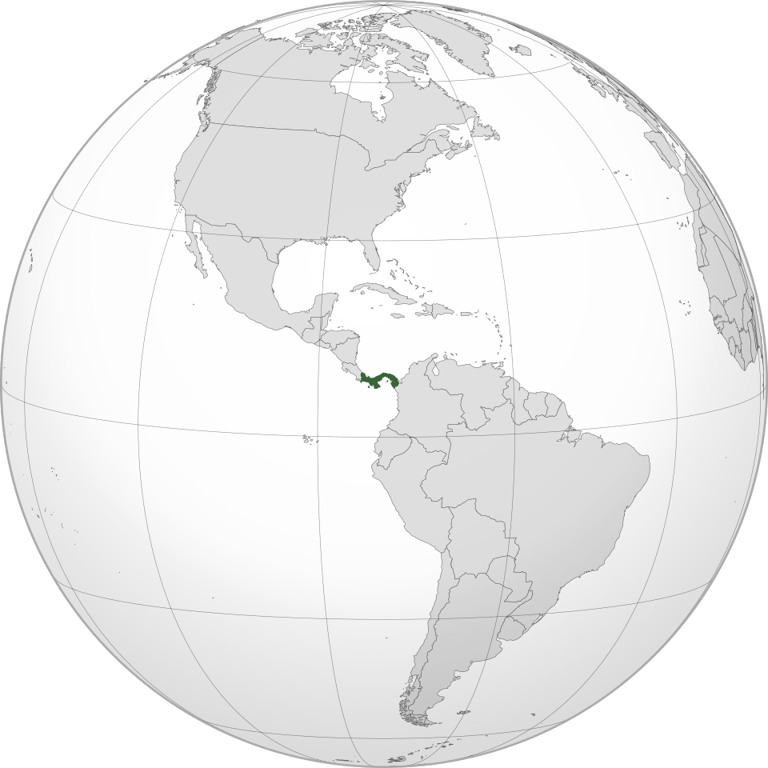
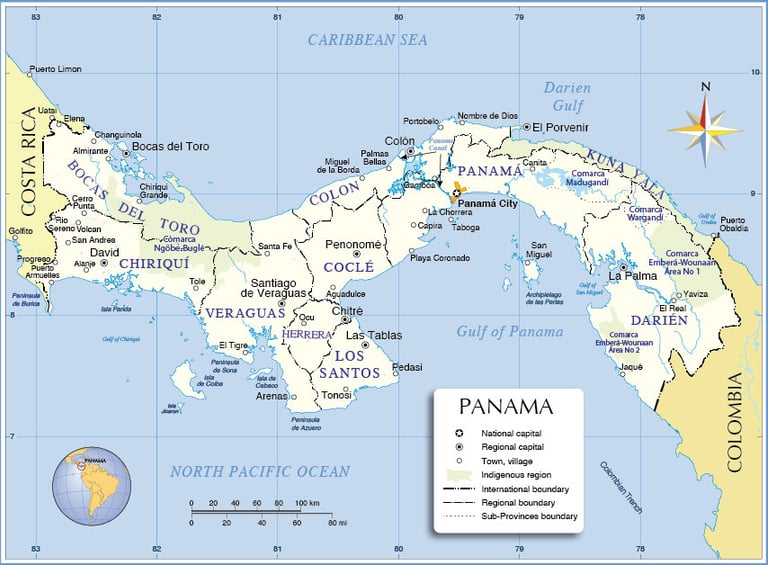
Official Name: Republic of Panama
Population: 4,536,008 (127th largest in the world, 21st largest in the Americas)
Area/Size: 29,120 square miles (a little smaller than South Carolina)
Capital: Panama City (2.1 million - sister city of San Diego, CA and Charleston, SC)
Spoken Languages: Spanish (official), a variety of indigenous languages
Religions: Catholic (63%), Protestant (25%), no religion (7%)
Life Expectancy: 80.1 years Internet Access Rate: 68.5%
Per Capita Income: $41,405 Unemployment: 6.5%
What do they Export?: Copper ore, ships, refined petroleum, bananas, fish
Export Partners: China (25%), Japan (10%), United States (6%), Costa Rica (5%)
Import Partners: United States (15%), Columbia (13%), China (13%), Ecuador (13%)
Government Type: Presidential republic (last election 2024 - open and free)
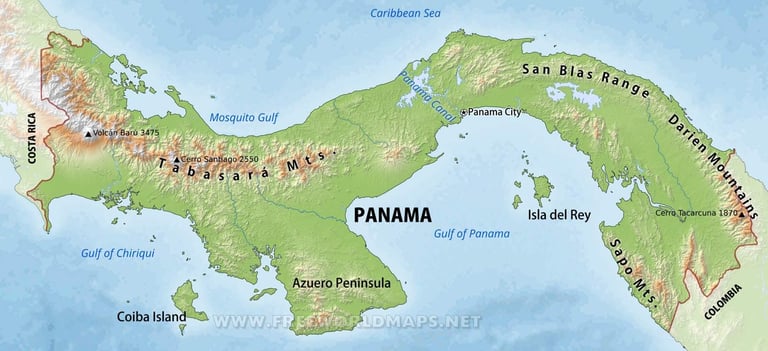
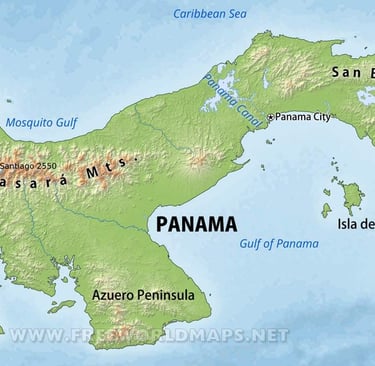
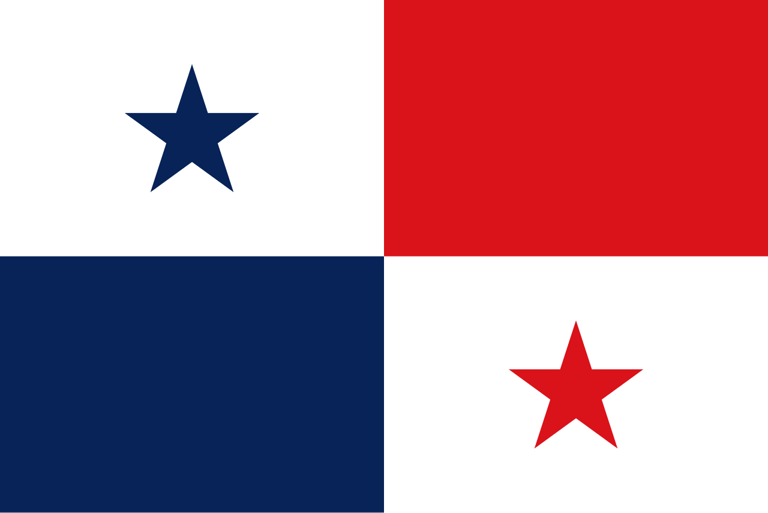
Section II - Images of Panama
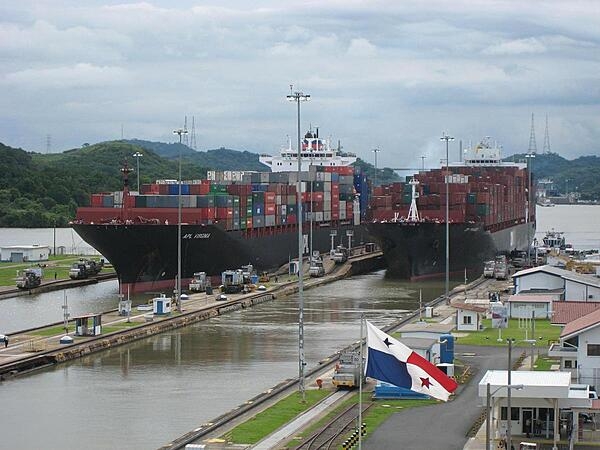
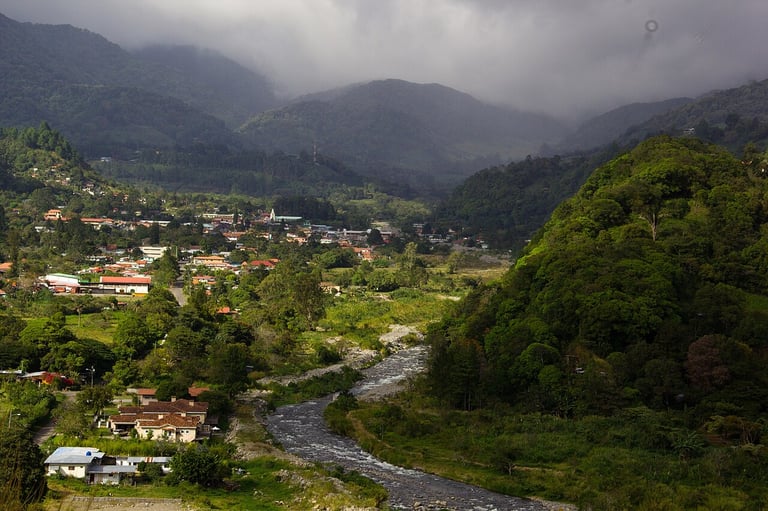


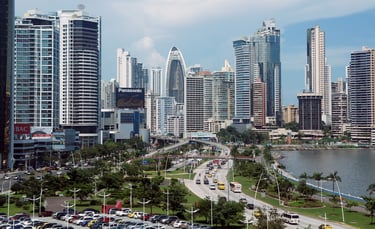
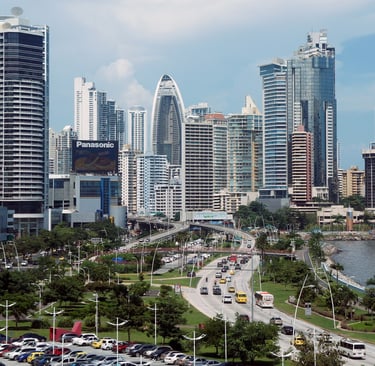
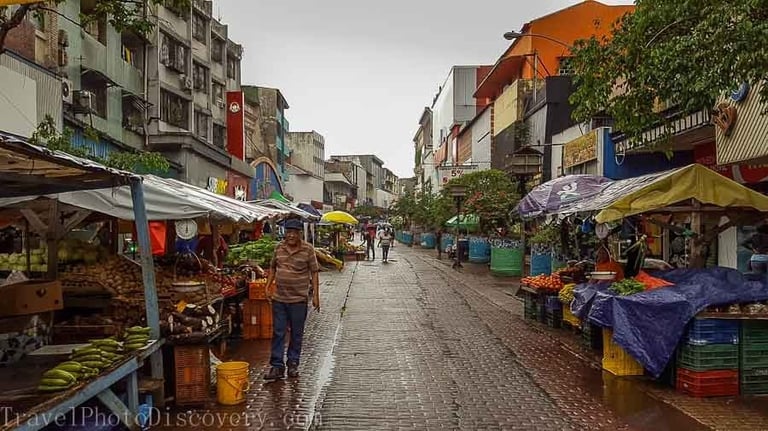


7 Key Dates/Periods in Panamanian History
I expanded this section a bit just because of the changes in government in Nicaragua through the 20th century. A lot of the periods listed in this "history" can also be supplemented by the history AND current events links further below.
c. 500 - 1500 - Panama was widely settled by Chibchan languages, Choco languages, and Cueva language speakers, among whom the largest group were the Cueva. There is no accurate knowledge of the size of the Pre-Columbian indigenous population of the isthmus at the time of the European conquest - recent estimates put the number close to 200,000. Archaeological finds, as well as testimonials by early European explorers, describe diverse native isthmian groups exhibiting cultural variety and already experienced in using regional trade routes. The indigenous people of Panama lived by hunting, gathering edible plants & fruits, growing corn, cacao, and root crops. They lived in small huts made of palm leaves over a rounded branch structure, with hammocks hung between the interior walls.
1500 - 1821 - Several Spanish explorers (including Columbus) visited the region in the first decade of the 16th century, but it was Vasco de Balboa's expedition across the isthmus to become the first European to sight the Pacific Ocean that brought Panama to prominence. Panama City and other sites were established on the Pacific coast, both to encourage trade routes but also to protect them from attacks by pirates and privateers. For 200 years (1540-1740) the Spanish colony in Panama became prosperous because of the pivotal role it played in enabling cross-ocean trade across the isthmus. However, the Spanish empire began to decline in the mid-18th century, and shipping companies began to avoid the labor-intensive process required to load and unload ships and the laden-down trek required to get from the one coast to the other.
1821 - 1902 - At the time of revolution of the New World colonies from Spain (including the work of Simon Bolivar in Venezuela, Colombia, etc..) Panama found itself torn in allegiance between revolutionary centers in Bogota and Lima. Eventually Panama became northern provinces of first New Granada (combining modern-day Colombia, Venezuela, and Ecuador), and later just a part of Colombia. However, most of the time the provinces in Panama were left to themselves, developing a history of self-rule. The U.S. was also starting to get involved in the region because of a desire to shorten travel from one coast to another, building a railroad across Panama in the 1850s and intervening militarily a couple of times.
1902 - 1914 - U.S. President Teddy Roosevelt took up the idea of a Panama Canal in 1902, building upon a failed French effort in the 1880s. However, when he could not negotiate a treaty with Colombia for use of the land, he instead worked with French sympathizers and a small Panamanian independence movement in Nov 1903 to help Panama break away from Colombia. Of note - Panama considers that date "Separation Day" and treats 1821 as the date of their country's independence. Once a treaty was signed between the U.S. and the new nation, the U.S. spent the next 10 years building the Panama Canal - it was officially opened in Aug 1914 (coincidentally just in time for the start of World War I in Europe).
1903 - 1977 - In the Hay–Bunau-Varilla Treaty of Nov 1903, the US was granted sovereignty over a strip of land 10 miles wide and 50 miles long on either side of the Panama Canal Zone. In that zone, the US would build a canal, then administer, fortify, and defend it "in perpetuity". During much of the subsequent 65 years, Panama was run by a small group of families involved in trade and the banana industry. However, in 1968 a military junta took over under the leadership of Omar Torrijos, who became the leader of Panama through the 1970s. As he began to nationalize parts of the Panamanian economy, the issue of American control of the Panama Canal once again came to the forefront. U.S. President Jimmy Carter and Torrijos finally agreed to a treaty in 1977 setting a 1999 date for the canal zone to be turned over to Panama.
1981 - 1989 - After the death of Omar Torrijos in a suspicious plane crash in 1981, the Panama Defense Forces (PDF) increasingly dominated Panama under General Manuel Noriega. Despite what appeared to be successful collaboration with US President Ronald Reagan on some topics, relations largely worsened in the 1980s. Tensions sharpened in Feb 1988 when Noriega was indicted in US courts for drug-trafficking. National elections in May 1989 were marred by accusations of fraud from both sides. The opposition party won by a 3-to-1 margin, but the Noriega regime promptly annulled the election and embarked on new repression. On Dec 20th, U.S. troops began a 1-week invasion of Panama, eventually capturing General Noriega and returning him to the U.S. for trial. The opposition leader was sworn in as the new president of Panama, while Noriega served a 40-year sentence for drug trafficking before his eventual death in May 2017.
Dec 31, 1999 - present - At the end of 1999, the Torrijos-Carter Treaty took effect and control of the Panama Canal was transferred to Panama. In return, Panama guarantees the permanent neutrality of the canal - since then, the canal has been administered by the Panama Canal Authority. Panamanians also approved a referendum for infrastructure improvements to the canal in 2006 - that work is now complete allowing the world's largest container ships to once again use the canal to reduce transit times. The Panama Canal remains one of the chief revenue sources for Panama. After the fall of Noriega, Panamanian elections have been much less contentious and with no involvement of the military, though some corruption scandals tarnished the political reputations of several Panamanian leaders in the late 2010s.
Other Non-Political Issues
Section III - Issues of Panama
General Information on Panama:
“Panama", One World Nations Online, Jan 2025, https://www.nationsonline.org/oneworld/panama.htm
“Panama", Wikipedia, Jan 2026, https://en.wikipedia.org/wiki/Panama or https://simple.wikipedia.org/wiki/Panama
"Panama", National Geographic Kids, https://kids.nationalgeographic.com/geography/countries/article/panama
"Visit Panama" (national tourism site), Government of Panama, 2026, https://www.tourismpanama.com/
“The World Factbook - Panama", Central Intelligence Agency, Jan 2026, https://www.cia.gov/the-world-factbook/countries/panama/
History Links on Panama:
"The Country That Changed The World: Panama, Where the Sun Meets Both Oceans" (video), Opentiera, Jan 2024, https://www.youtube.com/watch?v=XEU1PXwN8Zc
“Manuel Noriega and the 1989 U.S. invasion of Panama" (video - edited together from previous segments), 60 Minutes from CBS News, originally broadcast in segments in the 1990s, https://www.youtube.com/watch?v=bAGXo6DrDcU
"Modern Marvels: The Construction of the Panama Canal" (video), History Channel, 2021, https://www.youtube.com/watch?v=6LNuRW9t4JA
"The Profound History of Panama", Anywhere.com, 2014, https://www.anywhere.com/panama/travel-guide/history
"Why the Construction of the Panama Canal Was So Difficult—and Deadly", The History Channel, updated Jan 2026, https://www.history.com/articles/panama-canal-construction-dangers
Current Events Stories on Panama:
“The Darien Gap ‘closure’: Border theatre in the jungle" (opinion), Al-Jazeera, Aug 2025, https://www.aljazeera.com/opinions/2025/8/22/the-darien-gap-closure-border-theatre-in-the-jungle
“Panama Canal ports will keep operating after court finds concession unconstitutional, president says", AP News, Jan 2026, https://apnews.com/article/panama-canal-ports-us-china-b5fe3cdcc1fce45dbf1b0843a620830a
"Panama’s Guna set example for climate displacement resiliency" (video), Al-Jazeera, Nov 2025, https://www.aljazeera.com/video/newsfeed/2025/11/13/panamas-guna-set-example-for-climate-displacement-resiliency
"Panama's new president promises to stop migration through Darien Gap", PBS Newshour, Jul 2024, https://www.pbs.org/newshour/world/panamas-new-president-promises-to-stop-migration-through-darien-gap
"The Popular Banana Brand That We Might See Less Of", The Takeout, Jul 2025, https://www.thetakeout.com/1914048/popular-banana-brand-chiquita-shortage/
"We Went To The Panama Canal To See Why Trump Is Hellbent On Taking It Over" (video), CNBC, Jun 2025, https://www.youtube.com/watch?v=T-PoEsep_ME
Other Interesting Links Related To Panama:
"A food lover’s guide to Panama", Expedia, Mar 2025, https://www.expedia.com/magazine/local-lens-food-lovers-guide-panama
"Overview of Traditions and Culture in Panama with Video Guide", International Living, Apr 2022, https://internationalliving.com/countries/panama/traditions-and-culture-in-panama/
"Panama at the FIFA World Cup: Team profile and history", FIFA.com, Dec 2025, https://www.fifa.com/en/tournaments/mens/worldcup/canadamexicousa2026/articles/panama-team-profile-history
"Scientists make shocking discovery after interviewing fishermen at Panama Canal: 'We'll just keep running out of them'", Yahoo News, Nov 2025, https://www.yahoo.com/news/articles/scientists-shocking-discovery-interviewing-fishermen-113003544.html
"Stop #2 on a Yearlong Journey, a Spot in Panama That Takes It Slow", New York Times, Feb 2019, https://www.nytimes.com/2019/02/19/travel/panama-places-to-visit.html