Countries of the World (The Americas) - Peru
Sixth country from the Western Hemisphere in my new geography series. One small change you might notice I made (and went back to fix on earlier ones) was including "Internet Access Rate" rather than "Literacy Rate" for countries. I forgot I made that change the last 2-3 years in the classroom - felt like students could relate to it easier (and it helped them judge the development status of countries).
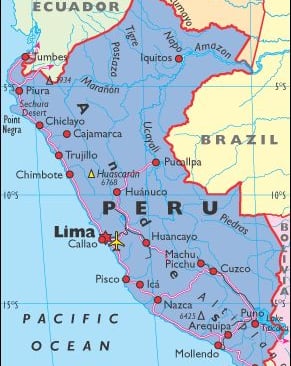
Section I - Basic Info on Peru
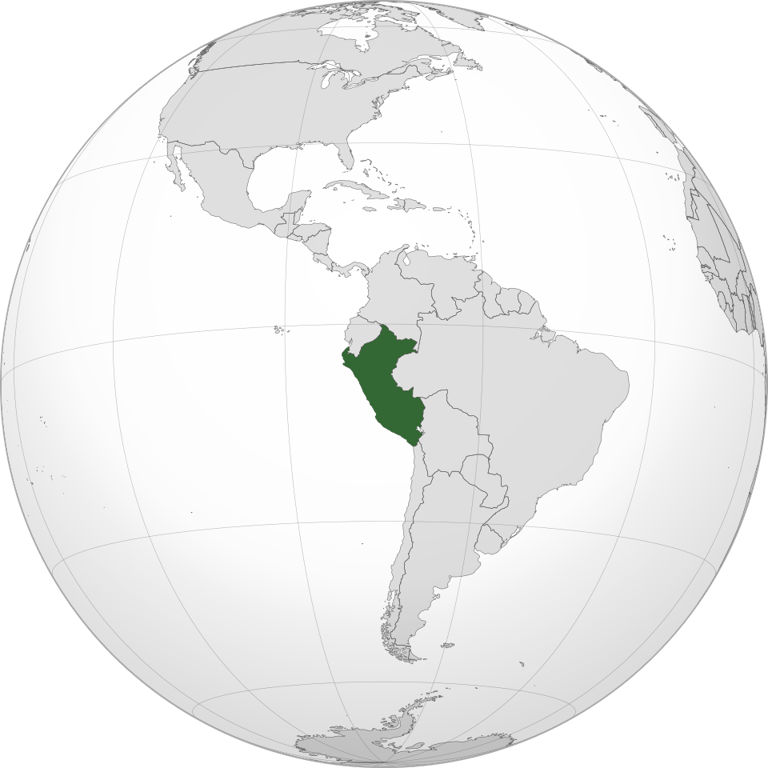
Official Name: Republic of Peru
Population: 32,768,614 (48th largest in the world, 7th largest in the Americas)
Area/Size: 496,225 square miles (about the size of Texas/New Mexico/Arizona combined)
Capital: Lima (11.5 million - sister city of Austin, TX and Madrid, Spain)
Spoken Languages: Spanish, Quechua, and Aymara (all official)
Religions: Catholic (82%), other Christian (15%)
Life Expectancy: 69.9 years Internet Access Rate: 82%
Per Capita Income: $17,802 Unemployment: 4.8%
What do they Export?: Copper ore, gold, grapes, zinc, other fruits
Export Partners: China (34%), United States (14%), Canada (5%), India (4%)
Import Partners: China (26%), United States (21%), Brazil (7%), Argentina (5%)
Government Type: Presidential republic (last election 2021, but president was impeached in late 2022 - vice president remains in power currently)
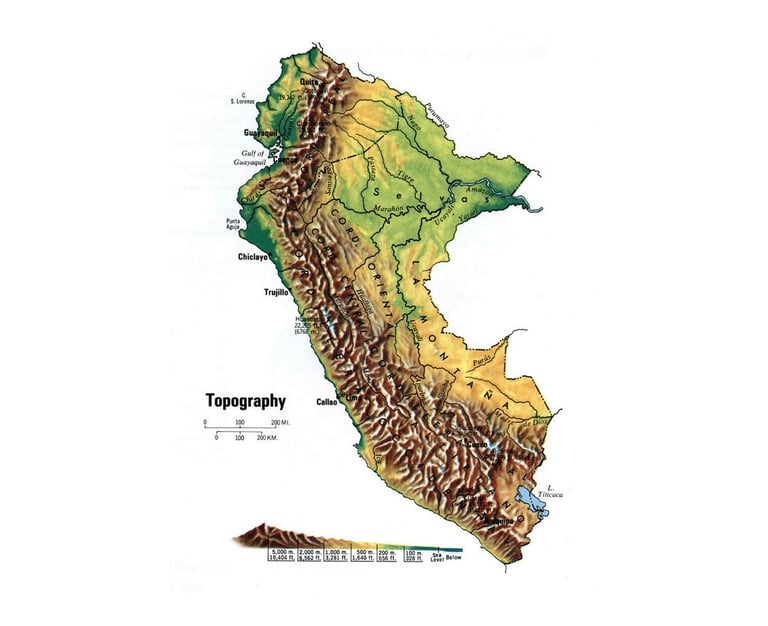
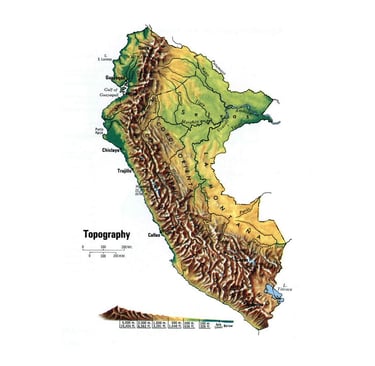
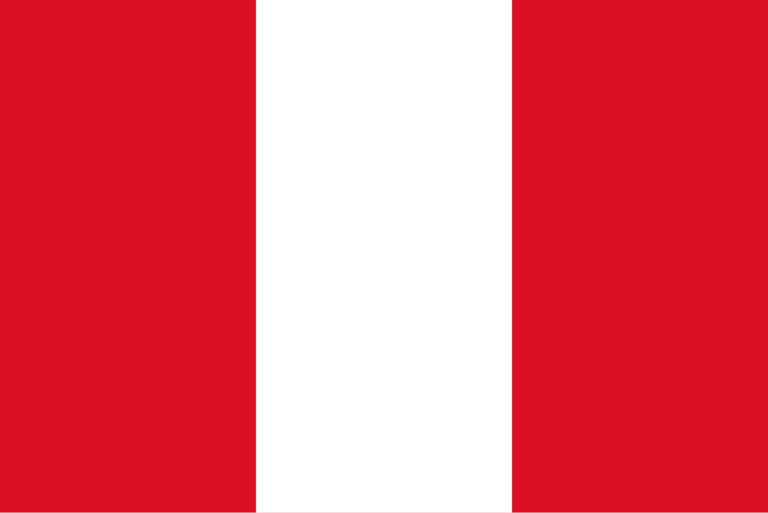
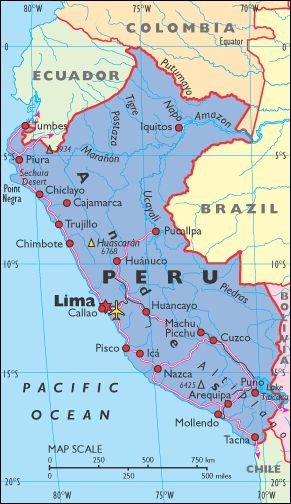
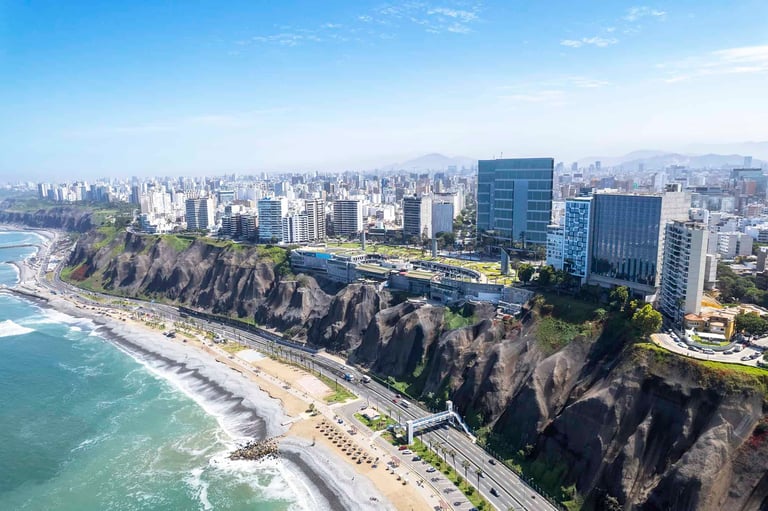
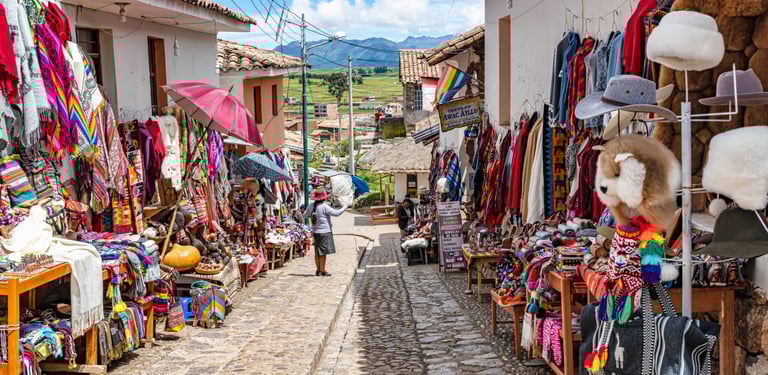
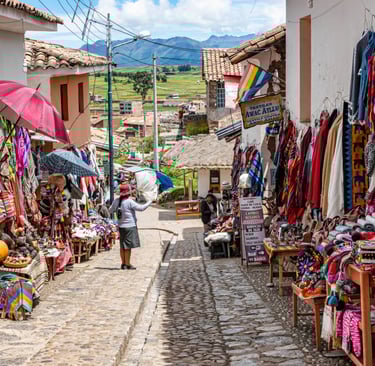
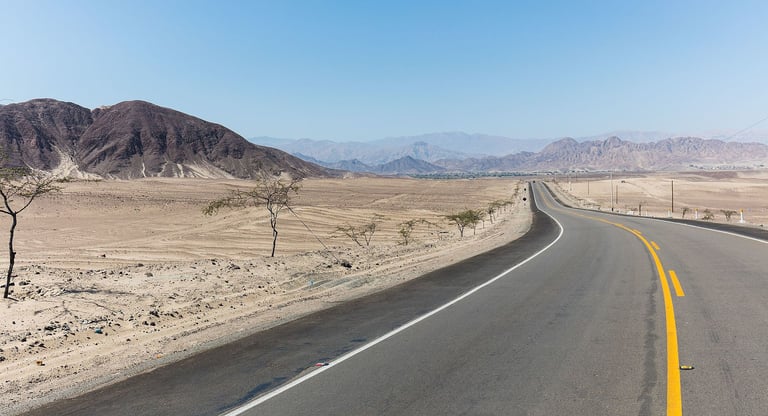
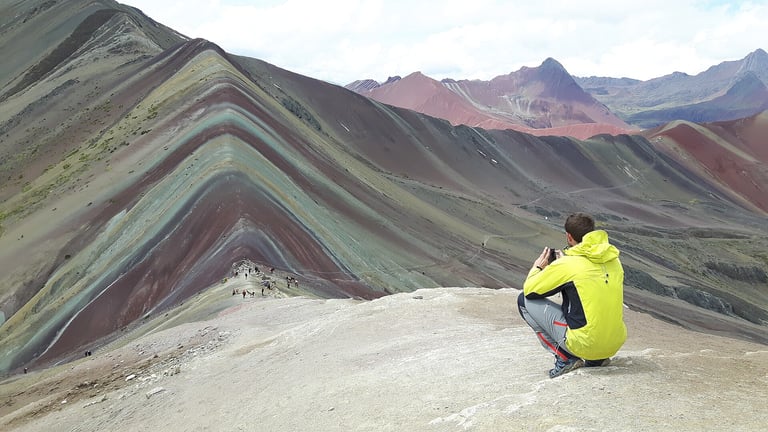
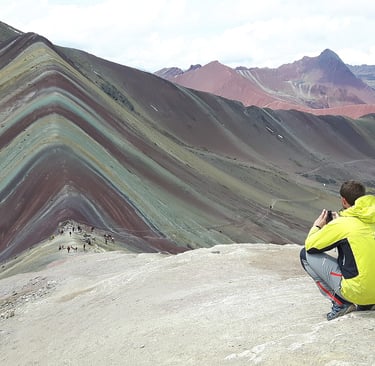
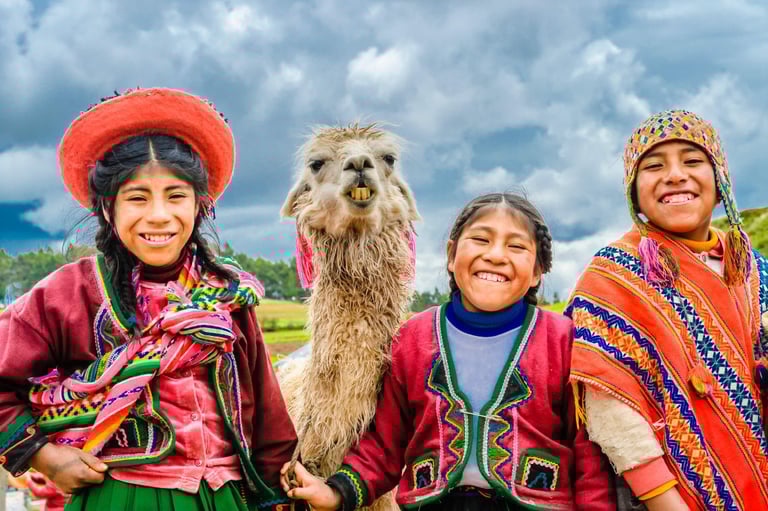
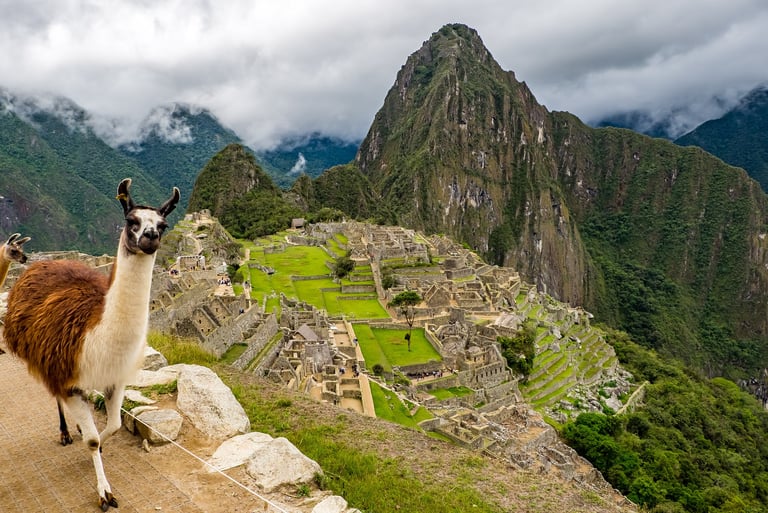
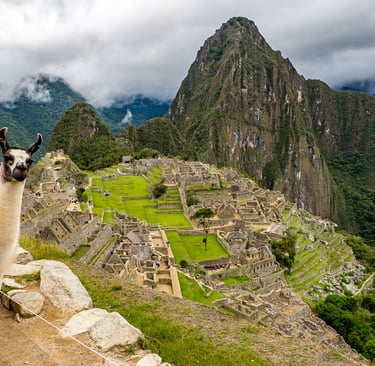
Section II - Images of Peru
7 Key Dates/Periods in Peruvian History
I'm going to keep this one fairly simple since so much of the history is influenced by its' large neighbors to the west and east. I also won't spend much time here on the recent history of governments - but will link an article or two in the current events section further below.
c. 1500 BC - 1450 AD - Andean societies were based on agriculture, using techniques such as irrigation and terracing; camelid husbandry and fishing were also important. The oldest known complex society in Peru, the Caral-Supe civilization, flourished along the coast of the Pacific Ocean between 3,000 and 1,800 BCE. The Chavín culture that developed around 1500BC was probably more of a religious than a political phenomenon. After the decline of the Chavin culture around the beginning of the 1st century CE, a series of localized and specialized cultures rose and fell, including the Paracas, Nazca, and Wari. The Moche, who thrived from 100-800AD, were renowned for their irrigation system which fertilized their arid terrain, their sophisticated ceramic pottery, their lofty buildings, and clever metalwork. The Chimu were the great city builders of pre-Inca civilization; as a loose confederation of walled cities scattered along the coast of northern Peru, the Chimu flourished from about 1140 to 1450.
1450 - 1533 - In the 15th century, the Incas emerged as a powerful state which, in the span of a century, formed the largest empire in the pre-Columbian Americas with their capital in Cusco. Inca expansion was slow until about the middle of the 15th century, when the pace of conquest began to accelerate, particularly under the rule of the emperor Pachacuti. Under his rule and that of his son, the Incas came to control most of the Andean region, with a population of 9 to 16 million inhabitants under their rule. From 1438 to 1533, the Incas used a variety of methods, from conquest to peaceful assimilation, to incorporate a large portion of western South America from southern Colombia to northern Chile, between the Pacific Ocean in the west and the Amazon rainforest in the east. The official language of the empire was Quechua, although hundreds of local languages and dialects were spoken. Many local forms of worship persisted in the empire, most of them concerning local sacred Huacas, but the Inca leadership encouraged the worship of Inti, the sun god and considered their King, the Sapa Inca, to be the "child of the sun." Atahualpa, the last Sapa Inca, became emperor when he defeated and executed his older half-brother Huáscar in 1532 to conclude a civil war.
1533 - 1800 - In Dec 1532, a party of conquistadors led by Francisco Pizarro defeated and captured the Inca Emperor Atahualpa in the Battle of Cajamarca. After years of preliminary exploration and military conflicts, it was the first step in a long campaign that took decades of fighting but ended in Spanish victory and colonization of the region known as the Viceroyalty of Peru with its capital at Lima. The conquest of Peru led to spin-off campaigns throughout the viceroyalty as well as expeditions towards the Amazon Basin. The Indigenous population dramatically collapsed overwhelmingly due to epidemic diseases introduced by the Spanish as well as exploitation and socio-economic change. Spanish viceroys reorganized the country with gold and silver mining as its main economic activity and first Amerindian (and later African slaves) as the primary workforce. With the discovery of the great silver and gold lodes in present-day Bolivia, the viceroyalty flourished as an important provider of mineral resources until the mid-18th century. The need to ease communication and trade with Spain led to the creation of new viceroyalties of New Granada and Rio de la Plata, and shifted the lucrative Andean trade to Buenos Aires and Bogotá, while the fall of the mining and textile production accelerated the progressive decay of the Viceroyalty of Peru.
1811 - 1870 - In the early 19th century, while most South American nations were swept by wars of independence, Peru remained a royalist stronghold. As the elite vacillated between emancipation and loyalty to the Spanish monarchy, independence was achieved only after the occupation by military campaigns of José de San Martín and Simón Bolívar. San Martin, with his army based in Chile, hoped to use diplomacy to avoid battle and sent representatives to Lima to propose the creation of a constitutional monarchy. The negotiations proved unsuccessful, but upon a retreat by Spanish forces into present-day Bolivia, San Martin was able to occupy Lima and declare Peruvian independence on July 28, 1821. The army of Simón Bolívar liberated Bolivia three years later, while José de San Martín retired from politics. The early years of the new country were fairly stable through increased state revenues from guano exports, but by the early 1870s the guano resources had been depleted, the country was heavily indebted, and political in-fighting was on the rise.
1870 - 1963 - In Apr 1879, Chile declared war on Peru, unleashing the War of the Pacific. Almost five years of war ended with Peru's loss of provinces in the Atacama region - the War of the Pacific was the bloodiest war Peru has fought in. After the War of the Pacific, an extraordinary effort of rebuilding began, as the government started to initiate a number of social and economic reforms to recover from the damage of the war. Internal struggles after the war were followed by a period of stability under the Civilista Party, which lasted from the 1880s until the start of the Great Depression in the early 1930s. Over the next 10 years, Peru also fought short wars with Colombia (1932-33) and Ecuador (1941), formalizing the boundaries between these countries. In a military coup in Oct 1948, General Manuel A. Odría became president and followed a populist course over the next 15 years that won him great favor with the poor and lower classes. At the same time, however, civil rights were severely restricted and corruption was rampant in his regime.
1963 - 2000 - Several coup d'états by the Peruvian military mark much of the 1970s and 1980s - also marked by the nationalization of the oil industry and efforts at agrarian reform. The economic turbulence of the time acerbated social tensions in Peru and partly contributed to the rise of violent rebel rural insurgent movements, like Sendero Luminoso (Shining Path) and MRTA, which caused great havoc throughout the country. Finally, in a break from the series of military takeovers, Alberto Fujimori assumed the presidency in 1990 and made agreements with at least some of the military officers wanting reform. When Fujimori faced opposition to his reform efforts, he dissolved Congress, suspending the judiciary, arresting several opposition leaders and assuming full powers in 1992. He then revised the constitution, called new congressional elections, and implemented substantial economic reform, including privatization of numerous state-owned companies, creation of an investment-friendly climate, and sound management of the economy. He also quelled the insurgent movements, but the fight was marred by human rights violations and atrocities committed by both the Peruvian security forces and the insurgents, eventually leading Fujimori to resign in Nov 2000.
2000 - present - Peru tried to fight corruption while sustaining economic growth at the start of the 21st century, but a series of short-lived presidencies and political conflict between the supporters of Fujimori (led by his daughter Keiko) and left-wing caretaker governments has accomplished little. In Apr 2009, former president Alberto Fujimori was convicted of human rights violations and sentenced to 25 years in prison for his role in killings and kidnappings by the Grupo Colina death squad during his government's battle against leftist guerrillas in the 1990s. The COVID-19 pandemic triggered an economic crisis that led to the removal of the president by Congress - over the next 2 years three more caretaker presidents would be forced to resign or impeached by the right-wing Congress. This culminated in late Dec 2022 with Vice President Dina Boluarte becoming the country's first female president for 3 years, but two more impeachment proceedings since then have left interim leadership in a state of uncertainty as Peru heads into general elections this month.
Other Non-Political Issues
Section III - Issues of Peru
General Information on Peru:
“Economy of Peru", The World Bank, Jan 2026, https://data360.worldbank.org/en/economy/PER
"Peru", National Geographic Kids, Jan 2026, https://kids.nationalgeographic.com/geography/countries/article/peru
“Peru", One World Nations Online, Jan 2025, https://www.nationsonline.org/oneworld/peru.htm
“Peru", Wikipedia, Apr 2026, https://en.wikipedia.org/wiki/Peru or https://simple.wikipedia.org/wiki/Peru
"The Story of PERU Explore its History and Culture | Travel Guide" (video), Opentiera, Dec 2023, https://www.youtube.com/watch?v=khYN-YSxzKo
"Visit Peru" (official tourism site), Commission for the Promotion of Peruvian Exports and Tourism, 2026, https://www.peru.travel/
History Links on Peru:
“A history of Peru | Curators' Tour of Peru: a journey in time" (video), The British Museum, Dec 2021, https://www.youtube.com/watch?v=-5bDoIDaYAY OR Museum page for the exhibition - https://www.britishmuseum.org/exhibitions/peru-journey-time
"Inca Island in the Sky (Full Episode) | Lost Cities with Albert Linn" (video), National Geographic, Feb 2024, https://www.youtube.com/watch?v=VB_WUMtdjpU
"Machu Picchu", History Channel, updated Jun 2025, https://www.history.com/articles/machu-picchu
"Mysteries of Machu Pichu Revealed | Modern Marvels (S10, E56)" (video), History Channel, Sep 2020, https://www.youtube.com/watch?v=bZdELQOmap4
“Peru's World Heritage Sites", UNESCO World Heritage Convention, 2026, https://whc.unesco.org/en/statesparties/pe AND specific page on Machu Picchu - https://whc.unesco.org/en/list/274
Current Events Stories on Peru:
“Five pieces of data about poverty and economic growth in Peru", The World Bank, Oct 2023, https://blogs.worldbank.org/en/latinamerica/datos-pobreza-crecimiento-economico-en-peru
"The latest on Peru’s escalating anti-government protests", PBS NewsHour, Jan 2023, https://www.youtube.com/watch?v=DDXe-gvKEVs
"Peru at a breaking point: How ten years of political chaos opened the door to organized crime", The Atlantic Council, Oct 2025, https://www.atlanticcouncil.org/blogs/new-atlanticist/peru-at-a-breaking-point-how-ten-years-of-political-chaos-opened-the-door-to-organized-crime/
"Peru election: Apathy and indecision deepen as country faces 9th leader in 10 years", Al-Jazeera English, Apr 2026, https://www.youtube.com/watch?v=bVjuD7YlEwI
"Peru: Meet the Candidates 2026", America's Quarterly, Feb 2026, https://www.americasquarterly.org/article/peru-meet-the-candidates-2026/
"Peru Votes for President, With 35 Names on the Ballot", New York Times, Apr 2026, https://www.nytimes.com/2026/04/12/world/americas/peru-presidential-election.html
Other Interesting Links Related To Peru:
"9 cultural traditions in Peru that still shape daily life", MSN, Apr 2026, https://www.msn.com/en-us/travel/tripideas/9-cultural-traditions-in-peru-that-still-shape-daily-life/ss-AA208IyH#image=1
"15 Traditional Peruvian Foods To Discover and Devour", Feastio, updated Apr 2026, https://feastio.com/peruvian-food/
"Peru: Captivating Landscapes" (video), House of Intent, May 2023, https://www.youtube.com/watch?v=tB7gKWRwHWk
"Peru Culture & Traditions: Language, Etiquette & Attire You Need to Know", International Travel, Mar 2018, https://internationalliving.com/countries/peru/traditions-and-culture-in-peru/
"Peru’s plan to drastically reduce Nazca Lines park size sparks concerns over environmental and heritage risks", CNN News, Jun 2025, https://www.cnn.com/2025/06/03/americas/peru-nazca-lines-park-environmental-risk-intl-hnk
Section IV - Resources About Peru
ECON and More
Curating articles for K-12 education.
CONTACT
© 2025. All rights reserved.