
Gas Prices and Sudden Spikes, Part I - Why and How They Happen
Read a couple of blog articles recently about changes in consumer preferences driven by MUCH higher gas prices, and thought a short article on resources wouldn't be a bad idea. PLUS - a couple of good resources to use to access recent prices and where that price comes from. In Part II I will focus on lesson plans to go with issues of gas prices.
Jay LeBlanc
3/23/20268 min read
As I mentioned in the intro, I read a couple of economics-based articles (which I will link here) on the choices people are making based on the sudden rise in gas prices over the past month. I don't want to get into issues of the conflict with Iran, but simply focus on the "unintended consequences" and how individuals confront those decisions. As I say repeatedly in this blog, economics is the study of CHOICES - so I'm going to focus here on what options individuals have, what factors affect those choices, and some lesson plans and resources to help you present them to your students.
I'm going to set this first portion up in three parts:
What is the situation with gas prices and where does that price come from?
Bigger picture, what elements will determine future prices in the industry? (NOT looking at the war, just the supply chain and scarcity issues)
What kind of resources could you use to bring this topic to your classroom?
Part I - What is the situation with Gas Prices, and What is Determining that Price?
Rather than starting with definitions or a long explanation, let's start with a choice of two video clips on how gas prices are determined. This first one is from a relatively-new YouTube channel called "Explaining Economics Like You're Five" (it has been around about 7 months) and runs about 9 minutes. Good for the K-8 classroom, but I would have no problem showing it in a regular-level high school classroom or to adult learners . . .
If you are looking for something a little closer to AP or college level, here is Jacob Clifford's take on the topic - I particularly liked how he uses supply/demand graphs to show how the "equilibrium" price is (or can be) constantly moving as new information impacts either supply or demand (or both). As usual with his videos, this is relatively short (5 minutes) but gets to the point quickly . . .
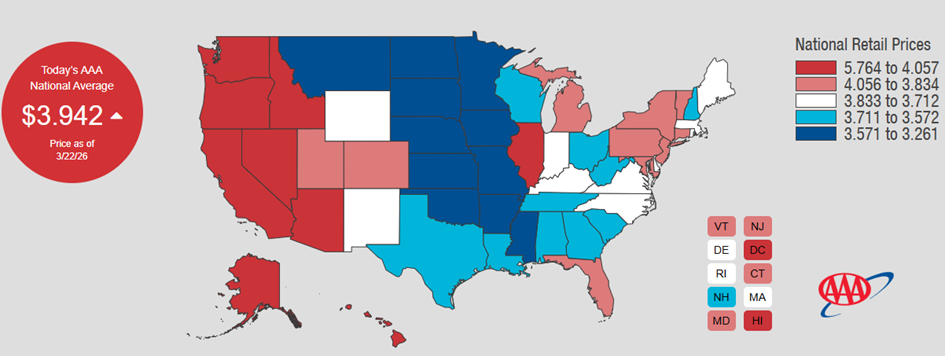
From there, let's look at a couple of good graphics to demonstrate the impact of gas prices. First, here is a daily update (from AAA) of gas price averages around the country (as of 3/23):
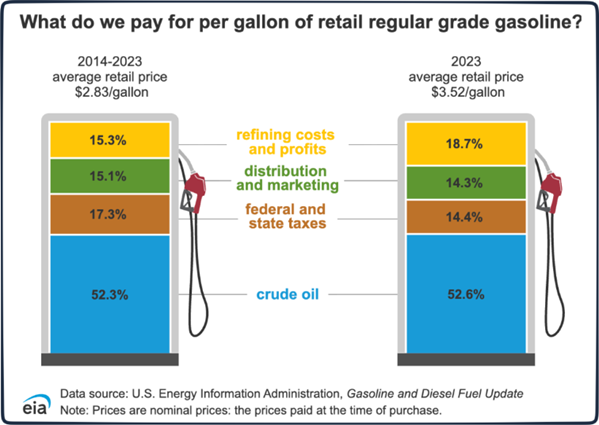
Now you could, of course, assume that this is another one of those "red state/blue state" things . . . and some of that does have a correlation (like local tax rates or surcharges for global warming efforts). But this next graphic gives you a more specific look at what elements make up the per gallon price . . .
I'm not going to get into it within the scope of this post (too easy to go down too many "rabbit holes"), but I am also linking below an interesting article I read from the same group that did the graphic above (the U.S. Energy Information Administration) detailing the elements that increase the price of gasoline in California specifically. It might be a beneficial trade-off (economics deals with trade-offs all the time) but it is nice to have the choice and opportunity cost spelled out in an article like that.
Part III - Resources/Articles on the factors impacting gas prices in general:
"AAA: Drivers Change Habits to Counter High Gas Prices", AAA Oregon/Idaho, Jun 2022, https://info.oregon.aaa.com/aaa-drivers-change-habits-to-counter-high-gas-prices/
"Factors That Affect Gas Prices: Gasoline prices are one of the most recognizable price points in American commerce", NACS, Feb 2025, https://www.convenience.org/Topics/Fuels/The-Price-Per-Gallon
"Gas Prices Explained - Econ in Real Life" (video), Jacob Clifford, Sep 2022, https://www.youtube.com/watch?v=XCCt7cxcgs0
"How Americans Are Navigating Higher Energy Costs on Every Front", Wall Street Journal, Mar 2026, https://www.wsj.com/economy/consumers/how-americans-are-navigating-higher-energy-costs-on-every-front-ee71f1ed?
"How fuel crises change consumer behavior at the pump", Upside Business Blog, Jul 2025, https://www.upside.com/business/retailer-blog/fuel-crises-consumer-behavior
"National average gas prices", AAA Auto Club, Mar 2026, https://gasprices.aaa.com/
"The Reason Why Gas Prices Change Every Week - Explained Like You're Five" (video), Explaining Economics Like You're Five, Sep 2025, https://www.youtube.com/watch?v=NgkUIm77-Ro
"Small comforts fade and big worries grow as fuel prices surge around the world", PBS Newshour, Mar 2026, https://www.pbs.org/newshour/world/small-comforts-fade-and-big-worries-grow-as-fuel-prices-surge-around-the-world
"Understanding Demand Destruction: Causes and Effects", Investopedia, Jan 2026, https://www.investopedia.com/demand-destruction-5222107
"Where Do We Care the Most About Gas Prices?", EconLife, Mar 2026, https://econlife.com/2026/03/rising-gasoline-prices/
"Why California Usually Pays More at the Pump for Gasoline", U.S. Energy Information Administration (EIA), May 2025, https://www.eia.gov/todayinenergy/detail.php?id=65184
Part II - What Elements Will Determine Future Prices in the Industry?
Again, I don't plan to speculate on the course of the conflict with Iran or other possible unintended consequences in the Middle East (like the LNG plant in Qatar that says it will take 2+ years to repair the damage Iranian missiles have done to their infrastructure). This portion is mostly based on a VERY interesting article from NACS (formerly the National Association of Convenience Stores), which is a nonprofit that advises small gas stations and convenience stores across the country on the latest trends impacting store profitability (like higher gas prices, for example). I just want to highlight a few of the factors they believe will impact trends in gasoline prices over the short and long-term:
Factors Affecting Price, Part I - "Ownership and Supply Arrangements":
Despite the elements in the media that sometimes claim gas price hikes are all part of an evil multinational conspiracy led by large petrochemical companies, NACS reminds us that only about 4% of convenience stores selling gas are owned by a refining company, and less that 0.2% are owned by a major oil company. 95% of convenience stores are owned either by individual owner/operators or regional chains, and their gas prices are typically determined locally in response to the cost of obtaining the gasoline from the distributor. Here are those four main factors:
Fuel type: Stores that sell fuel under the brand name of a refiner (Conoco, Shell, Mobil, etc..) typically pay a premium for that fuel, which covers marketing support and signage, as well as the proprietary fuel’s additive package.
Delivery method: Retailers who purchase fuels via “dealer tank wagon” have fuel delivered directly to the station by the refiner. These retailers may pay a higher price than those that receive fuel at “the rack” or terminal. In addition, retailers may contract with a jobber to deliver fuel to their stations or operate their own trucks, and the choice will influence overall costs.
Length of contract: Retailers may have long-term contracts with a specific refiner. The length of the contract, which can be 10 or more years, and associated terms of that contract can affect the price retailers pay for fuel.
Volume: Retailers may receive a better deal based on the amount of fuel they purchase, whether based on volume per store or total number of stores.
Factors Affecting Price, Part II - "Sales Strategies":
The other main factor affecting price, of course, is the combination of business sales strategies used by individual stores and large chains to "stand out" from the competition, either publicly or behind the scenes. I will briefly mention a few (again, largely borrowing from NACS's report):
Location: Stores located in areas where real estate costs are high may pass along a cost of business when setting their retail fuel prices. Some stores may factor in seasonality, particularly if they are in a location where customer traffic dramatically changes during the summer and winter months. Other stores may be in a competitive market where consumers have ample choices of where to shop (or in rural areas may be the "only game in town" literally).
When the fuel is purchased: Competing retailers may have different wholesale prices based on when they purchased their fuel, especially during times of extreme price volatility. Gasoline is a commodity, and its wholesale price can have wild swings. Depending on sales volumes and storage capacity, some retailers may receive three deliveries a day, while others receive one delivery every three days. Retailers may not be able to adjust their prices when wholesale prices increase because a competitor may not be experiencing an increase in their cost of goods sold. Conversely, a retailer may adjust gas prices when the competition adjusts prices, either following or in advance of a fuel shipment.
"Profit-driven" or "Loss-leader": Retailers often consider whether to sell gas at a low profit per unit and make up for it on volume, or sell gas at a higher profit per unit and expect less volume. So for example, a membership-based company like Costco or Sam's Club may offer lower gasoline prices as an incentive to draw in members, assuming they will make their profit in other areas of the store. In the same way, some stores offer incentives in the form of credit card discounts or tie-ins with grocery store chains.
Price Lags: Retailers tend to reduce their markup to remain competitive with nearby stores when their wholesale gas prices increase. This can lead to a several-day lag from the time wholesale prices rise until retail prices rise. Likewise, when wholesale gas prices decrease, retailers may be able to extend their markup and recover lost profits, with retail gas prices dropping slower than wholesale prices. But . . . you can also see anticipatory price increases when major events (like war or natural disasters) lead stores to believe that supplies may not be able to meet demand.
What Does That Mean for Consumers?:
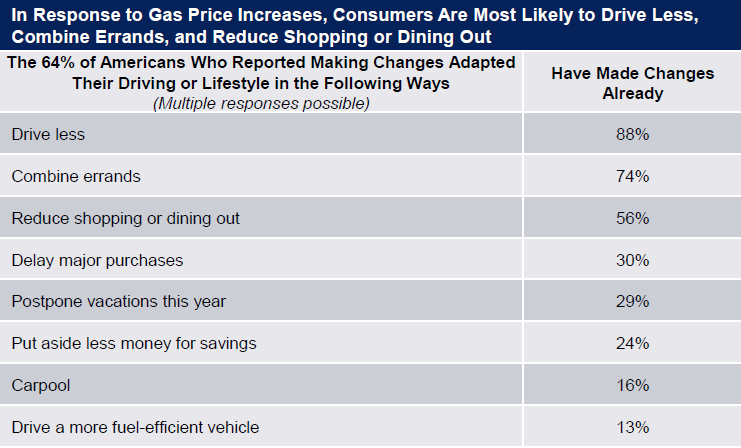
The impacts for consumers are varied - there will be a certain percentage of the population (families and businesses) that will simply plan to pay more and otherwise not change behavior. For many people, though, short-term changes tend to look for ways to adapt or save. This chart is based on a survey done in 2022 at the time of the last major gas price spike (during the spike of inflation that year) but represents a lot of the choices being made by families now - I only listed the responses reported by 10% or more of the respondents:
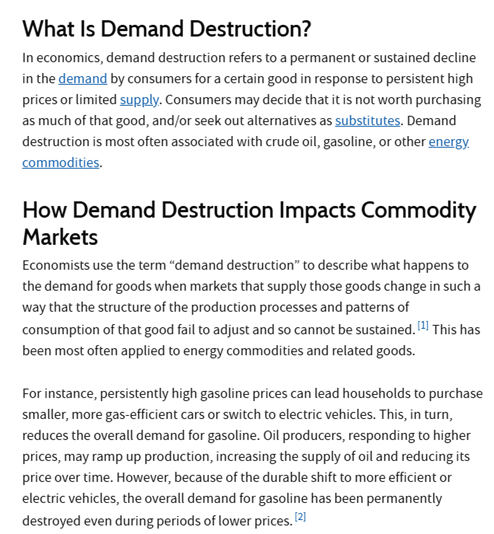
Beyond the choices you see above, think about the ones you DO NOT see. 5% or less of the respondents advocated major lifestyle changes or major purchases to adapt to a new paradigm - for example, taking public transportation or buying an electric vehicle. Those types of bigger decisions could be made if the gas prices stay high for a more extended period of time, but often have their own sets of unintended consequences (for example, a potential rise in the cost of an EV or the cost of charging rates). Economists monitor the possibility of "demand destruction" - when the paradigm DOES shift and new rules are either more acceptable to families or imposed by a government. As defined by Investopedia:
J.P. Morgan analysts are already warning of that possibility in many Asian countries (which are impacted more directly by oil supply issues in the Strait of Hormuz) . . .
“The response from Asian governments is, in JPMorgan’s view, further evidence that demand destruction has become an administrative phenomenon as well as a market-driven one. Bangladesh brought forward Eid al-Fitr and closed universities to save fuel. The Philippines and Sri Lanka introduced four-day workweeks. Pakistan shut schools and shifted universities to remote learning. Thailand and Vietnam encouraged work from home and limited vehicle use. Myanmar introduced alternating driving days. India suspended LPG shipments to commercial operators to prioritize household supply. Taken together, these measures amount to what (J.P. Morgan) describes as emergency demand management.”


ECON and More
Curating articles for K-12 education.
CONTACT
© 2025. All rights reserved.