Spreading It a Little Thin - The New Trend of "Peanut Butter Raises"
Saw a couple of references to this trend in the past week, and knew I would have to investigate. Not planning to make this a long one - mostly just give you some places to explore for yourself and a couple of ideas for classroom materials on the topic.
Jay LeBlanc
2/27/20264 min read
As I mentioned in the intro, I coincidentally saw two different references to this trend last week - so I decided to do a little investigating. Apparently it began as a TikTok trend, but quickly became an information point for business periodicals and a few news organizations to go into in more detail. There is not a lot yet on this as a source of educational lessons, BUT it does fit with existing economic concepts like compensation for employees and strategies to retain human resource talent. So I will still throw a few classroom resources in at the very end.
I'm going to set this up into three parts:
What are "peanut butter raises" and why are they becoming a "thing" in 2026?
What are the long-term implications of "peanut butter raises" for companies in and beyond 2026?
What kind of resources could you use to bring this topic to your classroom?
Part I - What is a "Peanut Butter Raise"? And Why Should I Care?
Rather than a definition, let's start with a video clip from "What the Tech!" (a video blog doing short video segments on the freshest technology news and emerging tech trends . . . with a healthy dose of skepticism). This is about 5 minutes, and does a good job of explaining multiple layers of this trend:
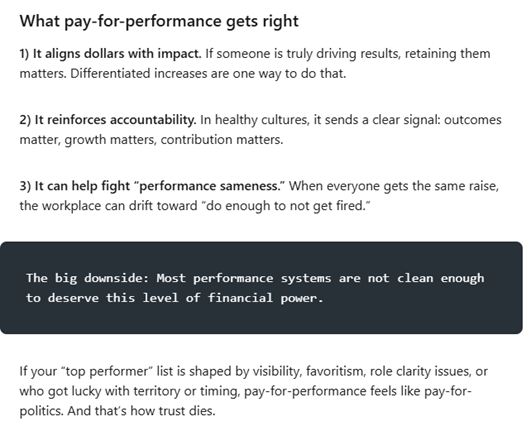
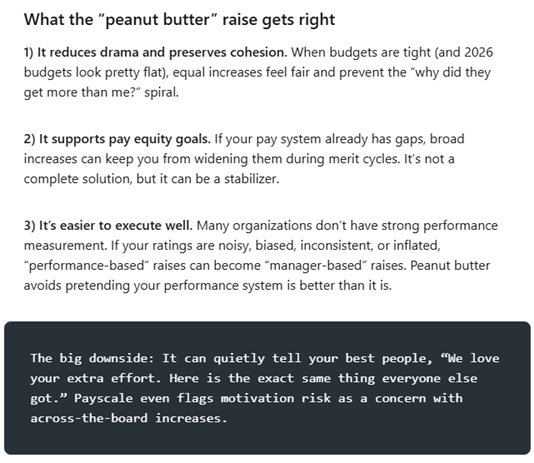
Now you can probably figure out pretty quickly that this is nothing new - just a new name for an old issue (whether it is called "cost-of-living raises" or simply "equity"). I'm going to borrow from a LinkedIn post by Curt Archambault (which I will link below so you can go and read the whole thing) - he does a great job of spelling out the positives and negatives of this approach:
By the way, I also really liked one of Curt's summary phrases about why neither of these systems works in isolation (beyond the obvious conflicts of interest). Curt says the anticipated 3% average raise in compensation (which he also notes hasn't changed much in 30 years) is "arguing about how to slice a pizza that’s already too small."
Resources directly referenced (or linked) in the article above:
"2026 Pay Trend: Peanut Butter Pay Increases on the Rise", Payscale.com, Jan 2026, https://www.payscale.com/press-releases/2026-pay-increases-preview (NOTE - the full report is linked within if you are interested)
"Hoping for a Raise this Year? You're Not Alone" (video reel), HerMoney from Jean Chatzky, Jan 2026, https://www.instagram.com/reels/DUWagv2D9uo/
"How So-Called Peanut Butter Raises Could Affect Your Paycheck in 2026", Investopedia, Jan 2026, https://www.investopedia.com/how-peanut-butter-raises-could-change-your-paycheck-in-2026-11893236
"Nearly half of companies are turning to poor ‘peanut butter’ raises—following the same pattern of the 2008 recession, an expert says. And it could take years to recover", Fortune, Feb 2026, https://fortune.com/2026/02/24/nearly-half-companies-ditching-merit-based-bumps-peanut-butter-raises-same-tactic-2008-recession/
"‘Peanut butter’ pay raises could cost companies their top performers, according to experts: ‘It’s such a shortsighted strategy’" (video), CNBC MakeIt, Feb 2026, https://www.cnbc.com/2026/02/22/peanut-butter-pay-raises-could-cost-companies-their-top-performers-according-to-experts-its-such-a-shortsighted-strategy.html
"Peanut Butter Raises: When Fairness Undermines Motivation", Curt Archambault at LinkedIn, Feb 2026, https://www.linkedin.com/pulse/peanut-butter-raises-when-fairness-undermines-curt-archambault-uopwc/
"The Peanut Butter Raise Standardizing Pay in 2026" (video episode #109), What the Tech!, Feb 2026, https://www.youtube.com/watch?v=JGILUYAXMlE
"Peanut Butter Raises Could Cost Companies Their Cream Of The Crop", Benzinga, Feb 2026, https://www.benzinga.com/markets/economic-data/26/02/50945289/peanut-butter-raises-could-cost-companies-their-cream-of-the-crop
More General Resources on the Topics of Employee Compensation/Human Capital:
"2026 Salary Guide From Robert Half Inc.", RobertHalf.com, 2026, https://www.roberthalf.com/us/en/insights/salary-guide
"COMPARE: Choosing Between Job Offers" (lesson plan), NextGen Personal Finance (NGPF), https://docs.google.com/document/d/1wI_AzCuGAUZnaw8QMMEdLka5dGB30Jnucj1QFdIdkXI/edit
"Employee Compensation and Benefits" (a CTE lesson plan), Texas State CTE, 2017, https://txcte.org/sites/default/files/resources/documents/Lesson%20Plan%20Employee%20Compensation%20and%20Benefits_0.docx
"How to Create an Employee Compensation Plan" (article), Ramsey Solutions, Sep 2023, https://www.ramseysolutions.com/business/how-to-create-an-employee-compensation-plan
"It's Your Paycheck: Invest In Yourself" (lesson plan), Federal Reserve Education, 2022, https://www.federalreserveeducation.org/teaching-resources/personal-finance/earning-income/invest-in-yourself
"Understanding salary trends for 2026" (video), FOX 19 Cincinnati, Oct 2025, https://www.youtube.com/watch?v=dkP2UlgenLo
"Your First Week and Beyond" (lesson plan on job skills), NextGen Personal Finance (NGPF), https://docs.google.com/document/d/1KF6HgNo-jr0dvYX0-ivgXxgN1muApnP6k7zU1hwElNA/edit
Part II - What Are the Implications Going Forward?
So what does this trend mean going forward? Well, Payscale just completed their 2025-2026 Salary Payscale Survey, and a few of their trends are summarized below (based on a median 3.5% increase for this year):
According to new research from Payscale’s 2026 Compensation Best Practices Report:
48% of organizations plan to continue pay increases based on performance
18% of organizations are considering peanut butter pay increases
16% of organizations are newly planning to implement peanut butter increases
9% of organizations already use peanut butter increases as their approach
8% of organizations are unsure
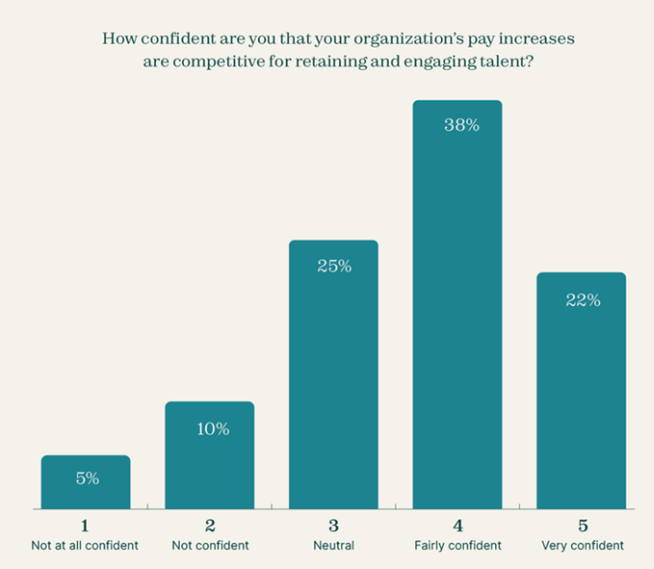
But of course, there is another factor at play in those numbers - WHY are you giving raises at all . . . ?
That could be a correct assessment . . . but experts also note that the "cream of the crop" workers typically have many more options and opportunities to be hired by a competitor or move into a new field. Fortune Magazine, in a recent article linked below, notes comparisons to the similar compensation strategies used by companies in the wake of the 2008 recession, and the side effects those had:
“Obviously, smaller pay budgets are going to make pay increases individually smaller, [with a] lack of differentiation amongst colleagues. That will probably be de-motivating,” Ruth Thomas at Payscale notes to Fortune. “Although we’re in an employer’s labor market, organizations still want to retain their top talent. Top talent are going to seek some type of reward for their input to the organization, and that may be a difficulty for many organizations.”
And extending the analogy, a lot of short-term satisfaction may simply be determined by how thickly (or thinly) the peanut butter is spread. Not only in terms of the overall compensation budget for the organization, but in terms of whether company executives are perceived as sharing in the "pain" or not . . .