Tax Day is Here! How Does the Money Get Spent . . ?
Didn't really plan this one ahead of time, but I was listening to the Marketplace Morning Report podcast earlier this week on this theme (how your federal taxes get spent after Tax Day) and thought it was a great opportunity to remind teachers of classroom lesson plans for that same topic.
My hope is that teachers are already familiar with these, but I'm always running into people (particularly newer teachers) who are not familiar with what is already available to help your students understand how money is allocated in the federal budget. Keep in mind this is a subject you can make as complex (or as simple) as you want to - in Colorado elementary students have standards about understanding what things taxes pay for, and I have led 4th grade classes through activities on sales taxes and how much money a new skateboard park for the community costs. Most of this post, though, is going to focus on federal taxes, since that is the focus of April 15th (not local sales or property taxes).
I'm not going to go into too much detail on this one - I really didn't plan this out in advance like I normally do. Just want to make you aware of the "go-to" resources out there - a couple of lesson plans, three sources for infographics, and a trifecta of videos:
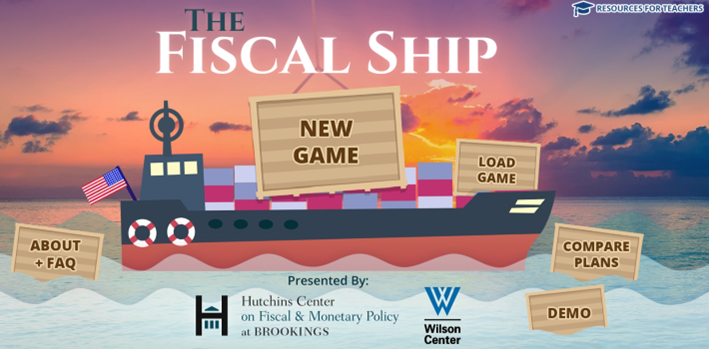
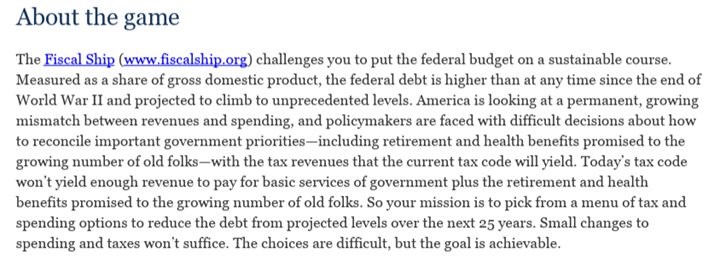
LESSON #1 - "The Fiscal Ship" - created by the Brookings Foundation, with lesson plan from the Council for Economic Education:
Right to playing the game! - https://fiscalship.org/
"The Fiscal Ship as a Teaching Tool" guide to the game - https://www.brookings.edu/wp-content/uploads/2019/06/Fiscal-Ship-Game-Guide_new-1.pdf
Lesson Plan for teachers to use in the classroom - https://econedlink.org/resources/federal-budget-lesson-plan-and-fiscal-ship-student-game/?view=teacher
YouTube video on how to play the game - https://www.youtube.com/watch?v=QSWUcaT4GGA
NOTE - The Foundation for Teaching Economics (FTE) also has a lesson plan using "Fiscal Ship" specifically in the area of national debt called "Lesson 3: Is Our Federal Debt Sustainable?" https://fte.org/wp-content/uploads/FBDD-Lesson-3-with-The-Fiscal-Ship-.pdf More on FTE's other lesson plans below . . .
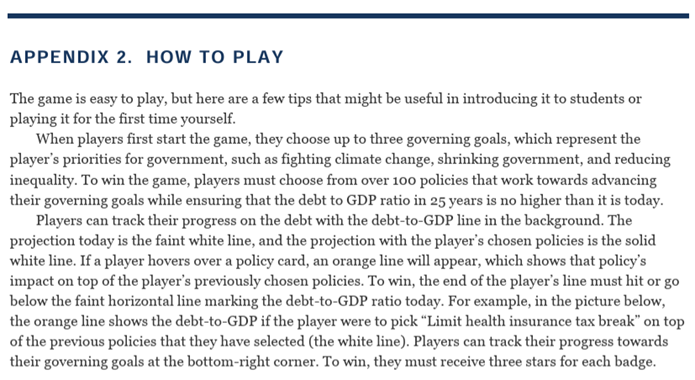
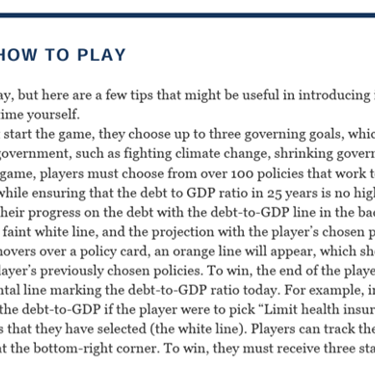
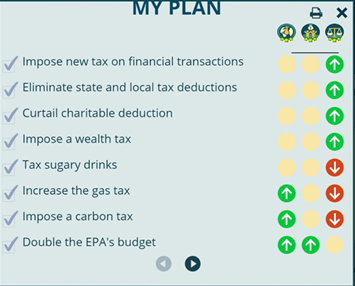
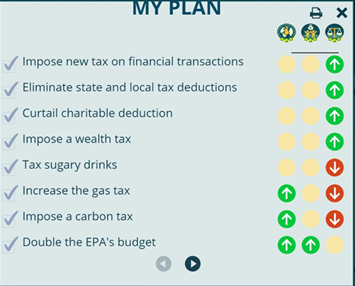
Here are some elements of what the game and the lesson look like (I'm not going to include much, since I want you to visit their websites):
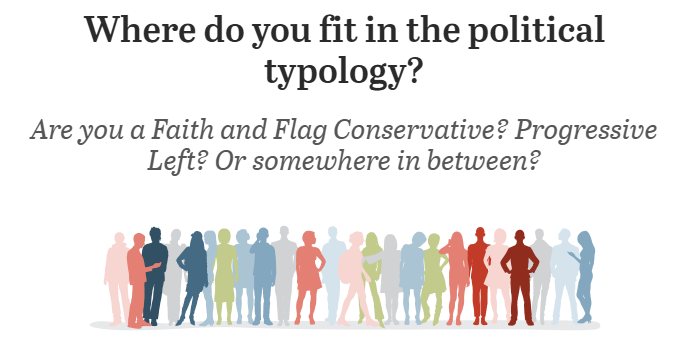
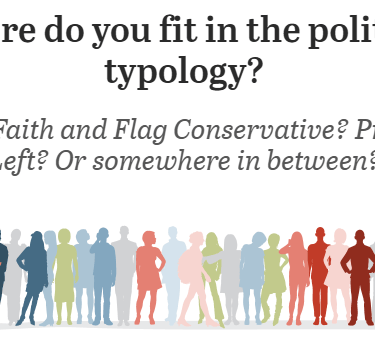
I would really suggest playing it yourself a couple of times, as well as watching the videos provided (above) by Brookings and CEE - they have a LOT of resources available for lesson structure and scaffolding, as well as monitoring students to make sure they don't get overwhelmed. One other extension I like for high schoolers (recommended by CEE) is the Political Typology Quiz from the Pew Research Center - get students thinking about whether they believe what they are advocating for.

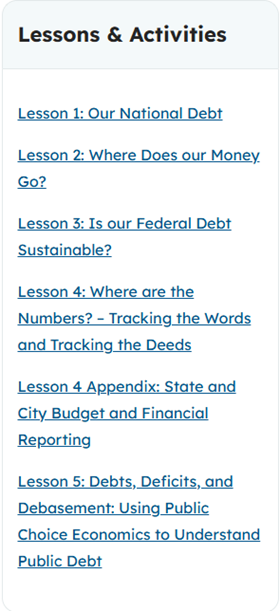
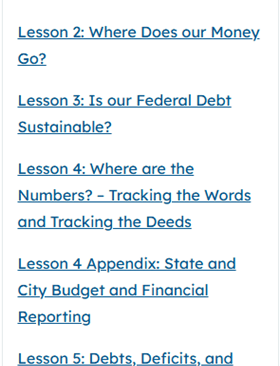
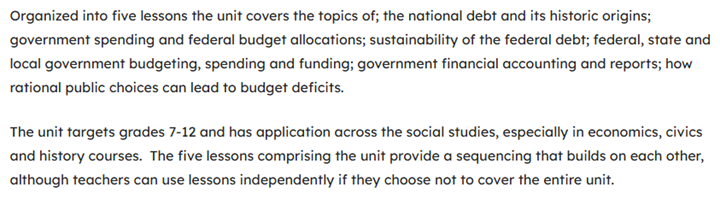
LESSON #2 - "Making Sense of the Federal Budget, Debt & Deficits" - a series of 5 lessons created by the Foundation for Teaching Economics (FTE)
Main page for the "Making Sense of the Federal Budget, Debt & Deficits" series - https://fte.org/teachers/teacher-resources/lesson-plans/making-sense-of-the-federal-budget-debt-deficits/
Appendix specific to State and Local Budgets - https://fte.org/teachers/teacher-resources/lesson-plans/making-sense-of-the-federal-budget-debt-deficits/lesson-4-appendix-state-and-city-budget-and-financial-reporting/
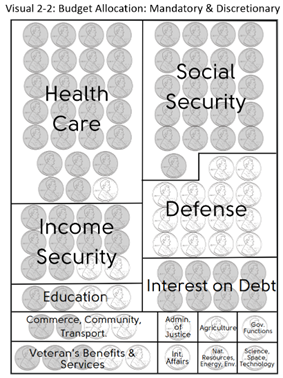
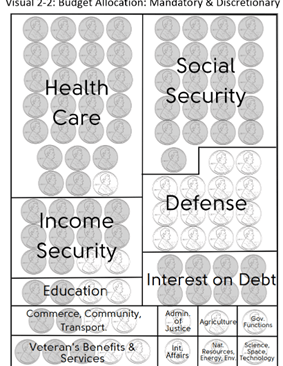
Video demonstration of the "To The Penny" activity contained in Lesson 2 - https://www.youtube.com/watch?v=CVPnaRg71qQ
A teacher webinar done by FTE on a related topic - "Spending My Money or Your Money: How The Incentives Change" - https://www.youtube.com/watch?v=b27HgQnDOMk
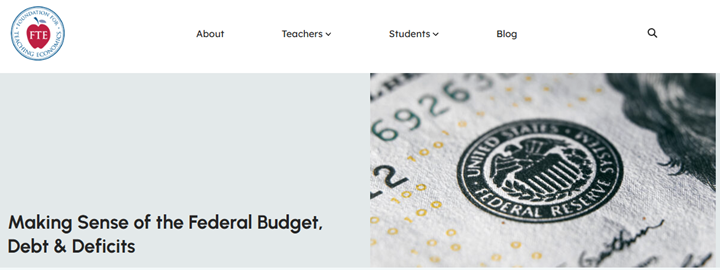
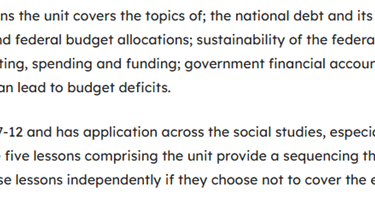
Here are some elements of what the series of lessons looks like (I'm not going to include much, since I want you to visit their websites):
In my opinion the "To The Penny" activity (and the discussions in Lesson 2 that go with it) is the highlight of this series of lessons, though if you are focusing on debt issues the lessons go much further into that. Worth noting - finding sets of 100 pennies IS getting more difficult - you might have to consider using plastic counters instead!
Sometimes you don't need a full lesson - just a resource to supplement an existing economics or government unit. So following this are three (3) infographics and two (2) videos (in addition to the videos mentioned in the lesson plans) that you could use to either integrate into your plans OR use the link to find something else that fits better . . .
INFOGRAPHIC #1 - "Infographics About the Federal Budget in Fiscal Year 2025" - created by the Congressional Budget Office (nonpartisan analysis for the U.S. Congress), as of Mar 2026:
Main page for the Congressional Budget Office - https://www.cbo.gov/
Main page for the new infographics (NOTE that each page has a separate infographic to download) - https://www.cbo.gov/publication/62286
This (below) is just one portion of one infographic in the set (as a sampler - I want you to go look for yourself):
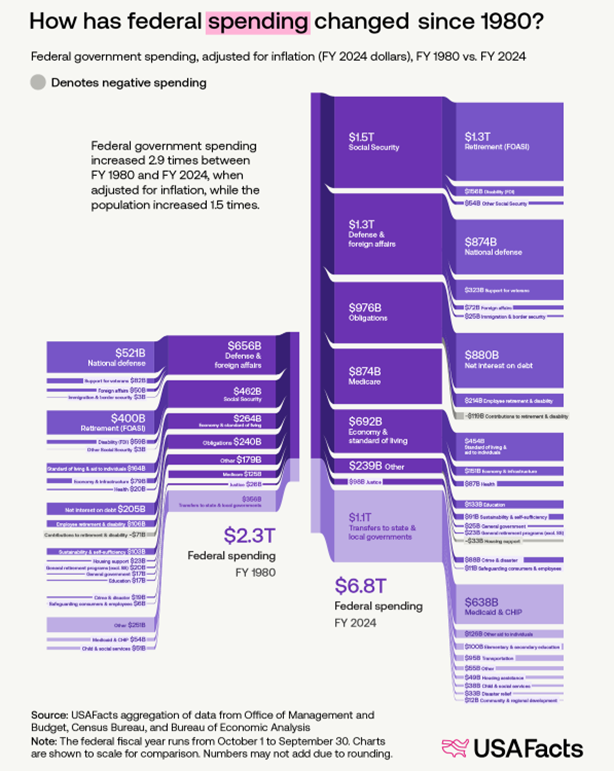
INFOGRAPHICS #2 - Two Infographics on Aspects of Government Spending and Federal Debt - created by the Visual Capitalist:
Main page for Visual Capitalist (with many more infographics) - https://www.visualcapitalist.com/
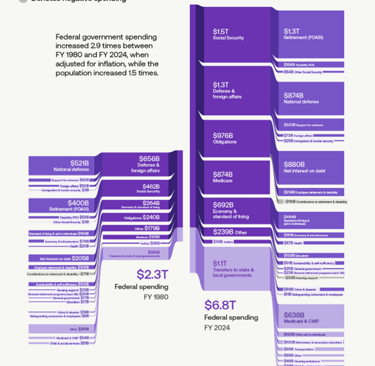
"Visualized: U.S. Government Spending (1980 vs. Today)" infographic, dated Sep 2025 - https://www.visualcapitalist.com/cp/us-government-spending-1980-vs-today/
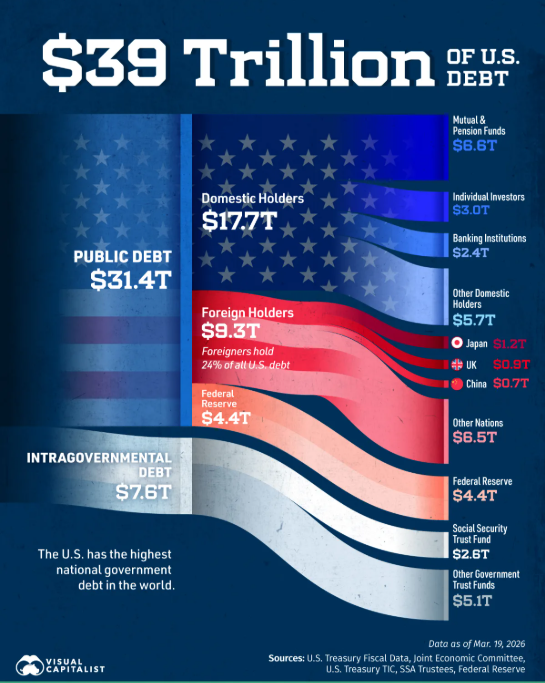
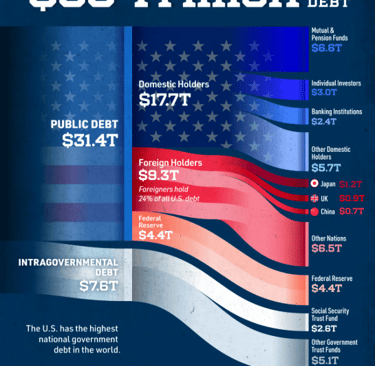
"Who Owns America’s $39T Debt?" infographic, dated Apr 2026 - https://www.visualcapitalist.com/see-who-owns-the-39-trillion-u-s-debt-in-2026-from-domestic-and-foreign-holders-to-the-fed-and-mutual-and-pension-funds/
INFOGRAPHICS #3 - A series of Infographics designed to put the "Federal Budget In Pictures" - created by the Heritage Foundation:
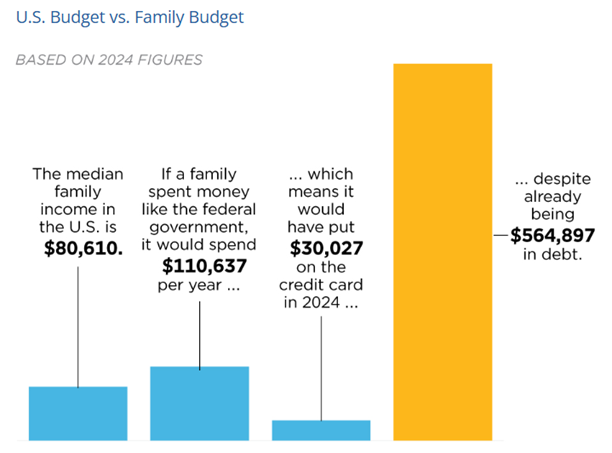
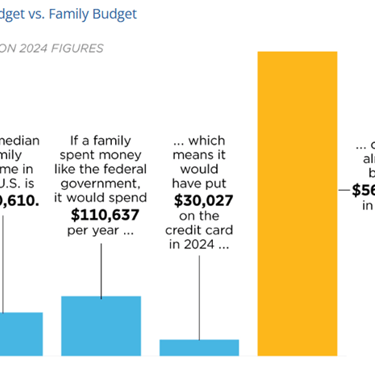
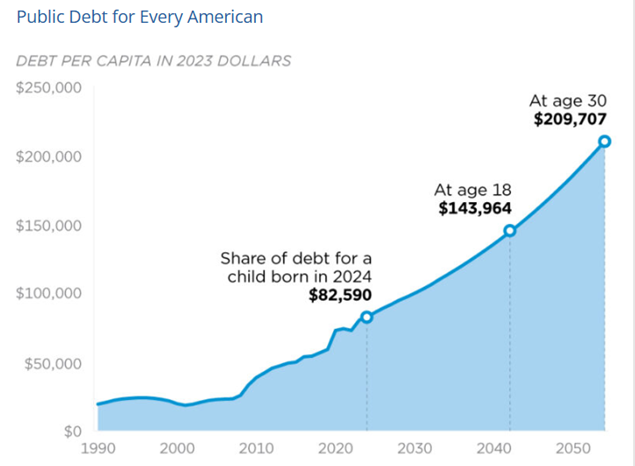
NOTE: I recognize that the Heritage Foundation leans on the conservative side, but the numbers don't change no matter which side of the political spectrum you are on . . . it probably impacts more which data you choose to feature. Either way, I really liked some of their graphics helping ordinary citizens (like you and your students) relate to the large numbers being "bandied" around:
"Federal Budget In Pictures" infographic page - https://www.federalbudgetinpictures.com/

"To The Penny" activity demonstration video:
For the videos I'm going to keep it pretty simple (but I will add the intended audience - either grade level or subject - to each title:
VIDEO #1: - What Is a Government Budget? How Governments Plan Their Money!: A Kids Guide" - created by Little Money Minds (Nov 2024), for Elementary (K-5):
Link to the video - https://www.youtube.com/watch?v=lLEhhUmTERo
VIDEO #2 - "Federal Spending, Debt, and Deficits" - created by Professor Dave Explains (Feb 2023), for Middle/High School:
Link to the video - https://www.youtube.com/watch?v=OykRnIniC6g
VIDEO #3 - "Monetary and Fiscal Policy: Crash Course Government and Politics #48" - created by Crash Course (updated 2016), High School ECON or GOVT:
Link to the video - https://www.youtube.com/watch?v=_tULRch1PRQ
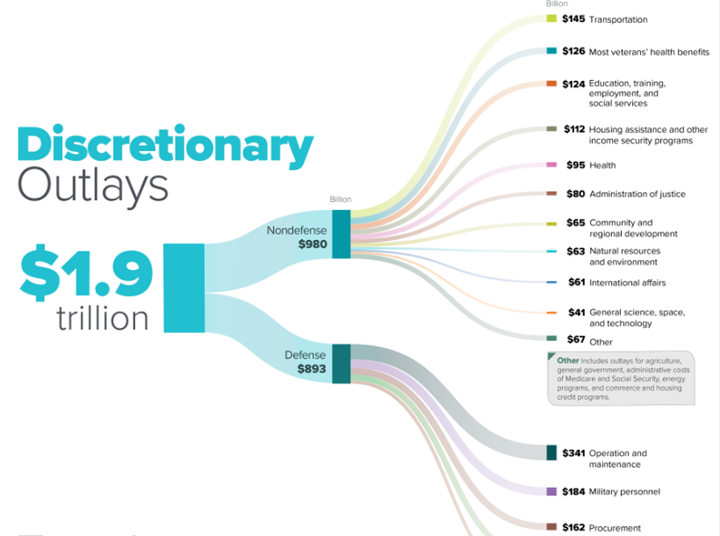
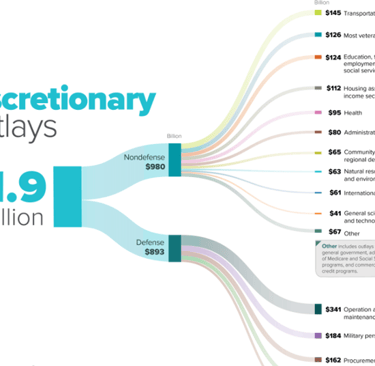
The topics for the four pages of infographics are displayed to the right - the graphic above is a portion of the "Discretionary Spending" page. Also note they have 15 previous years of this data in infographic form, in case you want to do some comparisons with your students (https://www.cbo.gov/recurring-publication/57304)


Other links related to the lessons/topics described above:
"Budget Framework" and "Time Table of the Budget Framework", The U.S. House Committee on the Budget, 2026, Framework - https://budget.house.gov/about/budget-framework/ AND Time Table - https://budget.house.gov/about/budget-framework/time-table-budget-process/
"How much has the U.S. government spent this year?", U.S. Treasury Fiscal Data, Apr 2026, https://fiscaldata.treasury.gov/americas-finance-guide/federal-spending/
"President's Proposed Budget for the U.S. Government, FY2027", U.S. White House - Office of Management and Budget, Nov 2025, Full Version - https://www.whitehouse.gov/wp-content/uploads/2026/04/budget_fy2027.pdf OR Executive Summary only - https://www.whitehouse.gov/wp-content/uploads/2026/04/fiscal-year-2027-topline-fact-sheet.pdf
"U.S. Debt Clock" (along with spending trackers), U.S. Debt Clock, Apr 2026, https://www.usdebtclock.org/
ECON and More
Curating articles for K-12 education.
CONTACT
© 2025. All rights reserved.