
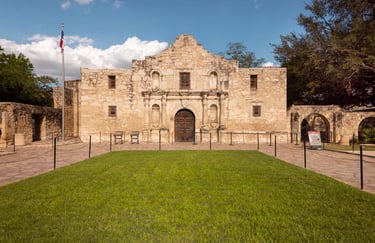
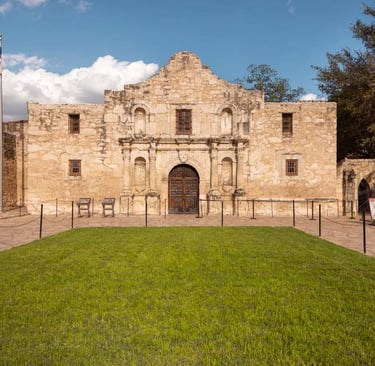
Texas Trip Post #1 - When in San Antonio . . . you MUST visit (or at least attempt to visit) the Alamo
As usual while I am travelling I had to recommend a few places while in Texas. I've been to the Alamo many times previously (my wife has family reunions in Texas periodically) so it's always a good spot to visit and see something in a little bit different way . . .
You will hear this periodically - there is a reason I titled this website (and blog) "ECON and More". While I've spent the last 8 years of my life focused on professional development in economics, personal finance, and business - the previous 25 years before that was teaching middle school social studies (and math). That meant a LOT of areas of social studies . . . and always looking for connections between history, geography, civics, economics, financial literacy, and a number of other subjects. And - I just like learning (and seeing) new stuff!
So last week I was in Austin and San Antonio, Texas (and the surrounding area) doing some work, and while I didn't have a lot of time to visit sites I did make the attempt to visit a couple. "Attempt" is the key word for the Alamo - it turned out they are doing a LOT of construction in and around the Alamo right now (guess cause it is considered the low season for tourists) so while you could get into the Alamo grounds, finding parking was next to impossible. I have visited it enough, though, to point you toward a few resources and hit on a few key talking points for teaching about it. And worth a reminder in the midst of all the 250th anniversary focus - early next month will be 190 years for the Alamo.
My focus for this post will be to mention a few "myths" about the Alamo (and teaching about it):
MYTH #1 - The Alamo was part of the Mexican-American War
I know a few teachers who argue that the whole period from 1835 to 1848 is a single war. In my mind that idea of a 10-year "timeout" may work if you are in the Hundred Years War of European history (which had a lot of timeouts) but doesn't really work as a break between a 7-month and a second 18-month conflict. This is part of the War for Texan Independence (Oct 1835 - Apr 1836), and matches the full Mexican army (3000 soldiers) against a bunch (~200) of volunteers thrown together from a rebellious northern province. Not the same thing as an invasion of Mexico from two sides by American armies years later (Apr 1846 - Oct 1847 marks the main fighting).
MYTH #2 - The Alamo was considered a glorious Mexican victory
Maybe by Santa Anna . . . but not by most of his army. While official casualty records were not kept (and Santa Anna denied any of his soldiers were killed or wounded) most historians estimate Mexican losses of 600-900 soldiers (or about 3 to 4 Mexicans for every Texan killed). A substantial percentage of those were "friendly fire" casualties, because of the arrangement of the Mexican columns as those behind shot them in the pre-dawn darkness. Santa Anna had also not provided a medical staff, and so many died of wounds that were not fatal. Mexican Colonel José Enrique de la Peña, in his memoir With Santa Anna in Texas, said:
"Why were our lives uselessly sacrificed in a deserted and totally hostile country if our losses could not be replaced? . . . the taking of the Alamo was not considered a happy event but rather a defeat that saddened us all."
And of course the losses that could not be replaced would be felt two months later in the ultimate defeat of Santa Anna at the Battle of San Jacinto.
MYTH #3 - The Alamo was a battle of whites inside against Hispanics outside
Most of the defenders of the Alamo were Anglo-Americans who had come from the United States, but there were also Tejano defenders who believed in the cause. Among these were Juan Sequin, Juan Abamillo, Gregorio Esparza (whose brother was with Santa Anna's army), José Maria Guerrero, and José Toribio Losoya. Juan Sequin led approximately 15 Tejanos to the Alamo originally (and they probably fought in the early skirmishes) but when Sequin was sent out as a courier on Feb 25th (the 3rd day of the seige) many of those men left the Alamo before the final battle and later rejoined Sequin before the Battle of San Jacinto (where Sequin and his men fought valiantly). Unfortunately their heroism did not lead to a "happy ending" - many of the Tejanos were later cheated out of their lands by the Texan majority, and Juan Sequin himself later fought on the Mexican side in the Mexican War.
MYTH #4 - Davy Crockett and Jim Bowie died gloriously at the end of the battle
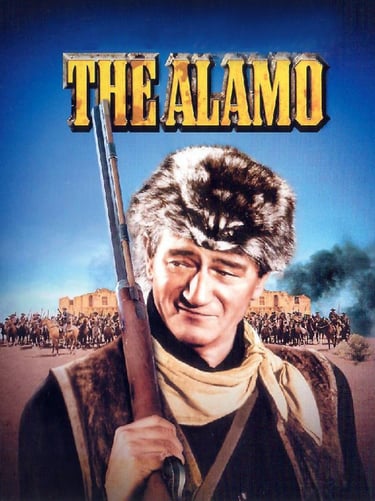
While a myth, it is more because historians simply don't know for sure how individuals died during the battle. For example, Jim Bowie was no longer in command at the Alamo probably because of an attack of tuberculosis keeping him in the infirmary - it is very likely he was in one of the outbuildings during the final battle (but could very well have still died fighting from his sick bed). In the case of Davy Crockett, I used to use excerpts from the John Wayne "Alamo" final battle scene, and would tell them that historians know he was NOT the one who blew a hole in the side of the building because he died on the other side of the site - that final scene was a creation because John Wayne was the star of the movie! But how exactly he died is still a source of speculation - some argue he led a final defense and died fighting, while others claim Crockett was taken prisoner at the end of the battle and executed by Santa Anna.
MYTH #5 - The sacrifice of the men at the Alamo gave General Sam Houston the time he needed to gather and train a new army of volunteers to ultimately defeat Santa Anna and win the war.
Again, provides several nice scenes in the John Wayne "Alamo" movie . . . but the timeline doesn't add up. Between mid-January and early March, Houston was not doing anything to organize an army. He had been made commanding general of the regular army in Nov 1835, but there were few regular army soldiers to command, and he had no authority over the volunteer militia. Between January and March, Houston took care of other business, personal matters, and attended the convention of the provisional government at Washington-on-the-Brazos. The army Houston led at San Jacinto was made up of men he found at Gonzales on 11 March, who were waiting to be led to the Alamo by Colonel Fannin, and others who joined later to avenge those who fell at the Alamo and Goliad. The preparation of that army took place over the subsequent 5-6 weeks while they were retreating from central Texas to San Jacinto (east of modern day Houston).
I'm going to express one more heretical argument - despite the flaws I mention above (and plenty of other examples of dramatic license), I never had a problem with using scenes from John Wayne's "The Alamo" in my classroom. There are definitely more accurate documentaries I could have used (I mention the PBS American Experience version below, for example) and in fact I supplemented before and after with clips from Ken Burns' "The West, Episode 2" to cover the reasons for Texas's rebellion and later the Battle of San Jacinto. But history needs to be more than a list of facts . . . and sometimes that means having students get emotionally engaged in the story even if it isn't 100% accurate. And if there was one thing John Wayne did a good job of in his version - you could relate to (and empathize with) the various flawed characters portrayed in the movie.
As usual, I want to throw in some resources teachers might find useful for this topic/location:
Articles/Resources about the Alamo (just some that stuck with me):
"'The Alamo' at 60: What John Wayne's film gets right and wrong about the famous Texas battle", Yahoo Entertainment, Oct 2020, https://www.yahoo.com/entertainment/the-alamo-at-60-what-john-waynes-film-gets-right-and-wrong-about-famous-texas-battle-landmark-221740466.html
"The Battle of the Alamo: A Historical Overview", Texas State Historical Association, updated Jul 2020, https://www.tshaonline.org/handbook/entries/alamo-battle-of-the
"Iconic Alamo site celebrates special 189th anniversary: 'Fabric of who we are as Texans'", USA Today, Mar 2025, https://www.usatoday.com/story/news/nation/2025/03/06/alamo-texas-iconic-battle-site-189th-anniversary/81212285007/
"Remember the Alamo? A battle brews in Texas over history versus lore", National Geographic, Jun 2021, https://www.nationalgeographic.com/travel/article/san-antonios-new-battle-over-the-alamo
"The Role of Tejanos in the Siege and Battle of the Alamo", Texas State Historical Association, updated Jul 2016, https://www.tshaonline.org/handbook/entries/tejanos-and-the-siege-and-battle-of-the-alamo
"When Myth and Meaning Overshadow History: Remembering the Alamo", Gilder-Lehrman Institute of American History, Spring 2012, https://www.gilderlehrman.org/history-resources/essays/when-myth-and-meaning-overshadow-history-remembering-alamo
Lesson Plans about the Alamo:
"Alamo Simulation", Gilder-Lehrman Institute of American History, https://www.gilderlehrman.org/history-resources/lesson-plan/alamo-simulation
"American Experience - Remember the Alamo", PBS, originally broadcast Feb 2004 (but most of the accompanying articles and resources are from the past year or two), https://www.pbs.org/wgbh/americanexperience/films/alamo/ OR https://www.youtube.com/watch?v=FVLNQDdF248 (video only)
"Classroom Resources", The Alamo/State of Texas, https://www.thealamo.org/teach/lesson-plans-and-guides (while the lesson plans are good, I would recommend use of the Alamo Church virtual tour for those who can't visit)
"Remember the Alamo Primary Source Adventures", Resources4Educators: The Portal to Texas History, https://legacy.education.texashistory.unt.edu/lessons/psa/Remember_Alamo/
"Texas Revolution: The Battle of the Alamo Extension Activity", Texas History for Teachers, https://education.texashistory.unt.edu/units/7/texas-revolution/battle-of-the-alamo-extension/


ECON and More
Curating articles for K-12 education.
CONTACT
© 2025. All rights reserved.