
Texas Trip Post #3 - Why Are My Jalapenos Not as Spicy Anymore? Blame Texas (A&M)!
This will be a quick one, but while on my Texas trip I was fascinated by this story I came across, so I had to do a little "follow up". As it turns out I am supportive of the effort (I can't handle spicy food at all) but my wife is less so. Of course, she also believes in growing her own jalapenos . . .
Last week I was in Austin and San Antonio, Texas (and the surrounding area) doing some work, and was reminded of several previous trips to Texas for family reunions (on my wife's side). Half the fun of a family reunion, of course, is getting to try new things at meals - on this trip I had to get Texas barbeque (probably need to do a couple of posts on the economics of BBQ when I go to Kansas City early next month) and TexMex enchiladas with chile con carne (totally different than what I can find in Colorado, and not so spicy as to kill my stomach).
I don't remember when during the weekend I first came across one of the references, but while buying some "gifts" for my wife I had occasion to look up peppers on the Scoville scale (which I will mention briefly below). An article then linked me to this internet controversy about why jalapenos are less spicy than they once were, and an argument within the state of Texas (part of the Longhorn/Aggie rivalry I'm sure) blaming Texas A&M for the change. While I didn't care personally about the spiciness of the pepper (other than on my wife's behalf) I had to wonder about the economic impact of a change like that (good and bad). So a little exploration down the rabbit hole . . . !
First, a little history overview (with AI help):
Timeline of the Jalapeño in the United States
6000 BCE – 1500s (Pre-Colonial): Domesticated by indigenous peoples in Veracruz, Mexico, and used as food and medicine.
16th Century (Arrival): Spanish explorers introduce jalapeños to the U.S. and Europe after finding them in Mexico.
1800s (Early Exposure): Peppers (including Mexican varieties) begin appearing in U.S. gardening literature and seed catalogs.
Early 1900s (Commercialization): Commercial cultivation begins in Texas, with the peppers marketed as a spicy staple. A method for pickling jalapeños is patented in 1921.
1940s–1950s (Mainstream Growth): The rise of Tex-Mex cuisine drives the popularity of jalapeños, particularly pickled, in the U.S. The modern stuffed, breaded, and fried jalapeño popper (originally known as "armadillo eggs") appeared in the early 1970s, while commercial sales of jalapeño-based pepper jelly started in Texas in the late 1970s.
1970s–1980s (Widespread Adoption): Jalapeños become widely available in supermarkets, shifting from a regional Tex-Mex ingredient to a national culinary staple.
1995 (Official Recognition): On May 10, 1995, the Texas Legislature adopts the jalapeño as the official state pepper.
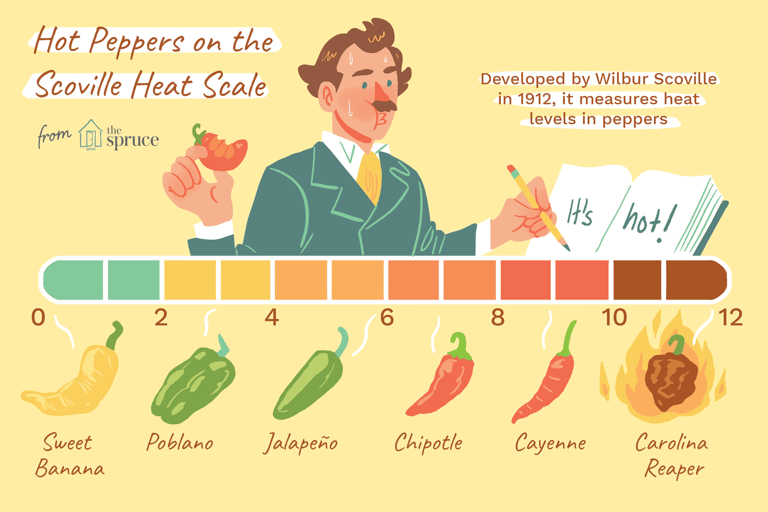
Second, a look at a Scoville scale diagram to understand where jalapenos rank on the continuum of spiciness - for the purists out there, I chose a very simple one:
I will just do a quick summary of the Texas A&M story - any of the articles or videos below can go into more detail about the "how". As Mexican food became more popular in American cuisine (particularly with a demand for ingredients at grocery stores rather than the "experience" of going to a Mexican restaurant) larger food processing companies wanted to get in on the action. However, one of the challenges with spicy peppers (and jalapenos in particular) is consistency - it is hard to predict the pungency level of a load of peppers based on both the genetics and environmental factors. Companies quickly realized, though, that while it is difficult (if not impossible) to make a spicy pepper less spicy, it is relatively easy to make a mild pepper spicier (by adding more capsaicin). If they could develop a variety of jalapeño that was always mild, unlike the options available at the time, they could use it for any salsa and add heat as needed to create spicier offerings.
So several brands (Pace Foods, Old El Paso, La Victoria, etc..) reached out to chile expert Dr. Benigno (Ben) Villalon - popularly known as "Dr. Pepper" because of his work with pepper plants. Dr. Villalon holds degrees in plant breeding, genetics, and pathology, and he served as a professor and research scientist at Texas A&M University for thirty years. And when they came to him, he told them " . . . we already have it. We’ve been working on it since 1972." It turned out that Dr. Villalon and his team had been trying to breed a virus-resistant bell pepper by crossing it with different peppers, including jalapeños. After a lot of crossbreeding, he realized he'd inadvertently created a low-heat jalapeño. This initial mild jalapeño had lost much of the pepper’s core flavor along with its spice, and it took Villalon about 10 years to develop a variety that didn’t have the heat but maintained the chile’s classic flavor profile. Beyond that, the new pepper had other advantages - it was controllably, mildly hot. It was resistant to bugs. It didn't develop kind of gnarly black spots, and it wasn't so curved."
So economically, the new variety did just what the food processing companies had wanted. According to Dr. Villalon, “The salsa industry really started booming. Their sales went up, not only for the processing industry, but also for the fresh market. By 1990, the United States outsold ketchup two to one with the mild salsa.” Because 60% of jalapeños are sent to processing plants, these were the varieties that farmers prioritized, making them the dominant crop. The side effect? These mild jalapeños have started appearing in our grocery store produce aisles, and now home cooks who enjoy heat are taking notice. (You’ll likely observe that many store-bought jalapeños that are more straight in shape too. This is evidence that mild jalapeño varieties aren’t as curved.) But just like with other crops such as tomatoes, there are still heirloom varieties of traditional jalapeno peppers available if people still want a spicier choice.
Specific Articles on the Texas A&M Jalapeño Controversy:
"Are jalapeños getting less spicy? Texas A&M researchers weigh in and explain" (video), 25 News KXXV, May 2024, https://www.youtube.com/watch?v=3wVeVn0uMo0
"Have You Noticed Jalapeños Seem Milder These Days? There’s a Reason for That", Food & Wine, May 2025, https://www.foodandwine.com/why-jalapenos-have-become-less-spicy-11740201
"Here’s Why Jalapeño Peppers Are Less Spicy Than Ever" (the original article that started this), D Magazine, May 2023, https://www.dmagazine.com/food-drink/2023/05/why-jalapeno-peppers-less-spicy-blame-aggies/
"It's Not Just You, Jalapeños Are Getting Less Spicy", Southern Living Magazine, Jul 2025, https://www.southernliving.com/jalapenos-are-less-spicy-11768631
"Jalapeno Information" (video), EverydayIsFeastDay, Feb 2026, https://www.youtube.com/watch?v=caUZFnyH4Co OR https://www.instagram.com/reel/DUWQBXWkUwt/
"Jalapenos are less spicy now than in the past", Yahoo News, Mar 2024, https://www.yahoo.com/news/jalapenos-less-spicy-now-past-202414252.html
General Lessons and Information on Jalapeños and other Hot Peppers:
"The cool science of hot peppers" (article/lesson), Science News Explores, May 2016, https://www.snexplores.org/article/cool-science-hot-peppers
"Growing Guide to Peppers", Kids Gardening, https://kidsgardening.org/resources/growing-guide-peppers/ (article) AND https://kidsgardening.org/resource-curriculum/ (lessons for possible connections)
"Hot Peppers and How to Handle Them", StartCooking.com, https://startcooking.com/hot-peppers-and-how-to-handle-them/
"How Farmers Harvest Green Chili Pepper: Jalapeno Pepper Processing Factory" (video), Sprout Garden Farming Documentaries, Oct 2024, https://www.youtube.com/watch?v=u7KBOHmek0w
"Superhot Chili Peppers | The Economics of Everyday Things" (podcast), Freakonomics Radio Network, Jan 2024, https://freakonomics.com/podcast/superhot-chili-peppers/ (original broadcast) OR https://www.youtube.com/watch?v=2fXH7w7nl74 (audio recording)
"The Ultimate Guide to The Jalapeños Scoville Rating", Mikey V's Foods (a Texas company), updated Nov 2025, https://www.mikeyvsfoods.com/post/the-ultimate-guide-to-jalape%C3%B1o-scoville-rating
ECON and More
Curating articles for K-12 education.
CONTACT
© 2025. All rights reserved.