
Texas Trip Post #4 - The Bats of Austin (even if they are mostly on vacation in Mexico right now)
This is the last of my Texas trip posts - though expect to get some similar posts from Kansas and Missouri when I attend the National Association of Economic Educators (NAEE) conference in Kansas City next month. Today I am doing a short segment on something I didn't get to see this trip (other than the Congress Street Bridge itself) - the famous Austin bat colony.
You will hear this periodically - there is a reason I titled this website (and blog) "ECON and More". While I've spent the last 8 years of my life focused on professional development in economics, personal finance, and business - the previous 25 years before that was teaching middle school social studies (and math). That meant a LOT of areas of social studies . . . and always looking for connections between history, geography, civics, economics, financial literacy, and a number of other subjects. And - I just like learning (and seeing) new stuff!
As I mentioned above, I didn't actually get to see the Congress Street Bridge bat colony last week while I was in Austin - they migrate south for the winter, typically between October and March/April. I did see the bridge while driving through, and more importantly have seen the bats heading out during several summers in Texas. So I thought I would do a little work to provide some information about them, and maybe more importantly some links to resources you could use in a science, geography, or even economics class.
First, a videoclip and some information about what the big deal is:
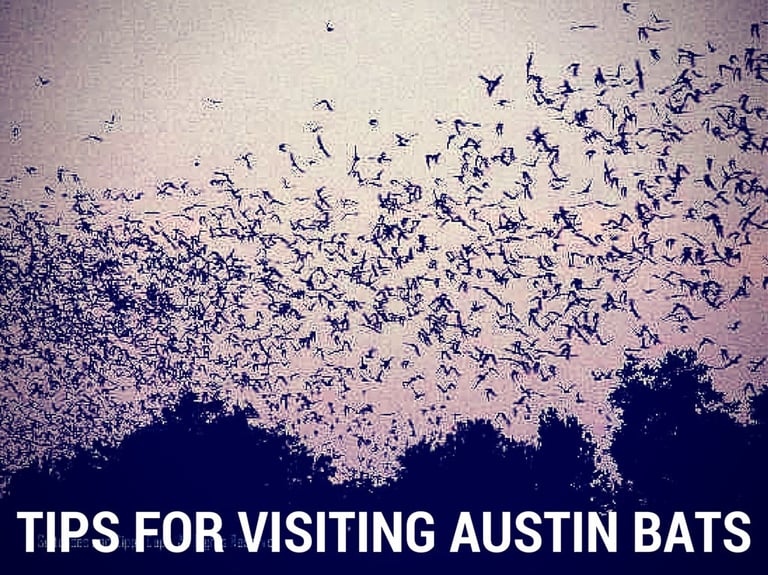
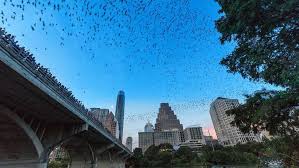
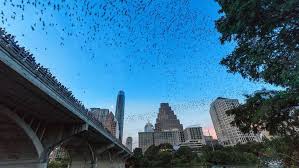
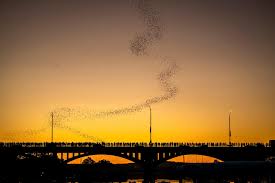
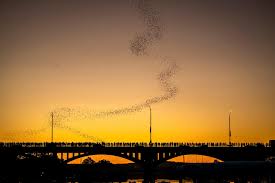
The colony living in the Congress Street Bridge (a bridge south of downtown Austin across the Colorado River and Lady Bird Lake) is recognized as the largest urban bat colony in the world, with an estimated 1.5 million bats in residence during the summer. While you might see some flying around during the day, most of them sleep during the day (especially in the heat of a Texas summer!) and then leave in huge clouds of bats around sunset each night. People gather below the bridge (or boat/kayak out into the river) to watch the fun. Here is a better idea of what that looks like - the clip on the left is more about bat conservation efforts, while the right video is more about the cultural impact:
Second, a little more detail about what they do (and why Austin decided bats were good to have around):
A few facts provided by the AustinBats.org website (maintained by a bat conservation nonprofit):
The colony consists of Brazilian free-tailed bats, roosting and rearing young in 3/4 to 1 1/2-inch-wide by 16-inch deep crevices between concrete beams.
The massive concrete beams serve as thermal heat sinks, providing ideal temperature ranges for rearing young.
Emergence columns from the bridge are visible for more than a mile, sometimes climbing thousands of feet above ground. Emergences include from one to five columns.
Mothers normally remain at a single location while rearing young. But males and females not rearing young move among several bridge roosts in Austin, and large numbers sometimes move in a single night between Austin bridges and major roosts in Texas caves.
Some use tail-winds to travel up to 100 miles per hour in order to reach distant feeding sites where the colony may consume up to ten tons of insects in a single night. Most feed on agricultural and yard pests greatly reducing needs for pesticides that threaten environmental and human health.
With the arrival of a major cold front in October or November most members of this colony migrate south into Mexico, where they remain active till their spring return in March and April.
Third, what are the economic and ecological impacts of this bat colony?
Free-tailed bats in Texas save farmers more than a billion dollars annually in avoided pesticide use.
They intercept billions of migrating moth pests each spring, reducing egg-laying on crops. One bat can easily prevent more than 20,000 eggs from being laid in a single night.
Unique microbes from free-tailed bat guano ecosystems in caves can be of great biotechnological value in detoxifying human wastes, even aiding in gasohol production.
Prior to the discovery of oil, guano fertilizer, extracted from these bats’ caves, was the biggest mineral export of Texas.
Free-tailed bats of Central Texas consume close to 200 tons of insects on an average summer night, essential to keeping ecosystems healthy.
The bats at Congress Avenue Bridge are an international tourist attraction that brings over 100,000 people and as much as $10 million to Austin every year.
NOTE - On a larger scale, the USGS estimates the overall positive impact of bats on American agriculture to be in the tens of billions of dollars (depending on how you estimate their impact on industrial resource use, like lumber).
As usual, I want to throw in some resources teachers might find useful for this topic/location:
Articles/Resources about the Austin Bats (or bats in general):
"13 Awesome Facts About Bats", U.S. Department of the Interior, Oct 2024, https://www.doi.gov/blog/13-facts-about-bats
"Bats Save Billions In Agriculture Costs As Technology Helps Save Them", Forbes Magazine, Nov 2024, https://www.forbes.com/sites/noelfletcher/2024/11/28/bats-save-billions-in-agriculture-costs-as-technology-helps-save-them/
"Benefits of Bats", National Park Service, Nov 2025, https://www.nps.gov/subjects/bats/benefits-of-bats.htm
"Congress Ave Bridge Bats: America's Most Famous Bats", AustinBats.org, Feb 2026, https://www.austinbats.org/bats
"Congress Avenue Bridge" (daily info on bat flights), AustinBatRefuge.org, Feb 2026, https://austinbatrefuge.org/congress-avenue-bridge/
"It’s frickin’ bats! History and significance of the winged mammal in Central Texas", KXAN-TV, Sep 2025, https://www.kxan.com/news/texas/its-frickin-bats-history-and-significance-of-the-winged-mammal-in-central-texas/
"What’s a wild bat worth to you? This economist is asking.", VOX.com, Jun 2024, https://www.vox.com/down-to-earth/355751/economist-price-nature-unexplainable
"Why are bats important?", United States Geological Survey (USGS), Sep 2025, https://www.usgs.gov/faqs/why-are-bats-important#faq
Lesson Plans about Bats:
"The Adventures of Echo the Bat", National Aeronautics and Space Administration (NASA) with the University of North Texas, http://science.hq.nasa.gov/kids/imagers/teachersite/RS3.htm
"Keep Texas Wild: Hanging Around with Bats" (children's activity pages from a 2008 education magazine), Texas Parks and Wildlife Department, Oct 2008, https://tpwd.texas.gov/education/resources/keep-texas-wild/hanging-around-with-bats/activities-and-lesson-plans
"Learning Resources on Bats" (collections of lessons, videos, and activities for K-12), Bat Conservation International, https://www.batcon.org/about-bats/learning-resources/
"Scientific Article for Kids: Why Do Bats Need More Food to Call Louder?", Science Journal For Kids, Jun 2021, https://www.sciencejournalforkids.org/articles/why-do-bats-need-more-food-to-call-louder/
"Echolocation In Action: A Hands On Activity", Teach Engineering, Mar 2021, https://www.teachengineering.org/activities/view/cub_soundandlight_lesson4_activity1


ECON and More
Curating articles for K-12 education.
CONTACT
© 2025. All rights reserved.