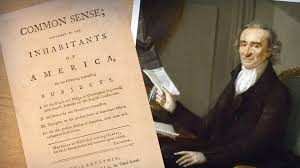
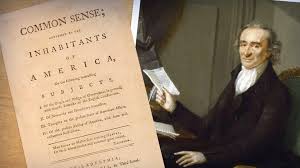
The 250th Anniversary of Thomas Paine's "Common Sense"
I plan to do some articles over the next year or two for the 250th anniversary of the United States - in fact, my series on underappreciated heroes/heroines of the Revolutionary War was intended to be a start on that. But I completely missed this one until I read an article from the Library of Congress yesterday, saying that the publication date of "Common Sense" was January 10, 1776. So a quick post here with some lesson plans to connect to that document . . .
Article #1 - "250 Years Ago: Thomas Paine’s Common Sense" (Headlines & Heroes Blog - The Library of Congress, Jan 9, 2026):
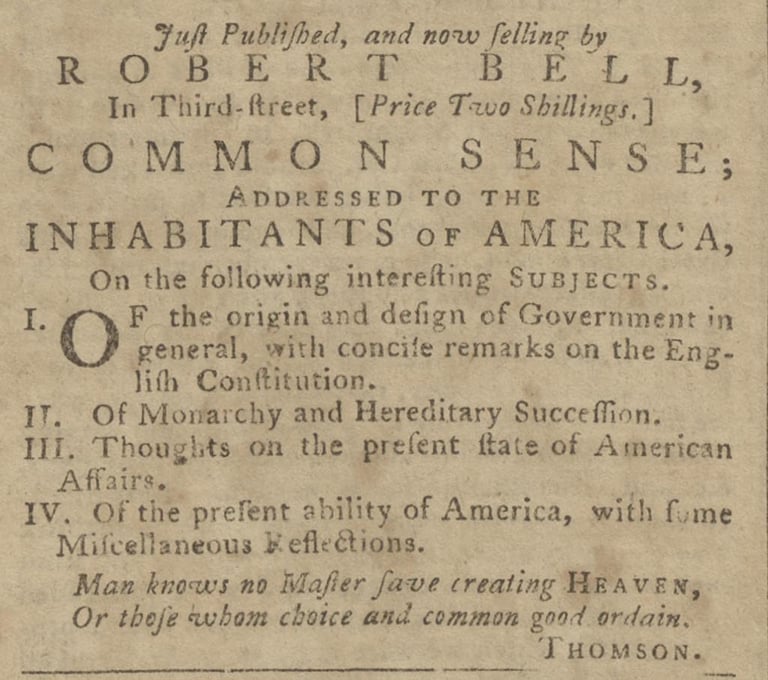
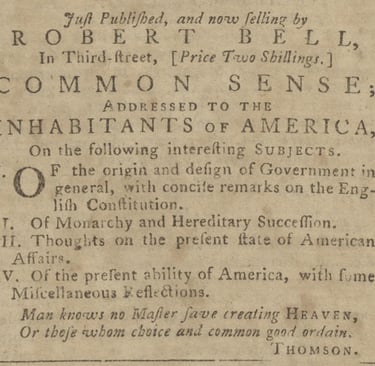
Part of what mixed me up on the date for the release of "Common Sense" is mentioned at the beginning of the article. The original publication was intended for sale in selected bookshops - therefore, its release was staggered throughout the colonies and its spread was limited initially to those who could both a) afford to pay for it; and b) access it in one of the American colonies' few cities. The Library of Congress includes an early advertisement for sale of the brochure in Philadelphia 5 days after publication:
Wider release (and wider discussion of the ideas contained within) comes with publication of the brochure within existing newspapers for public reading. Again, the Library of Congress has within their collections the first example of this from the Connecticut Courant and Hartford Weekly Intelligencer dated February 19, 1776 - an original copy is available at the library, but electronic copies are available for you and your students to access as well:
The other things I found interesting about the blog article from
the Library of Congress was the mention of contemporary
alternatives competing with Paine - something never mentioned in
textbook or video overviews of his writing. Specifically, Malea Walker
(a Reference Librarian at the LOC, and the writer of the blog article)
mentions two: a) a new pamphlet by loyalist James Chalmers called
“Plain Truth,” which he published under the name Candidus; and b)
newspaper opinion pieces published under the name of “Cato.”
In both cases the competing articles were almost immediately met
with their own detractors, most of whom did not focus on logical
arguments to persuade nearly as much as appeal to emotion. The
one that stuck with me was a quote critiquing "Plain Truth" saying
"If Common Sense in some places wanted polish, Plain Truth was covered
over from head to foot with a detestable and stinking varnish.”
Another good reminder (while reading the snap judgments of both left
AND right to the events of the ICE protests in Minneapolis last week)
that ours is certainly not the only generation with "partisan politics"
- we just now have mass media and the internet to make it
immediate and permanent. . .
Links to Primary Sources on "Common Sense" (beginning with the article above):
"250 Years Ago: Thomas Paine's Common Sense", Headlines & Heroes Blog - The Library of Congress, Jan 9, 2026, https://blogs.loc.gov/headlinesandheroes/2026/01/250-years-ago-thomas-paines-common-sense/
"Common Sense: Addressed to the Inhabitants of America, on the following Interesting Subjects", The Online Library of Liberty - The Liberty Fund, https://oll.libertyfund.org/pages/1776-paine-common-sense-pamphlet
"Plain Truth", UMBC Center for History Education, https://www2.umbc.edu/che/tahlessons/pdf/historylabs/Should_the_Colo_student:RS07.pdf
"Common Sense By Thomas Paine | Summary & Significance", AmericanRevolution.org, https://www.americanrevolution.org/common-sense/
"Thomas Paine's Common Sense: Why It Matters", Colonial Williamsburg, Dec 2025, https://www.colonialwilliamsburg.org/discover/sources/revolutionary-documents/thomas-paines-common-sense/
"Common Sense: How Thomas Paine Made the Case for an Independent and Democratic America", Thomas Paine Historical Association, Jan 2026, https://thomaspaine.org/wp-content/uploads/2025/12/Beacon-JAN-FEB-2026-12-15-ver3-MED.pdf
"The Pamphlet That Has Roused Americans to Action for 250 Years", New York Times (may be paywalled), Dec 2025, https://www.nytimes.com/2025/12/17/books/review/thomas-paine-common-sense-anniversary.html
"Thomas Paine, Common Sense and a Plan for America", Journal of the American Revolution, Nov 2025, https://allthingsliberty.com/2025/11/thomas-paine-common-sense-and-a-plan-for-america/
(Finally - an older connection to ECON) - "Were Colonial Americans More Literate than Americans Today?", Freakonomics, Sep 2011, https://freakonomics.com/2011/09/were-colonial-americans-more-literate-than-americans-today/
OK, maybe I should have asked for a Revolutionary War calendar for Christmas this year, rather than the 2026 National Day Calendar I got (though to be fair, I will use that one regularly for the monthly holiday resource posts). I knew "Common Sense" was released several months before the independence issue made its' way to the Second Continental Congress, but sort of thought it was later in the spring (as I note later, I was "partially" right). And of course as a teacher, I focused more on the words (and their impact) than a specific date of publication.
So what I plan to do here is simply link some resources - the original article from the Library of Congress (and their resources); some biographic material about Thomas Paine (who I will mention more later - in some ways I have always preferred his "American Crisis" as a writing to have students study); and some lesson plans on "Common Sense" and its impact on the independence discussion.
Resources on Thomas Paine himself - "Thomas Paine" video segments from Ken Burns' The American Revolution" PBS Series (UNUM Ken Burns, Jan 2026):
I thought for this segment on Thomas Paine (the person), a good starting point might be the new section released by Ken Burns (for the 250th anniversary of "Common Sense") of edited video segments from his new The American Revolution PBS series. While several of the later ones focus on Paine's role later in the Revolution and his other writings, Segments #3-5 focus specifically on Common Sense and a little bit of backstory on Paine himself. I'm just going to provide a link here to view them on his site.
Beyond that, I'm going to provide (below) a few additional links to biographical information about Thomas Paine and how he is remembered (or not) today.
Links to Biographical Information on Thomas Paine:
"Thomas Paine" (video playlist), UNUM Ken Burns, Jan 2026, https://www.pbs.org/kenburns/unum/playlist/thomas-paine#publication-common-sense
"Thomas Paine and His Importance in the History of the United States of America" (PDF), National Park Service/Thomas Paine Memorial Association, Jul 2024, https://parkplanning.nps.gov/showFile.cfm?sfid=755331&projectID=44217
"Thomas Paine", George Washington's Mount Vernon, Dec 2025, https://www.mountvernon.org/library/digitalhistory/digital-encyclopedia/article/thomas-paine
"Thomas Paine: The original publishing viral superstar", National Constitution Center, Jan 2023, https://constitutioncenter.org/blog/thomas-paine-the-original-publishing-viral-superstar-2
“The Times that Tried Men’s Souls”—Thomas Paine and American Independence, Center for the Study of the American Constitution, May 2025, https://csac.history.wisc.edu/2025/05/28/the-times-that-tried-mens-souls-thomas-paine-and-american-independence/
"Thomas Paine Major Milestones", The Thomas Paine Historical Association, https://thomaspaine.org/major-milestones/


Section III - Educational Resources on "Common Sense" and Thomas Paine:
This last section is simply a quick curation of some of the lesson plans and other educational resources available on Thomas Paine and his writings. Keep in mind (especially for the second group) that Thomas Paine is known for more than one pamphlet - for example, British history ignores his role in the "Revolutionary War" to focus on his later role as a social activist for worker rights.
Lesson Plans on "Common Sense":
"Thomas Paine’s Common Sense, 1776", America in Class from the National Humanities Center, 2014, https://americainclass.org/thomas-paine-common-sense-1776/
"Thomas Paine and Common Sense", The Gilder-Lehrman Institute of American History, 2012, https://www.gilderlehrman.org/sites/default/files/inline-pdfs/Thomas%20Paine%20and%20Common%20Sense.pdf
"Lesson Plan: Book That Shaped America - 'Common Sense"", C-SPAN Classroom, Nov 2023, https://www.c-span.org/classroom/document/?21464
"Module 2: Principles of the American Revolution" from the Constitution 101 Curriculum (specifically Module 2.5), National Constitutional Center, https://constitutioncenter.org/education/constitution-101-curriculum/2-principles-of-the-american-revolution
"Season of Independence Unit 4: Support for Independence", Museum of the American Revolution, https://www.amrevmuseum.org/season-of-independence-unit-4-support-for-independence
Other Educational Resources (other formats or related topics):
"The American Experiment: Thomas Paine’s Common Sense and Call for Independence" (video), Primary Source Close Reads Explained from the Bill of Rights Institute, 2022, https://www.youtube.com/watch?v=9scYsuvqIP4
"Liberty's Kids 112 - Common Sense with Thomas Paine", History Cartoons for Children from Liberty's Kids, Jan 2019, https://www.youtube.com/watch?v=mcStHPI22Jc
"The 250th Anniversary of Thomas Paine's 'Common Sense'" (podcast), All of It with Alison Stewart from WNYC, Jan 2026, https://www.youtube.com/watch?v=YJY_HnSdlFg
"Why was radical writer Thomas Paine significant? (Political and social reform in 18th century Britain)", The National Archives (UK), https://www.nationalarchives.gov.uk/education/resources/why-was-radical-writer-thomas-paine-significant/
ECON and More
Curating articles for K-12 education.
CONTACT
© 2025. All rights reserved.