
The World's Most and Least Popular Leaders (Part II) - Fact vs Perspective Comparing World Leaders
Let me start with what this ISN'T. This is NOT a political post - I have a hard enough time doing civics or current events and keeping it impartial. This is NOT support for any particular world leader - simply looking at the data and numbers. And this is NOT to support (or protest) President Donald Trump. This is a post about "fact checking" vs "perspective".
NOTE: I am repeating a little bit from Part I here
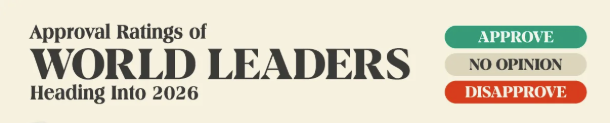
Where the idea for this post came from was a graphic I saw in my in-box last week from Visual Capitalist, depicting the approval ratings of about 40 world leaders at the end of 2025/beginning of 2026. Their data was based on a "Global Leader Approval Rating Tracker" run by Morning Consult, a paysite that monitors economic, business, and political trends for their clients over an extended period of time. While I could not access all of the data on their site, Visual Capitalist has created similar graphics based on their data in the past (which I could access to summarize the results). I don't want to infringe on their infographic (though I include a link to it at the end of the post so you can see it for yourself) - here I will simply show you the header:
I want to note that I have no reason to doubt any of the data presented is accurate (particularly because it is simply reporting the results of opinion polling) - I spot-checked a few of the numbers against news media websites from those nations to verify they were in the "right ballpark". I also have no particular issues with their methodology or the processes used by the polls to survey people (though I will compare/contrast that later to countries that don't use non-government organizations to "survey" approval ratings for their government). My discussion here is going to be about perspective, not accuracy of the numbers.
So I'm going to start with the same approximate numbers used for Donald Trump in Morning Consult's latest figures. Their latest approval ratings are based on data collected from Dec. 29, 2025 - Jan. 4, 2026 (so the week after the Visual Capitalist graphic, though according to them Trump's averages had not changed in that time). Ratings reflect a trailing seven-day simple moving average of views among adults in each country surveyed.
43% - Approve of Trump's job performance
51% - Disapprove of Trump's job performance
6% - Expressed no opinion on Trump's performance
BUT as I asked in Part I . . . what do those numbers actually mean? Are they good? Bad? Significant in some way? While the U.S. numbers typically only got perspective from historical comparisons to previous presidents, in this part we have direct comparisons available to other contemporary leaders. We also have some historical data tracking those results over a shorter time period. So what can that tell us, and what perspectives might we want to communicate to our students at the same time?
I thought I would be able to finish this topic in one post - then as I got into the data around partisan differences in polling it took on a life of its own! So I'm doing an immediate Part II, to get back to the topic I really wanted to start with . . .
So what I have done is divide up their data into a few groups, to try to provide a little bit of that perspective on numbers that otherwise just appear as headlines . . .
Group #1 (a little lonely up here) - Consistent Top Performers
Narendra Modi - Prime Minister of India
71% Approve, 22% Disapprove, 7% No Opinion on his job performance
Modi is the only leader who has been at the top of each of Visual Capitalist's (and Morning Consult's) ratings - his approval rating has declined a bit but stayed above 70% consistently. It also helps that over the 12 years of his rule, Indians' perception of the direction of their country has continued to climb.
Group #2 - New Guys on the Block
Group #5 - So Who Did We Miss? Where Are the Other World Leaders In the News?
Vladimir Putin - President of Russia (25+ years)
No approval rating, but received 88% of the vote in his last "election"
Kim Jong Un - Respected Comrade of North Korea (13+ years)
No approval rating, no elections of any kind
Xi Jinping - President and General Secretary of China (13+ years)
No approval rating - unanimously re-elected by the People's Congress in 2023
Ali Khamenei - Grand Ayatollah and Supreme Leader of Iran (36+ years)
No approval rating or election, but other government positions in Iran are elected
Benjamin Netanyahu - Prime Minister of Israel (3+ yrs current term, 18 yrs overall)
42% Approve, 58% Disapprove, 0% No Opinion on his job performance
Volodymyr Zelenskyy - President of Ukraine (6+ years)
No current approval rating - elected in 2019, but no elections during the war
Ursula von der Leyen - President of the European Commission (5+ years)
23% Approve, 36% Disapprove, 40% No Opinion on her job performance
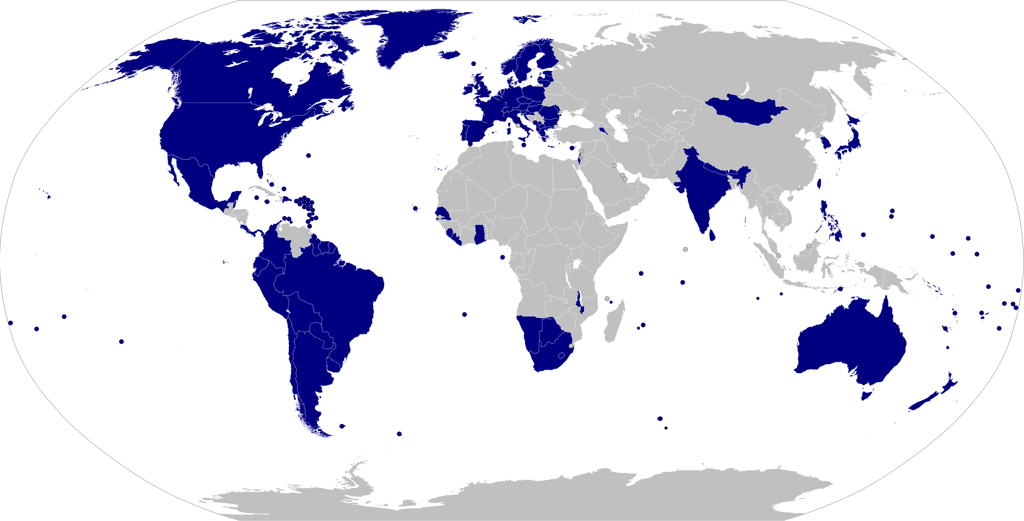
Most of these leaders listed (and the map below) is intended to simply remind you (and our students) that free elections, approval polls and freely-expressed opinions, and peaceful transfers of power in government are not the norm in the world. Hopefully there are some good ideas to work with here (and in the resource links below) to use this in some classroom discussions where the data/facts are the starting point, and perspectives based on those facts are the means for useful dialogue.
The map below shows countries (in blue) designated "electoral democracies" in Freedom House's Freedom in the World 2025 survey
Sanae Takaichi - Prime Minister of Japan
63% Approve, 24% Disapprove, 12% No Opinion on his job performance
Andrej Babiš - Prime Minister of Czechia
60% Approve, 29% Disapprove, 11% No Opinion on his job performance
Lee Jae-myung - President of South Korea
57% Approve, 33% Disapprove, 10% No Opinion on his job performance
On the surface (with just a fact-check, and no perspective) these three leaders would seem to be doing quite well in public opinion polls. So what's the "rest of the story"? All of them have been in office 6 months or less. Here are the approval ratings for their predecessors back in June:
Japan - 19% approval Czechia - 17% approval South Korea - 17% approval
Compare that "honeymoon period" to our next group of leaders (all still relatively new, but a little longer in office):
Group #3 - Newish Guys (and Gals) on the Block - a Year or Two Later
Claudia Sheinbaum - President of Mexico
53% Approve, 40% Disapprove, 7% No Opinion on her job performance
Javier Milei - President of Argentina
55% Approve, 41% Disapprove, 4% No Opinion on his job performance
Mark Carney - Prime Minister of Canada
48% Approve, 41% Disapprove, 11% No Opinion on his job performance
Anthony Albanese - Prime Minister of Australia
47% Approve, 43% Disapprove, 9% No Opinion on his job performance
Donald Trump - President of the United States
43% Approve, 51% Disapprove, 6% No Opinion on his job performance
Luiz Inácio Lula da Silva - President of Brazil
42% Approve, 54% Disapprove, 4% No Opinion on his job performance
Each of these leaders has been in office 1-3 years (Trump, obviously, is a bit of an outlier there because of his previous experience, but still one year in this term). All of them have polls that can vary quite a bit depending on who is being surveyed, who is doing the surveying, and what's going on in the news (for example, I saw polls for Sheinbaum in the past month as high as 70% approval and as low as 40% - I assume this number was an average). Several of them came in after unpopular predecessors (Trudeau in Canada and Biden in the U.S. were both in the 20s in their approval ratings during 2024). And yet . . . all seem to have firm control of their governments and no immediate threat to lose their leadership position.
Group #4 - So What's Going On In Europe?
(you might have noticed only 1 leader from that continent so far)
Giorgia Meloni - Prime Minister of Italy (3+ years)
41% Approve, 52% Disapprove, 6% No Opinion on her job performance
Jonas Gahr Støre - Prime Minister of Norway (4+ years)
37% Approve, 61% Disapprove, 2% No Opinion on his job performance
Ulf Kristersson - Prime Minister of Sweden (3+ years)
37% Approve, 55% Disapprove, 8% No Opinion on his job performance
Friedrich Merz - Chancellor of Germany (6 months)
36% Approve, 60% Disapprove, 4% No Opinion on his job performance
Recep Tayyip Erdoğan - President of Turkey (11+ years)
34% Approve, 51% Disapprove, 15% No Opinion on his job performance
Keir Starmer - Prime Minister of the United Kingdom (1.5 years)
23% Approve, 67% Disapprove, 9% No Opinion on his job performance
Emmanuel Macron - President of France (8+ years)
13% Approve, 80% Disapprove, 7% No Opinion on his job performance
There is a LOT I could get into here (probably several more posts 😁) but I will limit myself to three thoughts. First, this obviously isn't all of the leaders of Europe - just the main ones or names I thought teachers/students might recognize - but there aren't any other European leaders with substantial popularity in their own countries. Most of the ones I saw were well below Trump's approval ratings OR had 25-30% of their country with no opinion of them.
Second, I had to include the leaders of Norway and Sweden because we continue to have this popular (at least on social media) belief that "if we were only like the Nordic countries, life would be so much better". Not going to get into the realities of that at this point (and THEY don't call themselves socialists - another topic to get into in the future) except to note that many of the citizens of those countries seemingly have their own negative issues with their governments.
Finally, just looking at the last 3 people on the list (probably the three current European leaders most well-known to Americans AND the U.S. news media) I'm thinking it is unlikely that the bottom two will still be in power by the end of 2026 (and Erdogan will probably not join them simply because of his authoritarian leadership). To put Macron's numbers in perspective, Richard Nixon never got below a 25% approval rating during the Watergate scandal.
Resources just for Part II, starting with the motivations for this post:
"Ranked: Approval Ratings of World Leaders Heading Into 2026", Visual Capitalist, Dec 2025, https://www.visualcapitalist.com/ranked-approval-ratings-of-world-leaders-heading-into-2026/
"Global Leader Approval Rating Tracker", Morning Consult (reminder - this is a pay site with limited free views), Jan 2026, https://pro.morningconsult.com/trackers/global-leader-approval
Cognitive biases in news-making and fact-checking: a mixed methods approach, European Digital Media Observatory, Aug 2024, https://edmo.eu/blog/cognitive-biases-in-news-making-and-fact-checking-a-mixed-methods-approach/
Collection of lesson plans related to Polarization and Bias, All Sides, Jan 2026, https://www.allsides.com/schools
Lesson Plan: Detecting and decoding bias in the media, The European Association for Viewers Interest (EAVI), Aug 2022, https://eavi.eu/lesson-plan-detecting-and-decoding-bias-in-the-media/
List of the most recent elections by country, Wikipedia, Nov 2025, https://en.wikipedia.org/wiki/List_of_the_most_recent_elections_by_country
List of current heads of state and government, Wikipedia, Jan 2026, https://en.wikipedia.org/wiki/List_of_current_heads_of_state_and_government
"Tracking Freedom Around The World", Freedom House, Dec 2025, hhttps://freedomhouse.org/explore-the-map?type=all&year=2025 (map with data) AND https://freedomhouse.org/perspectives (blog articles)
ECON and More
Curating articles for K-12 education.
CONTACT
© 2025. All rights reserved.