
Underappreciated Heroes of the Revolution #5 - "Three Foreign Patriots You Probably Never Heard Of"
This is Post #5 in my series on lesser-known heroes of the Revolutionary War period. I'm not sure any of these three men had a major impact on the winning of the war, and 2 of the 3 didn't even survive the conflict. But compared to bigger names like Lafayette and Von Steuben, these are stories students will not be as familiar with - other than maybe the modern-day places named for them . . . ?
OK, here's another post where I will start by talking about who I am NOT featuring. In the most common textbooks, we do get a few specific names of foreign volunteers joining the Americans to fight for liberty. Their motivations are sometimes questioned, but they are nevertheless celebrated for their gallantry:
The two most common:
Marie-Joseph Paul Yves Roch Gilbert du Motier de La Fayette (the Marquis de Lafayette) - a great story, but remember that he did volunteer at the age of 19! So he fought bravely and eventually rose to command troops later in the war, but his role during the war was much more about the alliance with France and his personal friendship with George Washington and others.
Friedrich Wilhelm Ludolf Gerhard Augustin von Steuben (Baron von Steuben) - another great story especially focusing on the winter at Valley Forge, but mostly focused on his training and inspector role (since he rarely was involved with fighting on the battlefield). And most of the modern "study" of his role tends to focus on the question of whether he was a homosexual or not (rather than what he did in the war effort).
Three others who often get brief mentions in the textbooks:
Jean-Baptiste Donatien de Vimeur (the Count de Rochambeau) - enters the Revolutionary War story for one event - the Battle of Yorktown and (essentially) the end of the war. Leads the French troops sent to America, but is ordered to defer to Washington at Cornwallis's surrender as part of the "alliance". But for the textbooks, the story of an allied commander is not as inspiring as "gallant volunteers".
French Admiral François Joseph Paul (the Comte de Grasse) - in many ways you could argue this is the foreign officer with the greatest impact on the war - if he does not defeat the British relief force sailing to aid/evacuate Lord Cornwallis at Yorktown the war doesn't end two years later. But again, he is serving as a French admiral fighting their traditional enemy (Britain), not because of a love of American independence. Also doesn't help that he loses a subsequent naval battle to Admiral Rodney and the British the following year (leading to a weaker peace treaty in 1783).
Andrzej Tadeusz Bonawentura Kosciuszko (aka Thaddeus Kosciusko) - I thought about featuring him in this segment because he is a lesser known hero, but probably better known than the other Polish volunteer I chose to include. In particular, his statue in Lafayette Park north of the White House (along with statues of Lafayette, Von Steuben, and Rochambeau representing foreign Revolutionary War heroes) is one of the better-known memorials. And while his contributions to logistics and engineering were valuable, his major life events were largely after the war back in Poland as he fought unsuccessfully for Polish independence.
So who AM I featuring? Three lesser-known contributors - one from Poland, one from Prussia, and one from Spain. I'm going to format this a little differently - a short description for each person, followed immediately by the links (rather than putting them all at the end). Part of the reason for that is these really are lesser-known heroes - none of them has a lot of current lessons or recent new historical research.
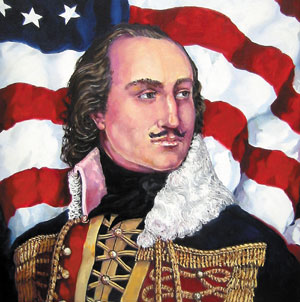
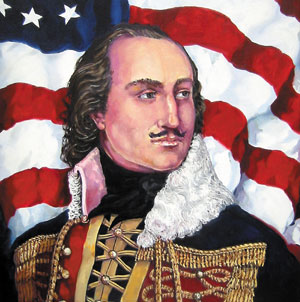
Casimir Pulaski:
As mentioned earlier, Poland has two fairly famous contributors to the American Revolution - Thaddeus Kosciusko and Casimir Pulaski. Very different stories, though - while Kosciusko came to America with a lot of book learning and theory on military engineering (but relatively little practical experience), Casimir Pulaski's family had been engaged in an off-and-on conflict to assert the rights of the Polish nobility against a Russian-sponsored takeover of the country. That conflict helped Casimir develop cavalry skills "on the fly" as their militia found itself fighting against organized military troops (much as the battles would be organized during the American Revolution). When he was forced into exile, Pulaski travelled first to France, then on to the New World with a letter of recommendation from Benjamin Franklin and Silas Deane (the ambassadors from the Continental Congress to France).
Pulaski arrived in America in mid-1777 (not a high point for the
Continental Army) and travelled to meet George Washington with the
army in New Jersey. Rather than wait for approval of his commission from
the Continental Congress, Pulaski volunteered to serve as Washington's
unpaid aide in the leadup to the Sept 1777 Battle of Brandywine Creek
outside of Philadelphia. During that battle (an American defeat) Pulaski
volunteered to lead a desperate cavalry charge in an effort to hold off the
British army and allow an orderly retreat. His efforts led to a commission
as a brigadier general and eventually his own cavalry command in the
Southern colonies.
Today Casimir Pulaski is commonly referred to as the "Father of the
American Cavalry" (a style of fighting that would become even more important later in the Civil War). In many ways Pulaski was developing strategy as he fought, which had its' strengths and weaknesses. Washington, in particular, was concerned that Pulaski's tendency to attack aggressively with horse cavalry might take too many risks as part of a larger army. As a result, by 1779 he was leading cavalry forces in South Carolina against the British effort to subdue the South. He had early successes through the spring and summer, and prepared (with Continental and French forces) to lead an attack on Savannah, Georgia in the fall. However, the combined army was soundly defeated at the Siege of Savannah in September, and in that battle Casimir Pulaski was hit by grapeshot from a British cannon and died two days later on a prison ship.
Today Casimir Pulaski is remembered in a variety of ways, some controversial. March 6th (Pulaski's birthday) is a state holiday in Illinois, though no longer one requiring a day off! There are 6 different cities and another 7 counties in the Eastern U.S. named Pulaski, statues in Washington D.C. and Philadelphia, and a monument in Savannah. A Smithsonian Network documentary in 2019 tried to make the case (after an autopsy of his supposed remains) that Pulaski was intersex - having both female and male DNA - and led to some controversy about Pulaski's perceived legacy.
"Discover the Short Life and Long Legacy of Casimir Pulaski, a Polish Cavalry Officer Who Became an American Revolutionary Hero", Smithsonian Magazine, Mar 2025, https://www.smithsonianmag.com/history/discover-the-short-life-and-long-legacy-of-casimir-pulaski-a-polish-cavalry-officer-who-became-an-american-revolutionary-hero-180986162/
VIDEO - "How Casimir Pulaski Became a Firm Favorite of George Washington", Smithsonian Channel, Apr 2019, https://www.facebook.com/watch/?v=1028898580627022
"Casimir Pulaski", American Battlefield Trust, https://www.battlefields.org/learn/biographies/casimir-pulaski
"Casimir Pulaski", George Washington's Mount Vernon, Jun 2025, https://www.mountvernon.org/library/digitalhistory/digital-encyclopedia/article/casimir-pulaski
"Was the Revolutionary War Hero Casimir Pulaski Intersex?", Smithsonian Magazine, Apr 2019, https://www.smithsonianmag.com/smart-news/was-revolutionary-war-hero-casimir-pulaski-intersex-180971907/
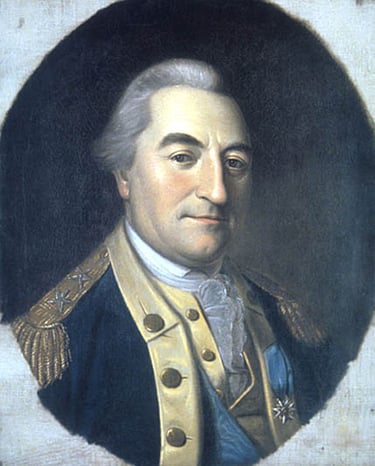
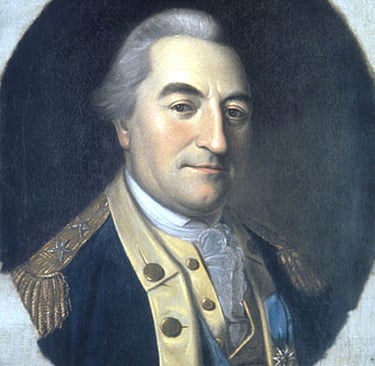
Baron Johann deKalb:
While many of the foreign fighters mentioned earlier (Lafayette, Kosciusko, Pulaski) were young men in their teens and twenties, Baron deKalb was a very experienced soldier in his mid-50s when he arrived in America. He had left Prussia as a young man to join the French army and fought with them in the Seven Years War, leading to a lifelong dislike of the British. Interestingly, one of deKalb's tasks after
the war was to travel to North America on behalf of the French to measure
colonial sentiment (in the early 1760s) for a possible rebellion against
British colonial rule (presumably to encourage French colonial rule, not
independence) - but nothing came of the project. Once he returned to
Europe, Johann settled in France to farm rather than return home.
Like Pulaski, deKalb met Ben Franklin and Silas Deane in Paris and heard
of their need for experienced officers to serve in the American army.
Baron deKalb ended up travelling with the Marquis de Lafayette and others
in early 1777 to Charleston, SC and then northward to Philadelphia. While
initially there was some dispute about the commission that had been
promised to him, deKalb was eventually made a major general and served
with Washington's army at Valley Forge, the Battle of Monmouth, and other
events of 1777, 1778, and 1779. Eventually he was put in command of the Maryland Division in early 1780 and sent south to provide an American army presence to combat British General Henry Clinton's attacks on Charleston and Savannah. DeKalb thought he would be put in full command of the southern army; however, the Continental Congress chose instead to appoint Horatio Gates to take command.
At the Battle of Camden in August 1780, most of the militia units broke and ran once confronted by British regulars on the battlefield. General Gates ran as well, leaving Baron deKalb and his regulars outnumbered against the might of the British. Unlike the volunteers, though, the Maryland Division fought well and allowed time for many troops to escape capture and imprisonment (which might have led to later success in the south, as we will see in the next two posts of this series). Unfortunately for Baron deKalb, however, that brave effort came at a high personal cost. He suffered eleven different wounds during the battle (most from bayonet charges during hand-to-hand combat) and was eventually captured and taken to Camden, where he died two days later. He was honored as a fallen hero even by the British afterward, and buried with full military honors near the hospital where he died.
Baron deKalb is not remembered today for a particular speciality (like training for Von Steuben or cavalry for Pulaski), but might instead be thought of as "what might have been". We'll never know if deKalb would have had a different plan for the Battle of Camden, though it is thought based on his few comments at the time that he would have preferred to retreat and not fight the British head-on with untrained militia. But we also know he was trained in the French army not to publicly challenge a commander's orders - in this case he did not speak openly of any misgivings about the battle plan. It will be left to other generals to rebuild and ultimately win the South (in a future post). Like Pulaski, today there are many cities and counties named after DeKalb (particularly in the South and Midwest) and a statue in Camden, SC (where he died).
"Johann deKalb", American Battlefield Trust, updated Jun 2024, https://www.battlefields.org/learn/biographies/johann-de-kalb
"De Kalb has died, as he has lived, the unconquered friend of liberty”, Emerging Revolutionary War, Aug 2019, https://emergingrevolutionarywar.org/2019/08/19/de-kalb-has-died-as-he-has-lived-the-unconquered-friend-of-liberty/
"Baron deKalb's Last Campaign", Journal of the American Revolution, Jun 2014, https://allthingsliberty.com/2014/06/baron-de-kalbs-last-campaign/
De Kalb: One of the Revolutionary War's Bravest Generals, by John Beakes, 2019, https://www.amazon.com/Kalb-Revolutionary-Wars-Bravest-Generals/dp/0788459007
"Major General Baron deKalb", originally from the Valley Forge Historical Society, copied to the South Carolina Historical Society, 2007, https://carolana.com/SC/Revolution/continental_army_baron_dekalb.html
Bernardo Vincente de Gálvez y Madrid, Count of Gálvez:
This one I will keep short, but like one of the remaining underappreciated heroes (George Rogers Clark) we will look at in our final posts of this series, the typical reaction to describing these men's actions is "There wasn't any fighting in the west during the Revolutionary War - you're making that up!" In the same way that EVERYONE knows all the Civil War battles took place in the South (ever heard of the Battle of Glorieta Pass in New Mexico? Or maybe the Battle of Wilson's Creek in Missouri?), they know the whole Revolutionary War was fought between Philadelphia and Boston, except that one battle in Yorktown. Or how about "Spain? Spain? You must be confused, Mr. LeBlanc - we were allies with FRANCE during the Revolutionary War!" That is true . . . as well as Spain and the Dutch Republic (and Native American tribes as independent nations at that time).
The main person I want to mention to conclude is Bernardo de Galvez, who served as the Governor of Spanish Louisiana (yes, it belonged to Spain at that point, NOT France) headquartered in New Orleans through most of the American Revolution. In that role, de Galvez was in a position to put pressure on British forts and settlements throughout the Mississippi River valley and lands west of Georgia (including settlements in what is today West Florida and the Gulf Coast). Bernardo de Galvez had extensive military experience early in his life, and was a Spanish colonel when he accepted the role of governor in 1776. One of his first tasks in that role (even before Spain or France agreed to ally with the Americans) was to supply American forces like those led by George Rogers Clark with gunpowder, muskets, uniforms, medicine, and other supplies through the British blockade to Ohio, Pittsburgh, and Philadelphia by way of the Mississippi and Ohio Rivers.
Once the Spanish declared war on Britain in 1779, de Galvez escalated his efforts in that region of North America. First, he captured British bases at Natchez, Mobile, and Biloxi, taking complete control of the Mississippi Valley. He then commenced a 2-month battle for the British fort at Pensacola, capturing it in May 1781 and preventing thousands of troops (and all their supplies) from being transferred to support Lord Cornwallis at Yorktown during the same timeframe.
Ironically, the end of the war and his victories were a "good news/bad news"
kind of thing for Bernardo de Galvez. On the one hand, he was celebrated
as a Spanish and American hero. The King of Spain made Gálvez a count and
the viceroy of New Spain, and placed him in command of all Spanish military
operations in the Americas. But . . . success also made him a potential
threat to other leaders in the New World and within the court in Madrid.
He fell ill and died at the age of 40 on November 8, 1786—some speculate
that he was poisoned, while other historians say it was yellow fever.
Today Bernardo de Galvez is little remembered - the land he governed would
soon be back under the control of France (leading, of course, to the
well-known Louisiana Purchase in less than 20 years). Andrew Jackson would
take ideas from some of de Galvez's strategies against the British for his own battles against them in the War of 1812 a generation later. Today his main legacy (other than historical honors like being made an honorary American by the U.S. Congress) is the name of Galveston Island and the city of Galveston, Texas.
"Bernardo de Gálvez: A Key Figure in the American Revolution", Texas State Historical Association, Nov 2025, https://www.tshaonline.org/handbook/entries/galvez-bernardo-de
"Treaty of Aranjuez (1779)", George Washington's Mount Vernon, https://www.mountvernon.org/library/digitalhistory/digital-encyclopedia/article/treaty-of-aranjuez-1779
"Bernardo de Galvez", American Battlefield Trust, https://www.battlefields.org/learn/biographies/bernardo-de-galvez
VIDEO - "Why "Galveston"? What do the American Revolution, a Spanish Governor & cattle drives have in common?", Galveston Unscripted, 2022, https://www.youtube.com/watch?v=ffCZXezKbTc&t=24s
"Bernardo de Galvez", American Revolution Experience (by the Daughters of the American Revolution and the American Battlefield Trust), https://american-revolution-experience.battlefields.org/people/bernardo-degalvez


ECON and More
Curating articles for K-12 education.
CONTACT
© 2025. All rights reserved.