
What is a "Santa Claus Rally"?
I normally don't do a lot around stock markets and investing - I have a hard enough time feeling knowledgeable about my own 401K! But like most teachers, I often had to teach about subjects outside my comfort zone (so you will occasionally get tips/resources on teaching about investing). This morning I saw an e-mail in my inbox from Investor's Business Daily and thought a bit of explanation to teachers (and what resources are out there) would be a nice "change of pace" from some of the other content I am working on for early 2026.
Jay LeBlanc
12/16/20254 min read
A Santa Claus Rally - What Is It?:
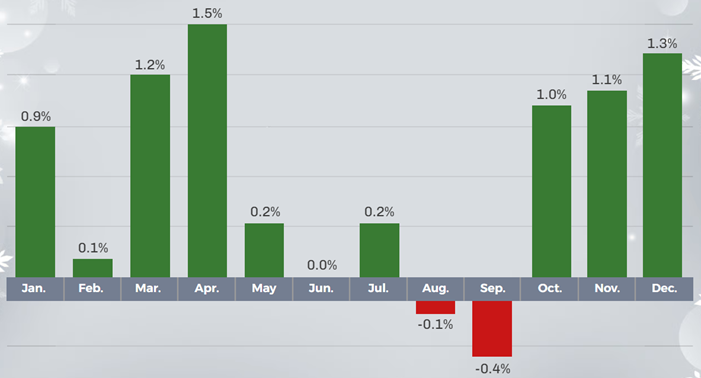
As I mentioned above, I saw the graphic above in my e-mail inbox this morning - all credit to Investor's Business Daily for the idea and the graphic, but I will still not be subscribing at this time. I've heard the phrase several times over the past couple of decades, and knew in a general way that it refers to the idea that the stock market "might" rally upward between Christmas and New Years Day (or sometimes the first week of January). Like a lot of investing advice, I took it with "many grains of salt". I usually assume people telling you the market is going to go up are telling you that to sell you something - either investment advice, actual investment proposals, or some kind of business relationship. And as a teacher, I rarely had the time (or interest) for the latest trend - my wife and I have accumulated through our married life mostly by a combination of frugality and willingness to keep saving even when it was inconvenient.
Now that I have a little more time on my hands, though, I decided when I saw the graphic this morning to investigate a little further, and see what evidence is behind the claims. So a few graphics . . .
So Why do Santa Claus Rallies Happen?
This question is a lot more unsettled - even those who agree it is a real phenomenon are uncertain why it happens at the same approximate time most years. However, after looking at 4-5 different sets of potential factors, I think I would narrow it down to a combination of these . . .
Holiday Shopping and Year-End Bonuses - Individual investors (who tend to be more bullish) may have the combination of a year-end bonus to invest and extra time off to spend it. This can result in higher stock prices, but can also result in better short-term economic news (like positive reports on Christmas sales from retailers) that boost the markets overall.
Tax purposes - to take advantage of tax code loopholes, some investors will sell stocks they've taken losses on ("tax-loss harvesting") at the end of December and then hope to buy them back at a lower price in January. This creates an artificial price bump, and investors anticipating this may drive up prices at the end of the year.
Lower trading volumes and liquidity - lots of institutional finance professionals take holidays in December and early January, leaving fewer traders to make smaller moves (so buying can have a larger impact on prices than it normally would have).
New Year repositioning (sometimes known as "window dressing") - investment managers may rebalance portfolios and stock up on last year's winners to make the balance sheets look better, leading to a boost of buying (particularly of high-cap stocks) on both sides of New Years.
Investor optimism fueled by the holiday spirit - as in behavioral economics, many people make investment moves based on positive emotions rather than rational calculations. Just keep in mind it goes both ways - a poor start to the new year (called the "January Barometer") also sometimes becomes a self-fulfilling prophecy signaling the start of an economic downturn.
Bottom Line on a "Santa Claus Rally":
Still no consensus yet whether 2025 will have a "Santa Claus Rally" or not - most of the time we don't know it is happening until it has already begun (like a LOT of movement in the stock markets)
Either way, chasing trends rarely works out well. Follow the news, but make your own decisions about how to spend, save, and invest your money.
"Santa Claus Rally" Articles and Resources:
"Santa Claus Rally: What It Is and Means for Investors", Investopedia, Dec 2024, https://www.investopedia.com/terms/s/santaclauseffect.asp
"The stock market ‘Santa Rally’: What is it and can investors benefit?", InvestEngine, Dec 2025, https://blog.investengine.com/the-stock-market-santa-rally-what-is-it-and-can-investors-benefit/
"The Santa Claus Rally Explained: Why Stocks Rise" (video), Money Instructor, Dec 2024, https://www.youtube.com/watch?v=UKRQC0ayjrY
"The Santa Claus Rally" (but try to ignore the sales pitch at the end), Investor's Business Daily, Dec 2025, https://get.investors.com/infographics/santa-claus-rally/
"Santa Is Coming… to Markets: What Is the Santa Claus Rally?", The Welch Group Wealth Management, Dec 2025, https://welchgroup.com/santa-is-coming-to-markets-what-is-the-santa-claus-rally/
Let's start with the obvious (at least to me) - I am NO expert on the stock market. And while I try to be an informed investor for my own retirement funds, I do NOT plan on giving advice to anyone else here. So this article (and any other article on investing) is not intended to be taken as a suggestion to base financial decisions on.
Other than the same advice I gave middle schoolers for 20+ years - save early, diversify your investments, and let the power of compound interest work for you!
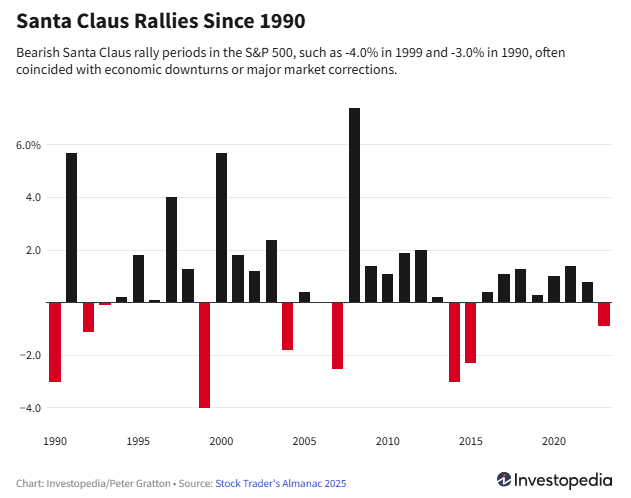
Let's start with the basics, as graphed by our friends at Investopedia. This graph shows stock market performance from 1990 through 2024 for a seven-day period spanning the last five trading days of December and first two trading days of January.
Historical data shows positive returns about four-fifths of the time - according to the Stock Traders' Almanac, the period back to 1950 averages a 1.3% gain, with a 1.6% gain when looking back as far as 1928 (before the Great Depression).
Having said that, keep in mind that four-fifths positive means 20% negative (including this past year).